Introduction
Scope of Document
This document specifies the set requirements for structural design engineers working on projects in Ras Al Khaimah. The main scope of this document is to provide main headings and important aspects which should be considered while processing the design of any project.
The main objective of the structural regulations is to ensure that all projects under the jurisdiction of Ras Al Khaimah Municipality follow a uniform approach for the design and construction of all structures. These regulations seek to assist all structural engineers submitting project(s) to Ras Al Khaimah Municipality to better understand the minimum requirements for the design, review and checking the design of any structure with Ras Al Khaimah Municipality team during the approval process that will facilitate and ease the permits issuance. It is anticipated that the use of these regulations will result in a unified form of design and construction of buildings throughout all types of structures.
These regulations are intended to be used in conjunction with international, federal, and local design codes, standards and other widely accepted references.
In the case of any conflict between these regulations and the mentioned design codes and standards, the requirements as outlined in the Ras Al Khaimah Municipality structural regulations will prevail.
Disclaimer
This document shall be read in conjunction with all the applicable federal and local laws, codes, standards, regulations, circulars, manuals, policies and procedures as implemented by Ras Al Khaimah Municipality.
All requirements indicated within these structural regulations may be amended whenever required and no prior notice required.
The full responsibility and liability of the design and construction of any project is on the consultant and the contractor without any responsibility or liability on the municipality.
Ras Al Khaimah Municipality is not liable for any defects, deficiencies, collapse or fatal mistakes in the design or execution of any project for which it has given approval.
General Requirements and Conditions

General Requirements
Structural design for buildings and facilities shall be prepared by a qualified structural engineer licensed to practice the profession and approved by the Municipality.
The structural calculations shall be prepared using recognized engineering software approved internationally.
The structural package for the different structural elements shall be submitted by the approved consultant by Ras Al Khaimah Municipality.
All buildings’ parts and related building’s materials shall have adequate safety and durability.
Structures shall be designed to withstand the most critical straining actions resulting from the codified load combinations, provided that the effect of the maximum resultant loads shall not exceed the allowable stress limit of the construction material.
Structures shall be designed to have sufficient stiffness to maintain any deformation due to vertical, horizontal loads and vibration within the allowable limits and without affecting the function of the structure.
Structures shall be designed to ensure the overall stability and individual elements’ stability under all loads’ types and cyclic loads.
All approved codes limits for strength, materials properties, durability and serviceability of structures are deemed to be satisfied wherever applicable.
Concrete mix design should be satisfying specified codes requirements.
Code minimum and maximum percentage of reinforcement related to different straining actions are deemed to be satisfied for all members.
Reinforcement details, development lengths and splices should be according to specified codes requirements.
Third Party Requirements
Third party review may be required for any of the following structures subjected to the pre-agreement with Ras Al Khaimah municipality:
Any building of height more than G+35 floors.
Irregular, complicated and un-usual structures.
Whenever there is any doubt about the need for a third party reviewer for a project, it is the consultant responsibility to approach the Ras Al Khaimah Municipality to confirm the requirements for third party reviewer. The consultant shall raise an official letter addressing the query.
Ras Al Khaimah Municipality has the right to request a third-party reviewer for any project if the consultant or specialist sub-contractor is found to be incompetent enough.
The third-party consultant shall be registered as a third part reviewer in any of the municipalities within United Arab Emirates, and shall be submitted to Ras Al Khaimah municipality for approval at the early stage of the design.
Third party reviewer shall have similar experience in the project under review with proven track record of reviewing similar projects.
Third party reviewer is required to adhere to Ras Al Khaimah municipality’ design regulations and circulars regularly.
Acceptable Software
The software approved by RAK Municipality as follows.
CSI Software (ETABS, SAFE, SAP 2000 and CSI-Columns)
MIDAS
STAAD
PROKON
SP COLUMN
RAM CONCEPT
ADAPT
PLAXIS
Any other internationally recognized software and regionally/locally standard software can be used for analysis and design subjected to pre-approval from the municipality.
Unit System
All structural calculations, analysis models’ output, technical reports and drawings shall be presented in SI unit system.
The following table gives a guidance for the consistent SI units’ system to be used:
Measurement item | Measurement unit |
Levels | m |
Dimensions | mm |
Force | KN |
Stresses | N/mm2 |
Bending moment | KN.m |
Bearing Pressure | KN/m2 |
Temperature | Co |
Deformations/Deflection | mm |
Building Lifetime
Building lifetime shall be defined according to the code requirements, construction, regular maintenance and Customer requirements.
Fire Rating
All structural elements and/or members shall have the following minimum fire rating unless otherwise noted by certified Fire and Life Safety specialist.
Two hours for horizontal elements.
Three hours for vertical elements and transfer elements.
The proper fire rating for concrete elements shall be achieved by defining the proper element size/ concrete cover, and for steel elements shall be achieved by proper coating thickness of cementitious or intumescent materials.
Approved Codes and Standards

The following are the main codes and standards that shall be followed for the structural design along with the other American Concrete Institute (ACI) publications.
The defined version is the minimum approved publication version.
Publication Reference | Publication Title | Application of Publication |
ASCE 7-16 | Minimum Design Loads and Associated Criteria for Buildings and Other Structures | Gravity loads, Wind loads and load combinations |
UBC 97 | Uniform Building Code | Seismic load |
ACI318-19 | Building Code Requirements for Structural Concrete | Concrete structural design |
PCI 8th edition. | PCI Design Handbook - Precast and Pre-Stressed Concrete | Design of Pre-cast elements |
ACI318-19 | Building Code Requirements for Structural Concrete | Design of post tension elements |
TR43 2nd edition | Post-Tensioned Concrete Floors Design Handbook (Second Edition) | |
ACI 350-20 | Code Requirements for Environmental Engineering Concrete Structure and commentary | Durability of concrete |
ACI224R-01 | Control of Cracking in Concrete Structures | |
CIRIA 766-18 | Control of cracking caused by restrained deformation in concrete | |
ACI562-19 | Code Requirements for Evaluation, Repair, and Rehabilitation of Concrete Buildings | Assessment and testing of existing structures |
ACI364.1-19 | Guide for Assessment of Concrete Structures Before Rehabilitation | |
AISC 360-16 | Specification for Structural Steel Buildings | Steel structural design |
AISC 341-16 | Seismic Provisions for Structural Steel Buildings | |
ACI 543R-12 | Guide to Design, Manufacture, and Installation of Concrete Piles | Pile Design |
UAE Fire and Life Safety Code | UAE Fire and Life Safety Code of Practice | Fire rating |
IBC 2018 | International Building Code | General |
ACI 363R | High-Strength Concrete design and requirements | HSC |
Materials

In accordance with the applicable standard, project specifications, and the requirements outlined in the Construction Materials Quality Control Guideline, the competent department is entitled to request - from any party - any testing or product certification that is deemed necessary to confirm the performance and quality of used building materials at any construction stage.
Concrete
Minimum concrete grade for existing structural members is accepted as per code limits.
Concrete for structural elements shall have a compressive strength f’c at 28 days not less than 28 MPa (fcu = 35 MPa).
Concrete for non-structural elements (blinding and screeds) shall have a compressive strength f’c at 28 days not less than16 MPa (fcu = 20 MPa).
Pre-stressing concrete shall have a compressive strength f’c at 28 days not less than 32 MPa (fcu = 40 MPa). Lower strength might only be used when it can be demonstrated that a lower strength is suitable and accepted by Ras Al Khaimah Municipality, making sure the effects of creep and shrinkage are included.
Modulus of elasticity has to be calculated in accordance with ACI318 formula.
Ec = (4700 √fc’) MPa.
In case of using High Strength Concrete (HSC) with f’c more than 60MPa, the modulus of elasticity must be calculated in accordance with Technical Report No.49’s provided formula:
Ec = (3320 √fc’ + 6900) x (Wc /2346)1.5) MPa.
Concrete grades input in design should be noted always as cylindrical compressive strength f’c values based on physical testing of concrete cubes where concrete cylinder strength is assumed to be equal to 80% of concrete cube strength.
High performance concrete -if any- should be achieved via the addition of supplementary cementitious materials (SCM’s) such as silica fume & metakaolin, using higher cement grades, lower water cement ratio, use of admixtures, among others to the mix.
A durable concrete for all types of concrete shall be prepared using a combination of cement and other SCM’s such as fly ash and GGBS in the concrete mix. SCM’s percentages in the mix shall be within the applicable set requirements of Ras Al Khaimah Municipality (As reflected in the below table) and with reference to BS EN 206 and BS 8500-1 Standards.
Temporary works such as shotcrete, non-structural protection screed and shoring are exempted from durable concrete requirements.
Where higher percentages of cement replacements by SCM’s are used, it is recommended to perform testing on concrete specimens at 56 days for the purpose of testing the compressive strength of concrete.
It is recommended to specify higher slump tolerances due to the effect of using GGBS on pumpability, placing and finishing of concrete.
Concrete Grade | Maximum Water to Cementitious Materials Ratio W/CM | Minimum Total (Cement + Cementitious Materials) Content (KG) | Combined Composition | |
Sub-structure | Durability Based | 0.42 | 380 | OPC* with (66%-80% GGBS or 36%-55% Fly Ash) |
0.35 | 380 | OPC* with (36%-65% GGBS or 21%-35% Fly Ash) | ||
Super-structure | C28/35 | 0.50 | 360 | OPC* with (36%-65% GGBS or 21%-35% Fly Ash) |
C28/35 | 0.45 | 380 | OPC* with (66%-80% GGBS or 36%-55% Fly Ash) | |
C32/40 | 0.42 | 360 | OPC* with (36%-65% GGBS or 21%-35% Fly Ash) | |
C32/40 | 0.40 | 380 | OPC* with (66%-80% GGBS or 36%-55% Fly Ash) | |
C35/45 | 0.40 | 380 | OPC* with (36%-65% GGBS or 21%-35% Fly Ash) | |
C40/50 | 0.40 | 380 | OPC* with (21%-35% GGBS or 6%-20% Fly Ash) | |
C45/55 and above | 0.35 | 380 | OPC* with (21%-35% GGBS or 6%-20% Fly Ash) | |
Non-structural | (Blinding) | 0.60 | 200 | OPC* with (36%-65% GGBS or 21%-35% Fly Ash) |
Notes:
* Other types of cement and cementitious materials combinations might be used subject to achieving the same performance (Strength and Durability) requirements and upon review and approval by the consultant.
1. OPC stands for Ordinary Portland Cement, GGBS stands for Ground Granulated Blast-furnace Slag.
2. Above composition and minimum combined cement & cementitious content are based on 20mm maximum aggregate size.
3. Silica Fume, Metakaolin or other strength enhancing material might be added to the concrete mix in Request to enhance certain characteristics such as compressive strength, durability requirements, etc.
4. The above table reflects the minimum requirements, so, whenever the design of the concrete class (DC-Class) reflected in the soil reports is more stringent than those reflected in the above table, the one reflected in the soil report shall prevail.
Reinforcement
Reinforcing steel shall be High Yield Strength deformed bars type 2 with minimum characteristic strength of fy =460 N/mm2 unless otherwise justified by the designer.
For shear design, the maximum yield strength to be used is fy=420 N/mm2.
All reinforcement shall conform to BS 4449 grade 460 or Equivalent Standards (ASTM or ISO) specifications as a minimum.
Welded wire mesh: Steel fabric reinforcement shall comply with BS 4483 or Equivalent ASTM specifications.
The preferred range of designated fabric types shall be as per Table A.1 of BS 4483 or Equivalent ASTM specifications.
Low relaxation Steel Wire Strands or High Tensile Steel Wire Strands for the purpose of pre-stressing concrete whenever used, shall comply with the set requirements of ASTM A 416/A 416M or BS 5896 specifications respectively.
Mechanical couplers for the purpose of rebars connections whenever used, shall comply with the set requirements of ISO 15835-1 standard specification or equivalent.
Structural Steel
In accordance with procurement requirements typical in UAE, all steelworks shall adopt standard section dimensions as defined by British Standards. However, the material shall be procured to demonstrate compliance to ASTM standards and the design shall be in accordance with the provisions as defined herein in this report.
Loading Criteria

Loading Notations
The following loading notations are the recommended notations to be generally used in loading definitions such as load cases and load combinations in structural analysis software and calculations.
Load type | Notation |
Self-weight | SW |
Super imposed dead load | SDL |
Live load-non reducible | LL |
Live load-reducible | LLr |
Mechanical load | Mech |
Thermal load | T |
Earthquake load | E |
Wind load | W |
Lateral earth pressure load | H |
Water uplift load | F |
Gravity Loads
Dead Loads
All Dead Loads are established based upon the self-weight of the structure and combined with the super imposed dead loads (finishes, partitions and other dead loads). The characteristic densities are listed under this section.
Self-weight of the primary structural elements shall be defined as a part of the material definition in the analysis software and not part of the applied superimposed dead load.
The following table illustrates the minimum density of the main materials to define the material self-weight.
Typical materials densities | |
|---|---|
Item | Density (KN/m3) |
Normal Reinforced Concrete; In-Situ Topping | 25.0 |
Lightweight concrete fill U.N.O. | 13.0 |
Plain concrete | 22.0 |
Normal weight screed (Typical finishes) | 20.0 |
Dray wall (Internal wall) | 3.0 |
Plaster | 20.0 |
Glass | 27.0 |
Steel | 78.5 |
Landscaping / Retained wet soils | 20.0 |
Dry soils | 18.0 |
Marbel | 27.0 |
For Hollow block system (Hordi); the self-weight of the hordi blocks shall be considered in the analyses as per the actual weight of the blocks from the manufacturer data sheet.
Partitions
As a general principle, the partitions’ loads shall be applied as an equivalent uniform load. However, actual partition line load assignments shall be required in some instances. The blockwork type and density to be confirmed with architectural drawings and included in the submitted general notes drawings and calculation.
The partition load shall be calculated in detail as per the architectural layout.
Minimum partition block density shall not be taken less than the following values unless proved otherwise by certified manufacture/supplier:
Typical block wall densities (unless otherwise provided from project supplier) | |
Item | Density (KN/m3) |
Normal weight solid blocks | 21.0 |
Normal weight hollow blocks (200mm thickness) | 14.0 |
Normal weight hollow blocks (100mm thickness) | 17.5 |
Light weight Aerated Autoclaved Concrete blocks (AAC) | 6.5 |
Normal weight thermo blocks | 15.0 |
Light weight thermo blocks | 8.8 |
Uniform distributed load on plan due to partitions only shall not be taken less than the following minimum values.
Minimum partition distributed loads on plan | |
Main Partitions Type | Load (KN/m2) |
Dry wall partitions | 1.0 |
Light weight block partitions | 2.5 |
Solid block work partitions | 3.5 |
Finishes
The density of the finishes on the slab shall be 20 KN/m3, and the actual thickness of the finishes shall be considered in the loading calculations.
Typical finishes distributed loads (unless otherwise calculated) | |
Finish thickness (mm) | Load (KN/m2) |
50mm | 1.0 |
75mm | 1.5 |
100mm | 2.0 |
Other Loads
Ceiling and services:
Load shall be 0.5 KN/m2 as a minimum uniform load on plan to be considered unless more accurate calculation is available to justify lesser loads.
Moreover, the actual uniform load for the suspended services shall be calculated at the mechanical floors and parking floors’ ceiling.
Façade load:
The actual façade load to be calculated and applied as a line load on the slab wherever applicable. In the case of having façade with more than one type of materials, equivalent line load to be calculated based on each material density and distribution.
In the absence of accurate façade load or justification from façade specialist; it shall be considered as 1.0 KN/m2 (on elevation). This value is not applicable for the heavy façade system such as GRC, stone cladding, etc., it shall be calculated accurately.
Machines’ plinth/base:
In the MEP areas, the equivalent load of the machine’s support plinths to be calculated.
Live Loads
Reducible Live Load
The live loads with a value that does not exceed 4.8 KN/m2 considered as reducible live load.
Non-Reducible Live Load
The heavy live load with value exceeds 4.8 KN/m2, car parking load and public assembly occupancies shall be considered as non-reducible live load.
Permanent Live Load
The mechanical and water tanks load shall be considered as permanent live load. The load of mechanical zones to be calculated as per the equipment manufacturer catalogue. However, the mechanical load value shall not be less than the value in the minimum live load values shown in the following table.
Minimum Live Loads
The following table represents the minimum distributed live load which shall be considered in the design. Any other live loads not mentioned shall be referred from ASCE 7-16.
Description of Live Load | Uniform Load (KN/m2) |
|---|---|
Residential (***) | 2.0 |
Hotel rooms (***) | 2.0 |
Balconies in multi-story buildings (all areas) | 1.5 times the live loads for the area served < 4.8 KN/m2 |
Balconies in villas (up to 9.5m2 area) | 3.0 |
Balconies in villas (more than 9.5m2 area) | 5.0 |
Corridors between apartments/rooms | 2.0 |
Lobbies and public corridors | 4.8 |
Staircases | 4.8 |
Public Spaces | 4.8 |
Retail Areas | 4.8 |
Offices | 2.5 |
General Plant rooms and MEP spaces (**) | 7.5 |
Transformers and generators rooms | 10.0 |
Car park | 3.5 |
Loading Bay Areas (unless accurately justified) | 15.0 |
Fire truck routes | 20.0 |
Roofs * | 2.0 |
Non-accessible steel roofs / Dooms /Folded roofs | 0.6 |
5.0 | |
Cinema | 5.0 |
Water storage (to be calculated according to water height) | 10xh |
Notes:
(*) Roof usage shall be confirmed with architectural drawings, the loads on roof used for garden or assembly purposes shall be 4.8 KN/m2 as a minimum. Any loads for MEP equipment or water tanks on roof shall be considered separately.
(**) The mentioned MEP loads is the minimum applied value unless required more values based on actual equipment loads.
(***) For the design of all flat slabs and post tensioned slabs, a minimum live load of 3KN/m2 shall be considered.
It is allowed to round up the live load of 4.8KN/m2 to 5.0KN/m2 for simplicity without changing any of the relevant code conditions.
Soil Lateral Loads
Soil pressure load and water load shall be calculated based on the soil investigation parameters.
As applicable, Soil lateral loads shall be determined using the equations for the at-rest earth pressure coefficient (KO) for the case of basement retaining walls, while it is allowed to use (Ka) only for the case of cantilever retaining walls.
Soil properties to be used in case of backfilled soil behind basement walls:
Where new fill is placed behind the retaining walls, the following provisions for the fill material properties is to be attained as a minimum unless more accurate details are specified by certified geotechnical engineer and properly supervised in site.
Soil Density (kN/m3) | Average Angel of Internal Friction | KO | Ka | Kp | m Base Frication coefficient |
18-20 | 30° | 0.50 | 0.33 | 3.0 | 0.4 Maximum * |
Note:
(*) Unless further justified.
The interface friction angle between the retaining wall and the adjacent soil shall be assumed as zero unless justified by wall surface roughness and soil-structure interaction analysis.
Soil properties to be used in case of shoring behind basement walls:
Where there is an existing shoring placed or casted directly against the native soils behind the basement walls; the soil properties provided in the soil report shall be used for basement wall design.
Surcharge loads
For all permanent retaining structures, the vertical surcharge loading on retaining structure shall be considered as per the following cases.
Case | Surcharge loads (KN/m2) |
Adjacent building at higher level (on shallow foundation) | Actual loads from the building at foundation level (located at higher level) |
Adjacent roads | 20 |
Construction site (current or future) | 20 |
Minimum value | 10 |
Uplift Load.
When considering the requirement for water uplift loads in design, the following should be taken into consideration by the consultant:
For the purpose of analysis and design, the actual water table level shall be considered plus minimum seasonal variation of 1.0m.
Dewatering effects of neighboring areas shall be considered.
The effect of future developments (canal, water bodies, landscaping…. etc.) on the water table level shall be considered.
The minimum factor of safety for overall stability against uplift shall not be less than 1.10 and considering the self-weight only during permanent cases and temporary cases (e.g. discontinuity of dewatering activity).
The consultant shall include clear notes in the structural general notes’ drawings stating clearly at which level of construction the dewatering will stop.
Different load case scenarios for uplift shall be analyzed, including both cases with and without the consideration of uplift load.
Thermal Effect due to Seasonal Variation and Self-Straining Actions
The design shall account for the forces and movements resulting from an imposed thermal load due to seasonal variation, considering building enclosure conditions and continuous long spans.
Thermal loads shall be considered for concrete structures if the building length is more than 45m.
Thermal loads shall be applied to any steel structure regardless of the building length.
The thermal load due to seasonal variation shall be applied in the 2D and 3D analysis models considering positive/negative effects as per the following minimum values.
Location | Structural Element | Temperature (Co) |
Below Ground (Basement) | Retaining walls/columns/shear walls/Beams/slabs (excluding Ground slab) | +/- 10 |
Ground level and upper levels (Superstructure) | Columns/shear walls/Beams/slabs/ | +/- 20 |
General | Steel structural elements | +/- 25 |
When incorporating the requirement for self-straining loads in a design, the following should be considered:
Creep effect.
Thermal effect.
Shrinkage effect (early and long-term).
Late pour strips shall be provided solely to mitigate early-age thermal cracking. However, seasonal thermal effects must be considered, and detailed calculations shall be submitted for review and approval.
Seismic Loads
The following requirements along with the requirements of the applicable code (UBC97) should be referred to when considering the technical requirements for seismic load design.
Item | Description |
Applicable standards | UBC97 |
Seismic Zone | Zone 2A For all buildings unless otherwise exempted in the following clause. |
Mass Source | 100% Dead loads, 100% permanent live loads and 25% of non-reducible live loads (LL). |
Damping Ratio | 5% for concrete and 2.5% for Steel. |
Importance factor “I” and ductility factor “R” | To be considered as per recommendations of the applicable codes and standards. |
Effects of Vertical Component of Earthquake Ground Motion | To be considered in the dead load component of seismic load combination according to the applicable codes and standards adopted for analysis and design. Where, Ev=0.5CaID as per UBC97. |
Elements supporting discontinuous members of lateral load resisting systems | To be designed using the provisions of the applicable codes and standards, with special seismic load combinations and appropriate overstrength factor (W). |
P-Delta effect. | To be considered according to the following combination: 1.2(Dead loads) +0.5(Reducible live load) +1.0(Non-reducible live load) |
Dynamic Analysis | To be considered as per recommendations of the applicable codes and standards. |
Minimum Scale Factor for Response Spectrum Analysis | g*I/R g=9.81 m/sec2 |
Soil Profile | According to the soil report recommendation. When the soil properties are not known in sufficient detail to determine the soil profile type, Type SD shall be used. |
Mass Participation Ratio | To be checked for a minimum of 90 %. |
Torsional Irregularity | To be calculated as per applied code, and additional eccentricity to be applied if any. |
Orthogonal Effect | To be considered either by the SRSS method or X/Y direction + 30% of Y/X direction. |
Exemptions:
Detached one- and two-family residential villas including the attached service blocks.
Less than G+4 residential buildings (e.g. 4 suspended slabs).
Single story shops with height not more than 6m and total area of complex not more than 500m2.
G+1 shops with total height not more than 8m and total area of complex not more than 500m2.
Up to G+1 motel (small hotels with limited number of rooms).
Service buildings of mosques (such as ablution building, Imam house).
Commentary:
The following typical buildings shall be designed for seismic loads regardless the number of stories or height:
Any building housing facilities required for emergency support.
Hospitals.
Fire and police stations.
Governmental and public buildings.
Schools and universities buildings.
Hotels.
Mosques and minarets.
Churches.
Shopping centers and hypermarkets.
Cinemas and theaters.
Multi-function halls (such as but not limited to ballrooms, sports’ hall, etc.).
Commercial and office buildings.
Multi story car parks.
Airport’s buildings and aviation control towers.
Buildings which have special structural systems (such as but not limited; irregular shape, long spans, etc.).
Industrial buildings.
All the buildings (even if not designed for seismic) shall include proper lateral resisting system arrangement to resist minimum magnitude of potential lateral loads.
For example, it shall include at least one of the following systems:
Set of minimum 2 clear framing system in each principal direction.
Shear walls in each principal direction.
Proper core wall.
Seismic Scaling
Whenever dynamic analysis is adopted, dynamic seismic load shall not be less than 100% of equivalent static loads at the base level.
Base level definition is the level of foundation or at which major change in stiffness occurs.
The seismic mass below the presumed base level may be ignored when analyzing the structural elements above the scaling level.
Seismic scaling down is not permitted (e.g., when dynamic base shear exceeds static base shear).
P-delta Effects
P-delta effects should be considered for all the buildings following UBC97 for a proper columns’ design including the slenderness effect.
Torsional Irregularity
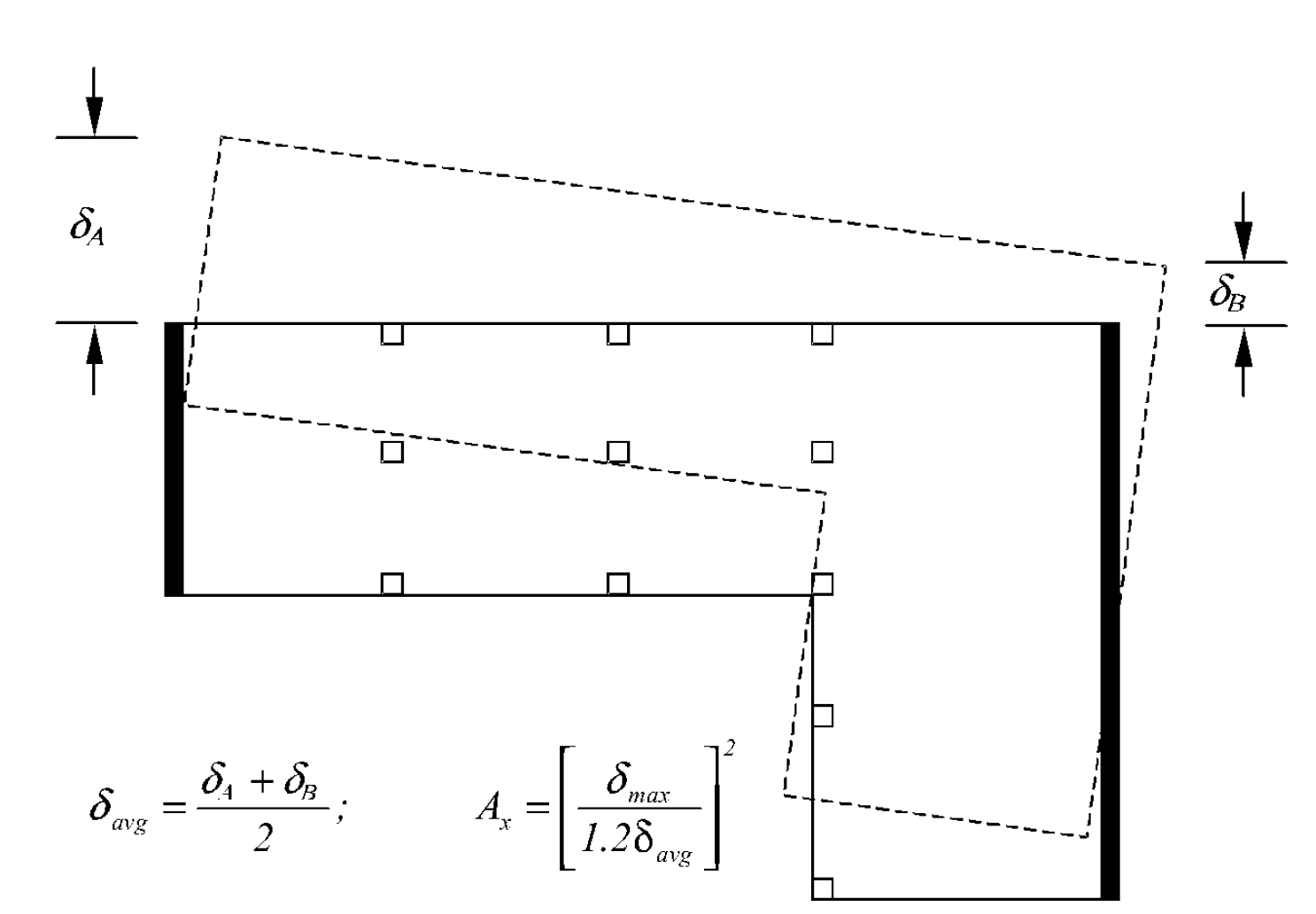
Torsional irregularity shall be considered to exist when the maximum story drift, computed including accidental torsion, at one end of the structure transverse to an axis is more than 1.2 times the average of the story drifts of the two ends of the structure.
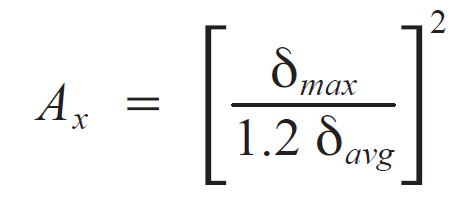
Where torsional irregularity exists, as defined in UBC97, the effects shall be accounted for by increasing the accidental torsion at each level by an amplification factor, Ax, determined from the following formula:
Where,
davg = the average of the displacements at the extreme points of the structure at Level x.
dmax = the maximum displacement at Level x.
The value of Ax need not exceed 3.0.
Note: -
- Torsional irregularities shall be verified using static load cases, and the torsion amplification factors shall be applied to the dynamic components (SPEC X/Y).
Wind Loads
The following requirements, along with the provisions of the applicable code (ASCE 7-16), shall be referenced when determining the technical requirements for wind load design.
Item | Description |
Applicable standard | ASCE 7-16 |
Wind Speed | As per RAK Wind Zone (next table and figure 5-1) |
Exposure Category | Classified based on site conditions as specified in Section 26.7 of ASCE 7-16. |
Ground Elevation Factor “Ke” | Evaluated considering the site's elevation effects in accordance with Section 26.9 of ASCE 7-16. |
Directionality Factor “Kd” | Applied as per directional wind considerations outlined in Section 26.6 of ASCE 7-16. |
Gust-Effect Factor “Gf” | Assessed based on structural response to wind turbulence per Section 26.11 of ASCE 7-16. |
Zone | Wind speed for different return periods (m/s) | |||||
Service Level Wind Speed | Ultimate Level Wind Speed | |||||
10-Years | 50-Years* (Strength Design) | 300-Years (Risk Cat. I) | 700-Years (Risk Cat. II) | 1700-Years (Risk Cat. III) | 3000-Years (Risk Cat. IV) | |
Zone 1 | 32 | 38* | 45 | 49 | 51 | 53 |
Zone 2 | 34 | 40* | 47 | 50 | 53 | 55 |
Notes:
The return period of 10 years shall be used for serviceability checks.
(*) The return period of 50 years shall only be used in accordance with Clause 5.3.5 of ACI318-19.
The risk category for wind load is as defined in Clause 1.5 (Table 1.5-1) of ASCE 7-16.
Zone 1 includes mainly Al Marjan island, Al Hamra and Mina Al-Arab, and bordered with the road E311 for simplicity of application. For more details, refer to the zoning map.
The current wind speeds are based on an extensive study conducted in 2023 by wind engineering experts RWDI and CPP (acting as a peer reviewer) with technical cooperation with RAK Municipality.
Impact of Elevation: The impact of terrain features such as peaks, hills and mountains passes were not captured in that conducted study. Accordingly, for the buildings which might be sensitive to wind loads on high mountain zones (such as Jais Mountains), it is recommended that designers consult clause 26.8 and C26.8 of ASCE 7-16 or conduct site specific topographic studies as required to conclude the design wind speed.
Commentary and Exemptions:
Wind load is mandatory for all types of steel structure buildings.
Wind load is mandatory for all reinforced concrete structure buildings more than G+15 stories.
Wind load may be exempted for reinforced concrete structure buildings below G+15 stories subjected to the municipality’s engineer judgment based on the building behavior (such as but not limited to; the slenderness, building irregularity, special structural system, wind load effect governing the design for any structural element).
It is the consultant’s responsibility to investigate the requirement for wind load application on the building before submission to the municipality.
In all cases, the design wind pressure shall be not less than 1 kN/m2.
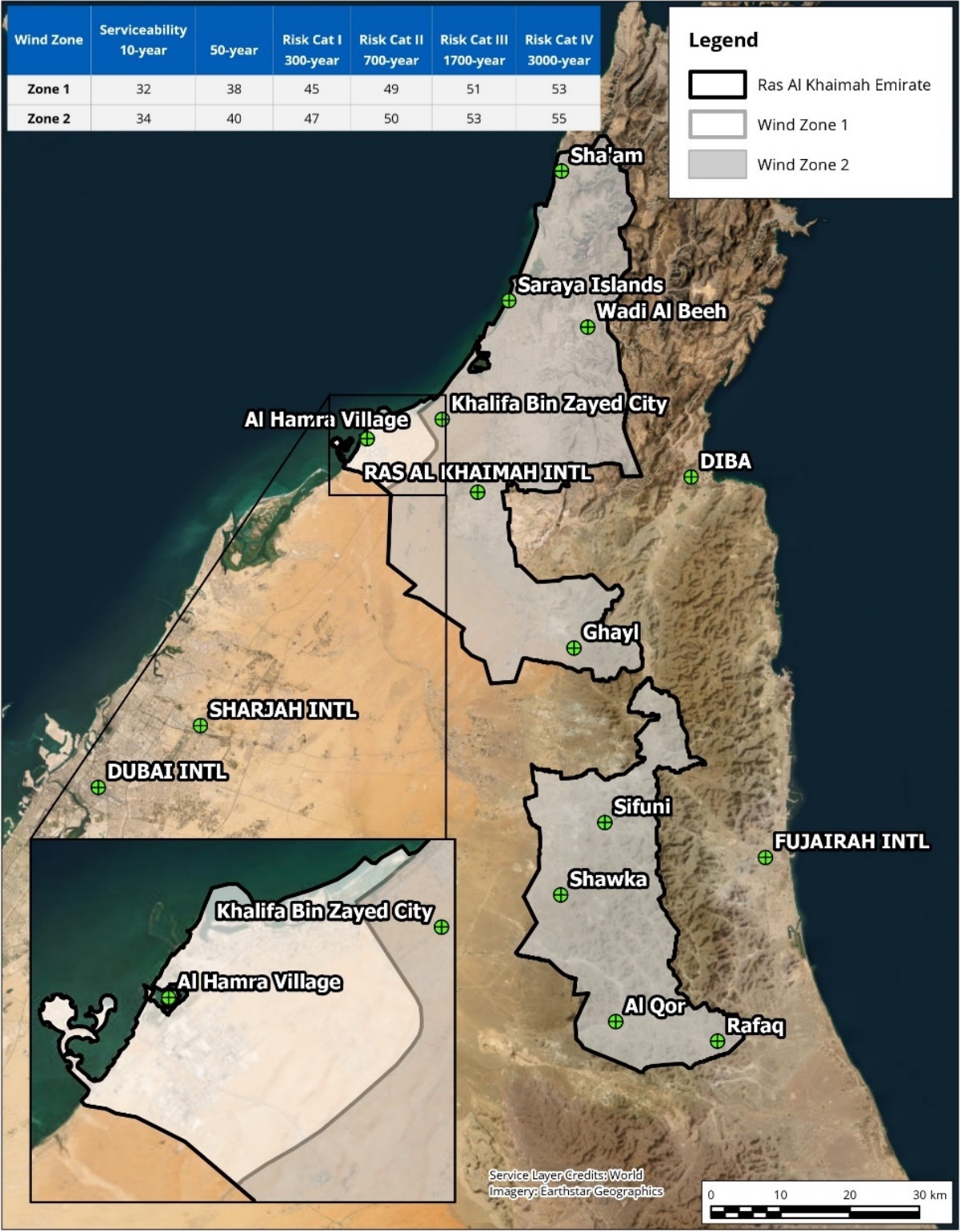
Figure 5-1: Design Wind Speed Zones in Ras Al Khaimah
Wind Tunnel Test.
Wind tunnel test shall be conducted in the following conditions.
Irregular, complicated, unusual structure. It shall be pre-agreed with Ras Al Khaimah Municipality.
Tall buildings more than 35 stories above ground.
Wind base shear from wind tunnel test shall not be less than 80% of the calculated code wind base shear, consistent with Clause 31.4.4 of ASCE 7-16.
For concrete structures, the maximum damping ratio shall be 2% for ultimate design and 1.5% for serviceability checks.
RAK Municipality has the right to request a peer review for wind tunnel testing of unusual buildings or where the testing provides unusual results.
Helipad Loads
For helipad load, ASCE 7-16 requirements shall be followed in addition to the following requirements:
Minimum live load of 5 KN/m2 to be applied.
Concentrated loads to be applied separately with factor 1.5 to cover the impact load of the helicopter.
The application of the helicopter concentrated load shall be studied as per the worst-case scenario in terms of load location with reference to the slab geometry.
Minimum Lateral Forces
Each structure shall be analyzed for the effects of static lateral forces applied independently in each of two orthogonal directions. In each direction, the static lateral forces at all levels shall be applied simultaneously. For purposes of analysis, the force at each level shall be determined using the following equation.
Fx = 0.01Wx
where,
Fx = the design lateral force applied at story x, and
Wx = the portion of the total dead load of the structure (SW & SDL) located or assigned to level x.
Structures explicitly designed for stability, including second-Request effects, shall be deemed to comply with the requirements of this section.
Loading Combinations
The ultimate limit states shall be determined in accordance with Section 2.3 of ASCE 7-16. These load combinations shall be applied to the design of all structural elements, ensuring that the most critical load effects are considered.
The Serviceability limit states shall be defined in accordance with Section 2.4 of ASCE 7-16. The prescribed load combinations shall be utilized for evaluating foundation capacities, structural reactions, and serviceability criteria, including crack width limitations. The most critical load combinations shall be considered in the design to ensure compliance with serviceability performance requirements.
Serviceability Requirements

Adequate provisions shall be adopted to limit the deflection of structural elements and eliminate risk of damage to non-structural elements due to vertical deflection and inter-story drift.
Control of Deflection in Concrete Elements
Immediate and long-term deflections shall be within code accepted limits for all concrete slabs and beams.
Non-linear cracked sections properties and effect of shrinkage and creep shall be considered in deflection calculations.
Modulus of rupture should be considered as per ACI 435R95 report (section 4.3.3) requirements.
fcr=0.33√fc’ MPa
Only actual provided top and bottom reinforcement should be considered in deflection calculations.
Load Combination | Limit | |
|---|---|---|
Vertical deflection of floor elements not supporting brittle elements or facade | Total deflection (long term deflection under sustained loads plus immediate deflection under non-sustained loads) | L/240 |
Live | L/360 | |
Vertical deflection of floor elements supporting brittle elements or facade | Total deflection (long term deflection under sustained loads plus immediate deflection under non-sustained loads) | L/240 |
Total deflection occurred after attachment of non-structural elements (excluding immediate deflection occurred before the attachment of non-structural component). | L/480 | |
Live | L/360 | |
Vertical deflection of transfer elements (beam or slab) (**) | Total deflection (long term deflection under sustained loads plus immediate deflection under non-sustained loads) | L/750 |
Notes:
(**) In case of excessive deflection regardless the limit is achieved; the vertical deflection shall be considered in the design of the floors above subjected to the engineering judgment.
Control of Deflection in Steel Elements
Load Combination | Limit | |
Vertical deflection of floor elements not supporting brittle elements or facade | Dead + Live | L/240 |
Live | L/360 | |
Vertical deflection of floor elements supporting brittle elements or facade | Dead + Live | L/240 |
Live | L/360 | |
Differential Live | L/500 | |
Vertical deflection of flat roofs not supporting brittle elements or facade | Dead + Live | L/180 |
Live | L/240 | |
Wind* | L/240 | |
Vertical deflection of flat roofs supporting brittle elements or facade | Dead + Live | L/240 |
Live | L/360 | |
Wind* | L/360 | |
Differential Live | L/500 | |
Vertical deflection of flat roofs not supporting any elements | Dead + Live | L/120 |
Live | L/180 | |
Wind* | L/180 | |
Vertical deflection of transfer element (**) | Dead + Live | L/750 |
Notes:
(*) Wind load shall be calculated using “10-year return period wind speed”.
The above deflection limits do not consider pre-cambering. Pre-cambering may be used to reduce the total deflection as deemed necessary.
(**) In case of excessive deflection regardless of the limit is achieved; the vertical deflection shall be considered in the design of the floors above subjected to the engineering judgment.
Control of Lateral Drifts
Seismic Drift
Buildings’ lateral drifts under seismic loads should be checked against UBC97 code specified limits.
Structural Component Description | Limit | |
|---|---|---|
Inelastic inter-storey drift | Fundamental period > 0.7 sec | Floor height (h) / 50 |
Fundamental period < 0.7 sec | Floor height (h) / 40 | |
Load combination for seismic drift shall be as per ultimate load combinations including seismic load case.
Wind Drift
Buildings’ lateral drifts under wind loads should be checked against ASCE 7-16 code specified limits.
Structural Component Description | Limit |
|---|---|
Inter-storey drift | Floor height (h) / 400 |
Overall building drift | Building height (H) /500 |
The load combination for wind drift checks is:
D + 0.5L + W, where wind load (W) is based on the 10-year return period wind speed. Or
D + 0.5L + 0.7W, where wind load (W) is based on the 50-year recurrence period wind speed.
Wind Inter-story drift and overall building drift shall be limited to the standard limits (ASCE 7-16) for all the building wherever wind load is applicable.
Wind Inter-story drift shall be considered in the design of façade and cladding system in Request to be protected as required.
Human Comfort and Vibration
Building Acceleration
Buildings should be designed and checked to meet human comfort of occupants as required.
Buildings accelerations shall be checked for high rise buildings for wind loads (10-year return period) and shall be less than the following limits.
Occupancy | Maximum acceleration limit |
Residential and Hotels | 15 mg |
Offices | 20 mg |
Vertical Vibration
Vibration assessment is essential for structural members exposed to dynamic loads, including, but not limited to, the following:
Floors supporting gyms, dance studios, and mechanical equipment.
Bridges or pedestrian walkways subject to footfall-induced vibrations.
Thin slabs with a span-to-thickness ratio exceeding 40.
Long cantilevers.
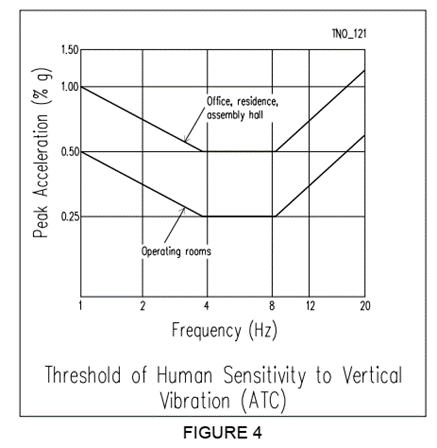
The susceptibility of floors to excessive vibrations caused by walking excitation or equipment operation should be assessed in accordance with Steel Construction Institute (SCI Publication P354), "Design of Floors for Vibrations", or DG11, "Floor Vibrations Due to Human Activity".
The following table provides the Vibration and Acceleration limits that shall be adopted in the design of the structures in terms of occupancy for the building facilities.
Occupancy | Acceleration Limit (%g) |
Offices, Residential | 0.5% |
Dining, Dancing and Gym | 1.5 to 2.5% |
Aerobics, rhythmic activities only | 4.0% to 7.0% |
Shopping malls | 1.5% |
Alternative Approximated Approach
Vibration assessment based on the relation between natural frequency and deflection can be verified using the following formulas:
f =18 /√d(mm) for intermediate spans.
f =20 /√d(mm) for cantilevers.
Where:
d is the maximum deflection due to loading in reference to the mass (m).
It can be considered for 100% Dead loads and 10% Live loads.
f is the natural frequency (1/T).
Minimum natural frequency of 4 HZ can be used as a limit for building normal usage (e.g. residential, offices).
Other Considerations
The consultant shall ensure that for buildings with irregular façade shapes, where potential noise may occur, the tonal noise generated by the vortex shedding mechanism is properly addressed by a wind specialist. The consultant is solely responsible for conducting the necessary study and proposing effective remedial measures to resolve the issue, if any.
The effects of axial long-term shortening due to elastic, shrinkage, and creep effects shall be investigated and accounted for in the design and construction, particularly for buildings exceeding 40 stories. Differential shortening between vertical elements shall be minimized to reduce the impact on the design of horizontal elements.
Structural Integrity

Structures, including buildings, shall be designed and constructed to withstand localized damage while maintaining their structural stability, and will not suffer collapse to an extent disproportionate to the cause. This shall be achieved through an arrangement of the structural elements that provides stability to the entire structural system by transferring loads from any locally damaged region to adjacent regions capable of resisting those loads without collapse. This shall be accomplished by providing sufficient continuity, redundancy, or energy-dissipating capacity (ductility), or a combination thereof, in the members of the structure.
Load Path Connections.
All parts of the structure between separation joints shall be interconnected to form a continuous path to the lateral force-resisting system. The connections must be capable of transmitting the lateral forces induced by the connected parts. Any smaller portion of the structure shall be tied to the remainder of the structure with elements strong enough to resist a force of at least 5% of the portion's weight.
Special consideration must be given to the following aspects:
Continuity: All parts of the structure must be interconnected to form a continuous load path to the lateral force-resisting system.
Strength of Connections: Connections must be designed to transmit lateral forces without failure. This includes ensuring that they can handle the forces induced by the connected parts.
Structural Tie-ins: Smaller portions of the structure, such as isolated or partial sections, must be tied to the larger structural elements with appropriately designed connections. These connections should be capable of resisting forces not less than 5% of the weight of the portion being connected.
Redundancy and Safety: Ensure that load path connections are designed with redundancy to avoid any failure due to unexpected overload or damage in a particular section.
Separation Joints: In cases where separation joints are used, it is critical that these joints do not disrupt the continuous load path. Properly designed connections should ensure the uninterrupted transmission of forces.
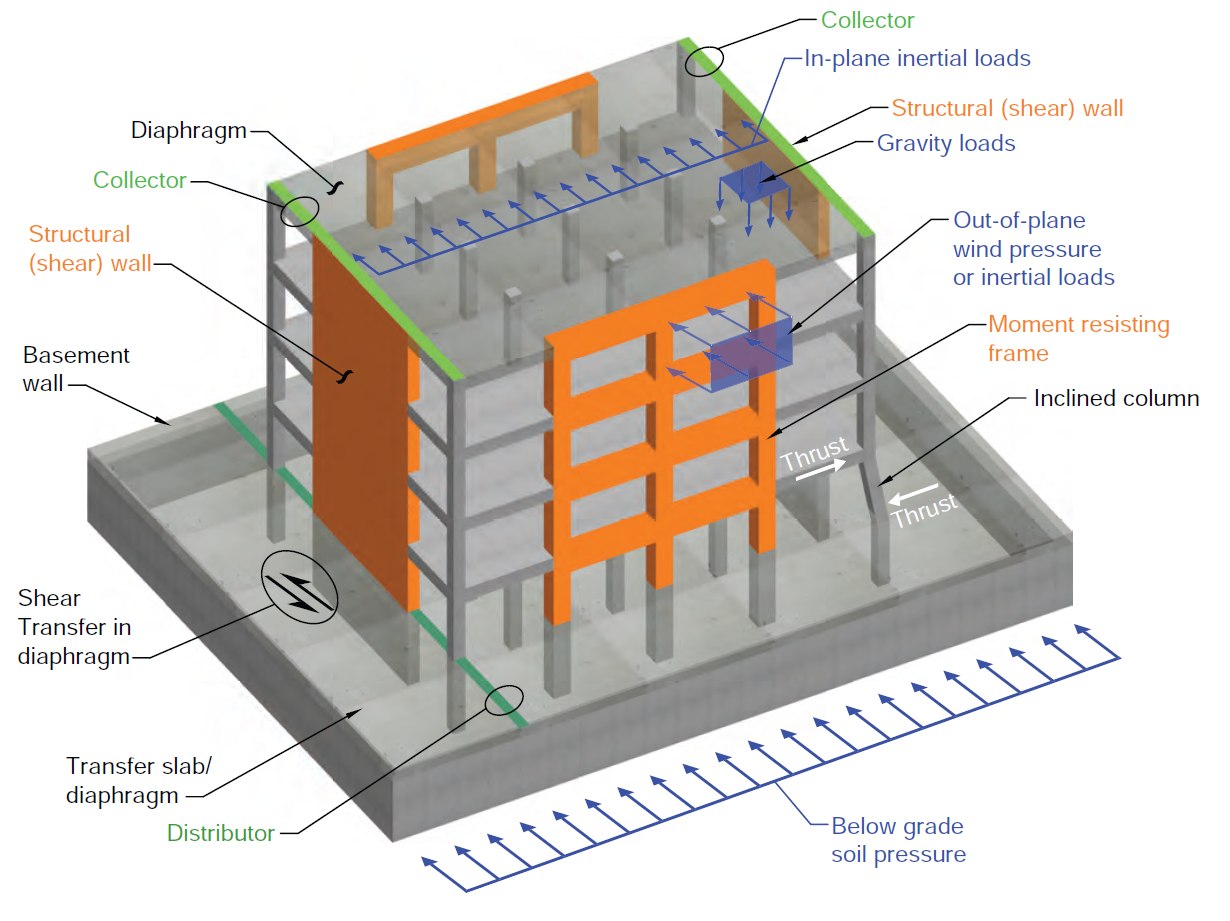
Typical diaphragm actions. (ACI318-19)
Durability Requirements

Waterproofing Requirement
Waterproofing is mandatory for all members in contact with groundwater or soil.
Any waterproofing material specifications and methodology of application should be shown on the submitted structural drawings.
Control of Cracking
Crack control for all parts of the structure should be satisfied following the requirements of ACI318, ACI 224R-01 and ACI_350 codes unless otherwise noted in this clause.
Crack control requirements are not limited to structural members subjected to ground water.
Early thermal and long-term cracking for concrete restrained elements shall be verified according to CIRIA 766-18.
Limiting cracks widths considered for different categories are presented in the following table.
Limiting Crack Width (mm) | |
Structural elements exposed to humidity, moist air. | 0.3 |
Structural element in contact with wet soil (with ground water table). (e.g. Retaining wall’s outer face, under-side of basement’s raft). | 0.2* |
Water retaining structures. (e.g. Swimming Pool, Water Tanks). | 0.1 |
Piles in contact with wet soil and under permanent tension stresses. | 0.1 |
Piles in contact with wet soil and under transient tension stresses. | 0.2 |
Note:
(*) unless otherwise required for deep retaining walls and foundation below ground water table.
Maximum permissible crack width for deep retaining walls and foundation below ground water table should be defined as per the following chart.
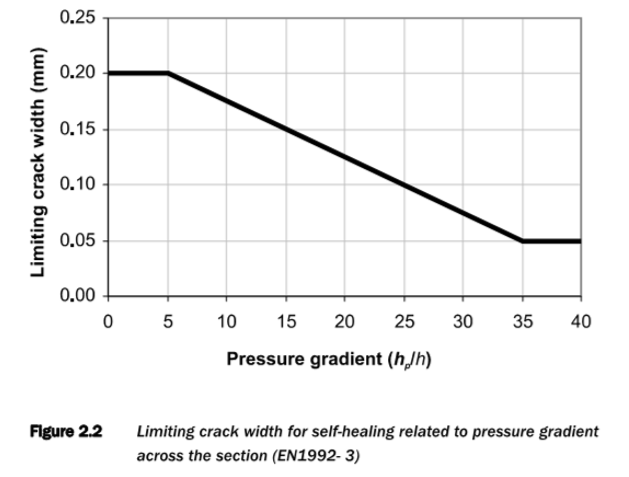
Where:
(hf)is the depth of the water table till the soffit of the structural element.
(h) is the structural element thickness.
Concrete Cover
The following clear concrete covers shall be provided as a minimum for different reinforced concrete elements unless otherwise required for fire rating and durability requirements.
Structural Element | Min. Clear Cover (mm) |
Concrete for deep foundations (e.g. Piles) | 75 |
Concrete permanently exposed to earth (e.g. Foundation and retaining wall’s outer face) | 75 |
Raft and basement retaining wall’s internal face | 50 |
Concrete for Pile cap/ Raft on Pile (bottom face) | 125 |
Concrete for Pile cap/ Raft on Pile permanently exposed to earth (sides and top face) | 75 |
Water tanks | 50 |
Slabs | 25 |
Beams | 40 |
Ribs | 25 |
Columns | 40 |
Walls | 30 |
Stairs | 25 |
Transfer beams | 50 |
Transfer slabs | 45 |
Spacing Between Bars
The spacing between bars in different concrete elements shall be strictly followed as per ACI318, and considering all the conditions related to constructability (e.g. vibrator size and proper vibration for concrete compacting).
Concrete General Design Requirements

Cracking Stiffness Modifiers
All stiffness modifiers for ultimate limit state analysis should be as per ACI318 code provisions.
Element | Walls | Columns | Beams | Slabs | |
RC/PT | RC | PT | |||
Required Cracked Properties | 0.7Ig* | 0.7Ig* | 0.35Ig | 0.25Ig | 0.35Ig |
Equivalent Stiffness Modifiers in 3D analysis (e.g. ETABS) | m11 =0.7 m22 =0.7 m12 =0.7 f11 =0.7 f22 =0.7 f12 =0.7 | I33 =0.7 I22 =0.7 T =0.7 | I33=0.35 I22=0.35 T =0.35*** | m11 =0.25 m22 =0.25 m12 =0.25 f11 =1.00 $ f22 =1.00 $ f12 =1.00 $ | m11 =0.35 m22 =0.35 m12 =0.35 f11 =1.00 $ f22 =1.00 $ f12 =1.00 $ |
Equivalent Stiffness Modifiers in 2D slab analysis (e.g. SAFE) | m11 =1.0 m22 =1.0 m12 =1.0 f11 =1.0 f22 =1.0 f12 =1.0 | I33 =1.0 I22 =1.0 T =1.0 | I33 =1.0 I22 =1.0 T =0.1 | m11 =1.0 m22 =1.0 m12 =1.0 f11 =1.0** f22 =1.0** f12 =1.0** | N.A. |
Notes:
Where “m” is the flexural stiffness of shell elements, “f” is the membrane axial stiffness of shell elements, “I” is the inertia of frame elements and “T” is the torsional stiffness of frame elements.
(*) Columns and walls cracking modifiers can be used 0.35 if proved by calculation that it is further cracked as per ACI318.
Cracking modifiers of retaining walls shall be reduced to f=m=0.35 for design purposes, and f=0.7 shall be solely used to account for thermal effects on the basement wall.
(**) Membrane cracking modifiers in slab’s 2D model (f11,f22,f12) during thermal analysis can be reduced to 0.25 for reinforced concrete slabs.
($) Membrane cracking modifiers in slab’s 3D model (f11,f22,f12) during thermal analysis can be reduced to 0.25 for reinforced concrete slabs and 0.35 for post tension slabs.
(***) For compatibility torsion only, torsional modifier can be reduced, but not less than 0.1. Beams shall be designed to resist a minimum torsional moment equal to the code cracking torque (Tcr).
Stiffness modifiers of transfer
elements shall be used as 1.0.
If the factored moments and shears from an analysis, based on the moment of inertia for the wall equal to 0.70 Ig, indicate that the wall will crack in flexure (based on the modulus of rupture), the analysis should be repeated with I = 0.35 Ig in the stories where cracking is predicted under factored loads. The design should then be based on the worst-case scenario, considering both the primary and cracked models.
For service analysis models used for wind lateral drifts calculations, stiffness modifiers can be calculated by multiplying the ultimate reduced stiffnesses into 1.4 as per ACI318 code provisions.
Columns and Walls
Columns shall be detailed according to the Intermediate Moment Resisting Frame (IMRF) requirements, as per Figure 9-1.
Columns and walls shall satisfy the slenderness requirements of compression members as per ACI318-19.
Moment magnification factor (dsn) for columns and walls shall not exceed 1.4.
Maximum capacity ratio (utilization factor limit) of all Columns/Walls under the maximum effect of design load and its combination shall not exceed 95%.
Column minimum longitudinal reinforcement shall not be less than 1% of column’s cross section.
Column maximum longitudinal reinforcement shall not be more than 8% of column’s cross section at splice location.
Wall minimum longitudinal reinforcement shall not be less than 0.4% of wall’s cross section.
If columns and walls’ longitudinal reinforcement ratio is more than 4% (at the location other than splices’ locations) mechanical couplers shall be used at splice locations.
Mechanical couplers shall be used if the spliced bar size is more than T25.
Whenever the longitudinal reinforcement of the shear wall exceeds 1%, cross ties, similar to those in columns, must be provided in accordance with ACI 318-19.
Minimal cross ties of 4 T10 per square meter shall be provided if the vertical reinforcement is less than 1%.
Beams
Beams shall be detailed according to the Intermediate Moment Resisting Frame requirements as per ACI 318-19, Clause 18.4. This does not apply to coupling beams, which must follow the requirements of ACI 318-19, Clause 18.3.
For beams subjected to equilibrium torsion, no torsion redistribution is allowed.
For beams subjected to compatibility torsion only. Beam should be designed to resist a minimum torsional moment equal to the code cracking torque (Tcr).
Beams shall be checked for long-term deflection limits.
Beams shall be checked for crack control limits.
Beams Bar Anchorage & Development Length shall be checked.
Beam-Column Joint Requirements for Intermediate Moment Resisting Frames (IMRF) shall be checked as per ACI 318-19.
Mechanical couplers shall be used if the spliced bar size is more than T25.

Figure 9-1: Column / Beam Connection Detail
Slabs
Slabs shall be designed for the combined effects of gravity, lateral loads (seismic or wind), and self-straining action loads where applicable.
Slabs shall be checked for shear strength one-way shear, and two-way shear considering the combined effects of shear and unbalanced moment, as applicable.
Two-way shear shall be checked to ensure that the ratio of applied shear to allowable concrete shear (without shear reinforcement) does not exceed 0.9 for pure gravity load combinations and 1.0 for other load cases.
If the ratio exceeds the limits mentioned above but remains within the nominal shear strength of the shear-reinforced section, shear links shall be provided.
Slabs shall be checked for long-term deflection limits considering cracking non-linear analysis, defined modulus of rapture and reinforcement as per clause 6.1.
Shear friction resistance shall be checked wherever the slab and other structural elements (e.g., columns, shear walls, and beams) were not constructed monolithically.
Diaphragm design, including its components (e.g., collectors and chords), checks, and reinforcement details, shall be provided for slabs as per ACI 318-19.
For multi-tower structures connected with a common podium, the setback effect and load path through the main diaphragm shall be considered in the design and checks.
Concrete grade (fc’) of columns/walls shall not be more than 1.4 times the concrete grade of slab. Otherwise, the precautions of ACI318 shall be followed.
Transfer Beams and Transfer Slabs
Transfer beams are to be supported on at least two direct supports till the foundation.
The eccentricity of the planted column axis relative to that of the longitudinal axis of the beam is not permitted unless properly calculated.
The gravity load transferred through the planted column to the transfer element must be at least equal to or greater than the loads calculated using the manual method (tributary area).
The deflection of the transfer element shall be minimized to reduce the additional deflection impact on the slabs and beams above that are supported by the planted column.
Transfer elements and their supporting structure shall be designed for special seismic load combinations, including the seismic overstrength factor Ω, extending to the foundation.
Time-dependent construction sequence analysis should be performed, especially for complex structures with vertical discontinuity in the lateral load-resisting system or due to column shortening. However, auto construction sequence can be used in simpler cases of vertical discontinuity.
Reinforcement should be detailed to ensure robustness by means of provision of adequate peripheral, vertical and horizontal ties.
Structural Movement Joints
In case thermal analysis is not taken into consideration for concrete structures, movement joints shall be provided between the parts of the concrete building with lengths exceeding 45m.
These joints are designed and executed in the super structure of the building only and not allowed within the basement retaining walls and foundation.
The width of the expansion joints shall be calculated between the two masses of the building according to UBC97 Clause 1633.2.11.
Expansion joints are used in fences at spacing not more than 15 m of fence length.
Additional Control Measures for Below Grade Construction
Control of shrinkage and early age thermal stresses by applying limitations on the design and specification of the concrete mix, including minimization of Portland cement content and substitution by fly ash or blast-furnace slag and silica fume.
Selection of coarse aggregate with a (verified) low coefficient of thermal expansion.
Control of peak concrete temperature and temperature difference across the section during placing and early age curing, including appropriate site monitoring.
Design of shrinkage and temperature control reinforcement, determined by analysis of the type of concrete used, restraint conditions expected and effect of local geometrical constraints.
Limitations on concrete pour sizes and timing between pours.
Design for thermal loads and considering its impact on deferent structural elements.
Specification of infill strip joints (late pour strips) at agreed locations by the consultant and cast circa 45 days after the concrete structures either side.
Foundation

General Requirements
The presence of soil investigation report is mandatory to execute the design of the foundation and to conclude all the relevant foundation recommendations.
Soil investigation report shall be carried out by competent and accredited geotechnical specialist.
Foundation type shall be as per the soil investigation report’s recommendation.
Foundation level should not be shallower than the geotechnical foundation level recommended by soil investigation report.
Foundation level should be in compliance with the architectural levels and service requirements.
The weight of foundations, soil filling weight above foundation shall be considered when calculating the design load. Soil filling can be only ignored if the specified allowable bearing pressure by soil investigation report is the net bearing pressure.
The effect of uplifting in the sub-structure shall be considered in the design and stability checks of foundation.
Raft of deep basements below ground water table shall be designed properly to resist the resultant hydrostatic pressure due to water uplift load.
For hydrostatic pressure due to uplift, lateral loads, and earth pressure, evaluate all relevant load combinations, including those with (H & F) and without, to ensure that all possible cases are covered.as per ASCE7-16.
The foundations of buildings or boundary walls are not permitted outside the boundaries of the plot.
Boundaries of the plot shall be shown in the foundation, basement, and ground floor plans.
The foundation of the fences shall be designed and implemented on all sides as a strip foundation with at least 800 mm below ground level, unless properly calculated as isolated footings.
The bases of columns/walls shall be simulated as per the following criteria unless further detailed scheme is studied to simulate the foundation/soil interaction.
Foundation type | Base simulation |
Pile caps | Fixed |
Raft (shallow / on piles) | Fixed |
Isolated / combined footings | Hinged |
Isolated / combined footings which are mandatory to be simulated as fixed base for the super structure’ stability | Fixed |
Shallow Foundation
Shallow foundation shall be sized and designed according to the recommended allowable bearing pressure as per soil investigation report.
Allowable bearing pressure shall correspond to maximum settlement of 25mm for isolated footings and 50mm for raft unless otherwise agreed before the design of the project.
The foundations shall be constructed under the natural ground level sufficiently to achieve stability and shall be protected from soil erosion and moisture changes resulting from climatic and thermal conditions, provided that the foundation level shall not be less than 1.0m below finished ground level.
Soil stiffness shall be simulated in the foundation Finite Element Analysis (FEA) model as area springs (based on specified subgrade modulus), the subgrade modulus shall be clearly defined in the soil investigation report.
Shallow foundation shall satisfy both structural design (including flexural, one-way shear and punching shear) and stability requirements (e.g. overturning, sliding and uplift).
Shallow foundations satisfy crack width requirements as required.
Two-way shear reinforcement is not allowed in isolated and combined footings.
Raft foundation occupying big areas shall be checked for early thermal and long-term thermal cracking.
Foundations on/or adjacent to slopes
The placement of buildings and structures on or adjacent to slopes steeper than 1V:3H (33.3% slope) shall comply with the requirements of IBC 2018, Sections 1808.7.1 through 1808.7.5.
Building clearance from ascending slopes
In general, buildings below slopes shall be set a sufficient distance from the slope to provide protection from slope drainage, erosion and shallow failures. Except as provided in Figure 10-1, the following criteria will be assumed to provide this protection. Where the existing slope is steeper than 1V:1H (100% slope), the toe of the slope shall be assumed to be at the intersection of a horizontal plane drawn from the top of the foundation and a plane drawn tangent to the slope at an angle of 45o to the horizontal. Where a retaining wall is constructed at the toe of the slope, the height of the slope shall be measured from the top of the wall to the top of the slope.
Foundation setback from descending slope surface.
Foundations on or adjacent to slope surfaces shall be founded in firm material with an embedment and set back from the slope surface sufficient to provide vertical and lateral support for the foundation without detrimental settlement. Except as provided in the previous Section and Figure 10-1, the following setback is deemed adequate to meet the criteria. Where the slope is steeper than 1:1 (100-percent slope), the required setback shall be measured from an imaginary plane 45 degrees to the horizontal, projected upward from the toe of the slope.
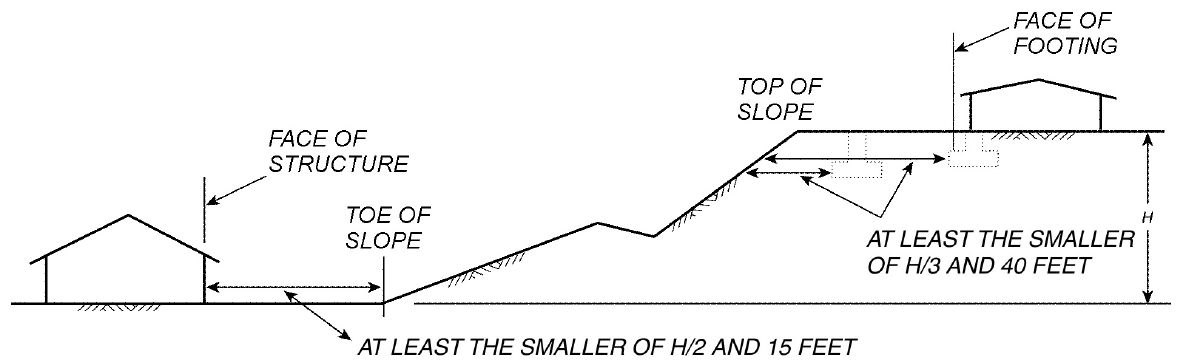
Figure10-1: Foundation Clearances from Slops

Figure 10-2: Explanatory figures for clause 10.2.1
Retaining Walls
The retaining walls shall be reinforced concrete, taking into account any recommendations of the reinforced concrete adjacent to the soil such as cement type, concrete cover, water proofing and crack width limitation.
It is mandatory to have retaining wall structure when the difference in level between the plot and adjacent plots/ roads and sikas is 1.50m or more. Retaining wall may be required even if the difference in level is less than 1.5 meters if the municipality deems it necessary.
The consultant is responsible for gathering, reviewing, and submitting all required information. This should include, but is not limited to, the site plan and relevant certificates at various levels, which are essential for determining the specifications for retaining walls.
The requirements for retaining walls shall be clearly defined at the early stage of the design and shall be properly coordinated with the main building’s foundation.
Retaining walls shall be designed to withstand a combination of lateral loads from earth pressure, surcharge loads, groundwater pressure, backfill loads, and gravity loads. Soil lateral loads shall comply with Clause 5.3.
The retaining wall shall be designed to resist sliding and overturning with safety factors of at least 1.5. The bearing pressure beneath the retaining wall's foundation shall remain within the allowable limits, considering eccentric loading conditions.
The most critical loads’ combination shall be considered in the stability checks of retaining walls (e.g. with/without surcharge loads).
The thickness of the retaining wall shall be at least 250 mm, and the thickness at the bottom shall be sufficient to resist the resultant shear and bending moments due to the most critical loading case.
Retaining walls shall be checked for both early-age and long-term thermal cracking.
Liquefiable Sites Requirement and recommendation.
The design of foundations in liquefiable sites shall comply with Section 12.13.9 of ASCE/SEI 7-16 and its associated subclauses. The following liquefaction-related considerations shall be explicitly addressed:
Lateral Spreading – Assessing and mitigating the potential for lateral soil displacement due to liquefaction.
Global and Differential Settlements – Evaluating liquefaction-induced settlements and their impact on foundation performance.
Provision of Ties Between Individual Foundations – Ensuring structural integrity and stability through appropriate foundation connectivity.
Negative Skin Friction (Downdrag) on Pile Capacity – Accounting for the effects of liquefaction-induced downward soil movement on pile axial capacity.
If the impact of liquefaction exceeds the allowable thresholds specified in ASCE/SEI 7-16 (Table 12.13-2 for lateral spreading and Table 12.13-3 for differential settlement), ground improvement measures shall be implemented to mitigate associated risks.
Factor of Safety Against Liquefaction
The Factor of Safety (FS) against earthquake-induced liquefaction shall be determined as follows:
FS = CRR/CSR ≥1.5
where:
CRR = Cyclic Resistance Ratio (available soil resistance to liquefaction)
CSR = Cyclic Stress Ratio (cyclic stress induced by the design seismic event)
Seismic Design Parameters
Seismic design parameters shall be based on UBC 97, Zone 2A.
Peak Ground Acceleration (PGA) = 0.2g
Deep Foundation (Piles)
General Requirements
It is not permitted to use the (driven piles) method to execute the piles. If this method is used in the foundations, prior approval should be obtained from the municipality.
It is prohibited to assign deep foundations as springs in a 3D ETABS model to capture the reactions for the piles design.
Piles shall be sized and designed in accordance with the geotechnical pile capacity mentioned in the soil investigation report (diameter, length). Unless a PTP test is conducted for pile design optimization.
The factor of safety shall be at least 2.5 for compression piles and 3.0 for tension piles, unless geotechnical justification calculations are provided.
The reduction in skin friction capacity due to the slurry utilized shall be considered in the pile design based on the soil investigation.
Piles should be designed to resist all loads (vertical and lateral) transferred from foundation element.
Axial compressive working stresses on piles should not exceed 0.25fc’.
Design lateral shear force shall be determined based on the maximum of 5% of the vertical load on the pile and the square root of the sum of the squares (SRSS) of horizontal loads resulting from the superstructure and foundation analysis.
Curtailment of longitudinal pile’s reinforcement shall follow the resultant ultimate bending moment profile along the pile.
Shear reinforcement of piles shall be designed according to the ultimate resultant shear force profile along the pile.
The shear capacity design of the pile shall account for the effect of the corresponding axial force on the pile (tension). It is recommended to neglect the corresponding compression force, if any.
Circular section of pile shall be considered as an equivalent rectangular section for shear design purpose as follows:
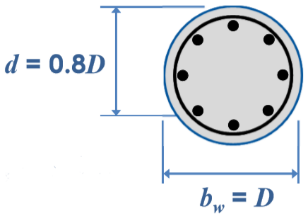
Depth (d)=0.8xDiameter (D).
Width (bw) = D.
Pile’s reinforcement shall follow the following minimum requirements.
Longitudinal Reinforcement Requirements | Minimum bar diameter | 16mm | |
Minimum reinforcement | 0.5% of pile’s cross section area | ||
Extend of reinforcements | Longitudinal reinforcing should continue at least with the minimum percentage for the full length of the pile. | ||
Ties Requirements | Minimum bar diameter of ties | 10mm | |
Maximum spacing (Smax) of ties | Within distance Lo from foundation soffit. Where Lo = 3 times pile diameter. | 8 times of longitudinal bar diameter, and not more than 150mm | |
Outside distance Lo | 12 times of longitudinal bar diameter, and not more than 200mm | ||
Pile stiffness shall be modeled as point springs (vertical and horizontal) in the foundation Finite Element Analysis (FEA) model. The values of these point springs shall be clearly defined in the soil investigation report. In the absence of horizontal pile stiffness data, it shall be assumed to be no less than 10% of the vertical pile stiffness. For percentages exceeding this limit, further justification and calculations shall be provided.
The pile diameter shall be selected to satisfy structural requirements of flexural and shear before executing the final pile design by a piling specialist.
Structural design of piles shall consider the following allowable tolerances’ effects:
Moment due to allowable eccentricity of 75mm.
Lateral load due to allowable out of plumb 1:75.
Design lateral load of the pile shall be the resultant of both X and Y directions of the same load case.
Piles shall be designed laterally as fixed head piles as long as the pile cap is restrained in both directions.
The center-to-center spacing of piles shall not be less than 2.5 times the diameter of the pile. A thorough pile group assessment shall be conducted, considering soil-structure interaction, building stiffness, and foundation stiffness.
The impact of pile group effects on pile stiffness and settlements shall be considered in the design of piles and raft by the consultant and the geotechnical piling contractor.
Bored cast-in-situ piles, particularly long piles, the mobilization of end-bearing resistance is significantly influenced by soil or rock disturbance at the pile toe level, requiring much larger settlement compared to skin friction mobilization.
Given the geotechnical conditions of Ras Al Khaimah, no more than 10% of the pile’s geotechnical capacity shall be utilized, subject to acceptable settlement limits. If a higher percentage is to be considered, a detailed geotechnical study including justification and verification through geotechnical FEM analysis, analytical methods, and/or pile load testing—must be conducted by a geotechnical specialist and submitted for initial approval by RAK Municipality before proceeding with pile design.
The contractor shall submit the as-built records of piles to the consultant upon completion of piling construction. The consultant is responsible for ensuring that all piles are executed within the allowable tolerance. If any pile exceeds the permitted tolerance, the consultant must assess the impact of the deviation on the foundation and/or pile design.
It is the sole right of the municipality to request the as-built of the piles for verification whenever deemed required.
Preliminary Test Pile (PTP)
A minimum of one Preliminary Test Pile (PTP) shall be provided for each project, considering the maximum pile diameter and length to ensure suitability for site conditions.
PTP Arrangement & Submission Requirements
The arrangement of non-working PTPs must be formally submitted to the RAK Municipality during the design stage, including the following:
Official Assignment Letter – A formal appointment letter for the specialist, submitted to the RAK Municipality.
Method Statement – Prepared by the Engineer and/or Geotechnical Specialist Contractor, detailing the scope and objectives of the PTP.
PTP Location & Interference Check – The location shall be provided by the Geotechnical Specialist Contractor and Consultant to ensure suitability. Additionally, confirmation must be provided that the PTP does not interfere with permanent structural piles for the main structure.
Detailed Drawings – Clearly illustrating the PTP location and associated instrumentation.
Test Duration – Information specifying the planned duration of the PTP.
PTP for Pile Design Optimization
Since the PTP is used for pile design optimization, the following shall be ensured:
One PTP shall be provided for each 350 piles.
The test results must be analysed by a competent geotechnical specialist and presented in an interpretative report, confirming the soil design parameters.
This interpretative report must be approved by the RAK Municipality before pile design commencement.
The Method Statement must identify all involved parties in the testing and reporting process.
A revised soil report with updated soil parameters must be submitted to the RAK Municipality along with the updated pile design package.
Notes
If pile failure is not achieved under the test load, the final design shall only consider the maximum soil parameter values (Fs, Qs, and Qb) derived from the test—interpolation is not permitted.
The test load must continue until failure. If failure is not reached, the minimum applied load must be 3.0 times the working load of the pile.
Pile Tests
The necessary tests for the endurance and quality of piles should be carried out.
The tests shall be submitted to the inspection engineer of the municipality prior to casting the foundations, results shall be verified to ensure that they conform to the technical specifications and standards.
The following are minimum tests requirements for piling works approval.
Pile Test | Minimum percentage of piles |
Integrity | 100% |
Dynamic load (load test magnitude 150% of working load) | 5% |
Static load (load test magnitude 150% of working load) | 1% & Minimum one pile of each pile type |
Sonic (recommended for dimeter more than 750mm) | 10% |
Piling Package by the Consultant
Piling package by the structural consultant shall present the following information in the piling package.
Structural calculations and analysis models to demonstrate the piles loads.
Preliminary structural drawings demonstrate the overall structural feasibility and piles’ loads.
Piles’ layout drawings showing piles’ arrangement, setting out and piles’ types.
Piles’ general notes drawings covering but not limited to:
Piles’ concrete and reinforcement grade.
Concrete cover.
Pile tests’ types and failure criteria.
Piles’ schedule covering the following information:
Pile type (legend).
Pile diameter.
Number of piles within each type.
Pile cutoff level.
Pile tentative toe level (to be verified by piling specialist during the piling specialist submission).
Pile’s working loads
Maximum Compression load and corresponding lateral loads from same load case.
Maximum Tension load and corresponding lateral loads (if any).
Number or percentage of tests for each pile’s type.

Piling Package by the Piling Contractor
Final piles’ design shall be done by a licensed piling specialist. The design shall be based upon the piling reaction schedule prepared by the consultant and the soil investigation report information provided.
Piling specialist shall present piles’ information in a form of piles layout and schedule similar to the consultant presented information in addition to the followings.
Toe level confirmed based on the specialist’s design and/or verification.
Piles’ full reinforcement details.
Geotechnical and structural design calculations of piles.
Soil investigation report.
Pile Caps Requirements
Pile cap shall satisfy structural design including flexural, one-way shear and punching.
CRSI 2015 can be referred for one-way shear whenever deep action is satisfied.
Two-way shear reinforcement is not allowed in pile caps.
Pile caps shall be restrained to ensure no moment transferred to the piles.
Single pile cap must be restrained in the two main directions.
Piles caps have two or more aligned piles must be restrained in the perpendicular direction to these piles.
The pile cap restraining can be satisfied by foundation tie (ground beams) or connecting slab.
Foundation ties shall be capable of resisting, in tension or compression, a minimum horizontal force equal to 10 percent of the larger column vertical load.
Minimum clear edge distance between face of pile and pile cap edge shall not be less than 250mm.
The pile cap bottom cover to be considered in the ultimate design shall not be less than 125mm.
The depth of pile cap shall be properly coordinated by the consultant to ensure sufficient depth for the development detail of pile longitudinal reinforcement.
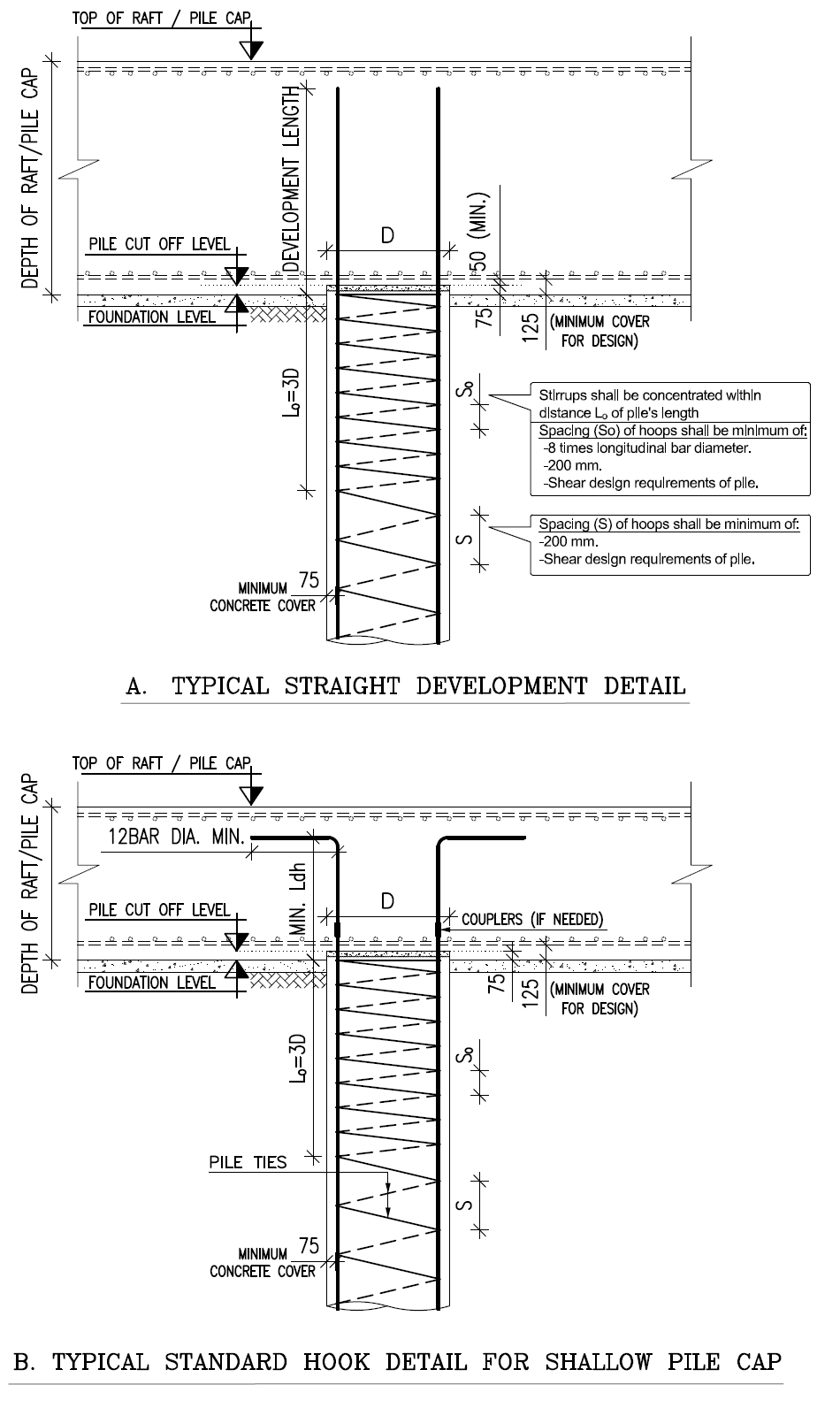
150 mm.
Figure 10-3: Pile reinforcement development details within pile cap.
Pre-Stressed Concrete

The current pre-stressed regulations are relevant to the post tensioning bonded systems only, whereas the other pre-stressed systems shall be submitted for review and approval prior to work.
The post tension structural elements shall be designed and executed by a specialized company in this field.
The post tension elements shall be designed by a qualified engineer who is approved by the Competent Department.
It is the consultant’s responsibility to communicate the approved loading criteria and loading plans to the post tension specialist.
The structural calculation shall be submitted according to approved engineering software, in addition to the detailed drawings of the elements used, according to the international codes, with the stamp of the Consultant and the post tension specialist.
All material shall be approved by the Consultant prior to commencement of execution and installation.
Unless otherwise required by the design, the general requirements below shall be complied with according to the directions of the Ras Al Khaimah Municipality.
General Design Requirements
The minimum thickness of the pre-stressed concrete slab shall be at least (Span/40) and not less than 200mm. For any further deviation from these limits, vibration shall be properly analyzed by the post tension specialist and verified by the consultant.
Structural calculations shall verify both short term and long-term deflection, camber and vibration are within the permissible limits.
Temperature and lateral loads analysis should be done using 3D building model, and the resultant forces shall be considered in addition to the gravity loads from the pre-stressed analysis.
Cubic strength for the concrete used in pre-stressed slabs shall not be less than 40 N/mm2.
Concrete cover shall comply with durability or fire resistance requirements, whichever condition is more onerous. The cover shall be measured to the outside surface of the duct; the minimum net cover for the bonded system shall be 35 mm.
Low relaxation Steel Wire Strands or High Tensile Steel Wire Strands for the purpose of pre-stressing concrete shall comply with the set requirements of ASTM A 416/A 416M or BS 5896 specifications respectively.
The total prestress losses considered in the analysis and design shall not be less than 150 MPa unless detailed verification calculations for all relevant losses are provided.
The spacing between the ducts shall not exceed 1500mm or 8 times the slab thickness whichever is less.
All columns within flat slab system should be checked for punching shear as per the identified code.
Pre-compression value (P/A) shall not be less than 0.9 MPa. Otherwise, the slab shall be considered as a reinforced concrete (RC) slab.
Tensioning shall be applied from both ends if the length of the cable exceeds 35 meters.
The ducts surrounding the cables shall be bonded ducts, and the cables shall be grouted with a certified grouting material.
Rectangular spiral stirrups can be added in tension areas, not less than 6 laps of 12 mm diameter.
Pan ducts for tension shall be used if the cable track runs past the columns, to prevent any unintended overshoots in the column design.
It is preferable to arrange the tendons so that each tendon has one dead end adjacent to one live end, alternating the tendon ends
For curved tendons, hairpins shall be provided at the curvature. The minimum offset at the curvature shall not be less than 2 inches (50 mm).
The cable routing shall be supported by metal chairs installed on the metal scaffolding, with the spacing between them not exceeding one meter.
The locations of the cables shall be clearly indicated on the pre-stressed concrete slabs.
The number of sample cubes taken for testing from casted concrete shall be at least 6 for each 50 cubic meters. Tests shall be scheduled according to the approved code.
Serviceability Requirements-Flexural Members
Design for serviceability requirements of members shall comply with ACI318 or Technical Report No.43-Euro Code.
Permissible Stresses in Pre-Stressing Steel
Case | Maximum limit |
Jacking force for post tension elements | 0.75 fpu |
Post-tensioning tendons immediately after tendon anchorage | 0.70 fpu |
Pre-Compression Stresses
For slabs with varying cross section along the slab span, either parallel or perpendicular to the tendon or tendon group, the minimum average effective pre-compression stresses of 0.9 MPa is required at every cross-section tributary to the tendon or tendon group along the span.
If the average pre-compression stresses exceed 3.0 MPa, the design engineer shall explicitly recognize and account for the consequence of shortening of the member in connection with the restraint of the member’s supports.
Minimum Bonded Reinforcement
Bottom Reinforcement.
Minimum area of bonded deformed longitudinal reinforcement shall be in accordance with Clause 8.6.2.3 of ACI318-19.
In positive moment areas, bonded reinforcement shall be detailed in accordance with Clause 8.7.5 of ACI318-19.
Moreover, the slab shall be provided with a bottom reinforcement mesh not less than T10-250.
Top Reinforcement.
All support areas shall have a minimum top reinforcement that required by the applicable code, for the purpose of distributing cracks and strength design requirements.
Minimum area of bonded deformed longitudinal reinforcement in the negative moment zone at column supports shall be in accordance with Clause 8.6.2.3 of ACI318-19.
In negative moment areas, bonded reinforcement shall be detailed in accordance with Clause 8.7.5 of ACI318-19.
A top reinforcement mesh of at least T10-250 shall be provided for roof slabs and slabs with a thickness of 300 mm or more.
Moreover, the slab reinforcement shall be provided wherever deemed required for lateral and different thermal effects. The roof slab shall be provided with a top reinforcement mesh not less than T10-250.
Design Requirements
Verify serviceability limits, including deflection and vibration limits.
Diaphragm design and checks shall be performed considering gravity loads, lateral loads (seismic and wind), self-straining actions, and hyperstatic moments for all slabs as per ACI 318-19. Additionally, detailed reinforcement requirements shall be provided.
Anchorage zone design should include top and bottom reinforcement, similar to a hidden beam, with a width equal to the spacing between tendons to prevent bursting in the compression zone. Additionally, it is highly recommended to provide spiral stirrups around the anchorage at the live end to mitigate concrete bursting.
Two-way shear stress (punching shear) limits and design must be verified using another program, as RAM results are not considered reliable for punching shear analysis.
One-way shear design and checks shall be provided whenever deemed necessary, such as, but not limited to, beside shear walls and planted columns.
Minimum reinforcement (Asmin = 0.00075 Ac) shall be provided for the slab.
Reinforcement Detailing
Edge Reinforcement
Un-tensioned reinforcement should be placed along edges of all slabs. This should include U-bars laced with at least two longitudinal bars top and bottom.
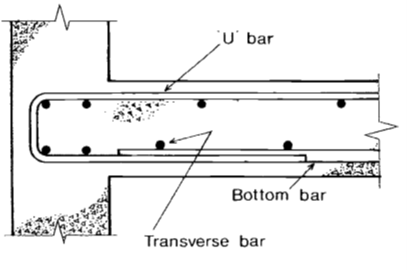
Figure 11-1: Reinforcement layout at the edge of a slab.
Reinforcement Between Tendon Anchorages
The slab zone between tendon anchorages requires reinforcement to span the unstressed zones. Any prestressed tendons that pass through this zone, parallel to the slab edge, may be included with the relevant reinforcement, provided it is in the local tension zone.
The area of tension reinforcement (and/or prestressed tendons) provided parallel to the slab edge should resist bending moments from the ultimate vertical loads calculated for a continuous slab spanning la. This reinforcement should be evenly distributed across a width equal to 0.7la and should be continuous along the edge.
The area of reinforcement placed perpendicular to the slab edge should be the greater of 0.13% bh, or a quarter of the reinforcement provided parallel to the edge. It should be placed evenly between anchorages and extend the greater of la or 0.7la plus a full anchorage length into the slab.

Figure 11-2: Unstressed areas of slab edges between tendons requiring reinforcement
For situations where it is not practically possible to place the prestressing tendons within 0.5h from the column, reinforcement should be placed to bridge the vertical force from the adjacent tendon to the columns as shown. The reinforcement should:
Be placed under the prestressing tendon.
Have sufficient area to transmit the vertical component of prestressing for that tendon to the column extend a full anchorage length beyond the tendon lie within 0.5h of the column and at least one bar should pass over the column.
where “h” is section depth.

Figure 11-3: Additional reinforcement required where tendons are not within 0.5h from the column.
Steel Structures

General requirements
Steel structure buildings shall be designed by a specialist in terms of design and execution experience.
The structural design of steel buildings shall be prepared by a qualified structural engineer licensed to practice the profession and approved by the municipality.
The detailed design calculations shall be submitted using approved analysis software in addition to the detailed shop drawing for the various steel elements, with the stamp of the consultant and the steel contractor.
Maximum capacity ratio of all steel elements under the maximum effect of design load and its combination should not exceed 95%.
All the requirements and limitations of both ultimate and service limit status should be satisfied according to the design code.
Design shall include all limit states in addition to the limit states of strength and serviceability as follows:
Strength limit states including general yielding, rupture, yielding, buckling and transformation into a mechanism.
Serviceability limit states
Stability against overturning & sway.
Fracture due to fatigue and brittle fracture.
Corrosion and durability.
In Request to ensure the durability of the structure under conditions relevant both to its intended use and to its intended life, the following factors should be considered in design:
Environment around the structure and the degree of exposure.
Shape of the members and structural detailing.
Protective coatings.
Whether inspection and maintenance are possible.
All steelwork exposed to the external environment shall be either hot dipped galvanized or will have a suitable paint system to protect against corrosion in compliance with minimum Customer requirements.
The proper fire rating for steel elements shall be achieved by proper coating thickness of cementitious or intumescent materials.
Structural Integrity
All buildings shall be effectively tied together at each principal floor level.
Each column shall be effectively held in position by means of horizontal ties in two directions, approximately at right angles, at each principal floor level supported by that column.
Horizontal ties shall be provided at roof level, except where the steelwork only supports cladding that weighs not more than 0.7 KN/m2 and that carries only imposed roof loads and wind loads.
Continuous lines of ties should be arranged as close as practicable to the edges of the floor or roof and to each column line. Ties designed and provided as shown in following figures are acceptable.
All horizontal ties, and all other horizontal members, should be capable of resisting a factored tensile load, which should not be considered as additive to other loads, of not less than 75 KN.
Each portion of a building between expansion joints shall be treated as a separate building.
For special buildings where it is stipulated to be designed to avoid disproportionate collapse, all requirements with regard to tying of columns, continuity of columns, resistance to horizontal forces, notional removal of column, accidental loading and key element design etc. shall be carefully studied and designed as required by the relevant sections of codes.

Figure 12-1: Tying of columns
Geotechnical and Soil Investigation

Boreholes and Site Testing
Boreholes Number
For single small plot of less than 1600m2; it shall be minimum 2 boreholes.
For moderate plots; it can be one borehole for each 750-1000m2 and not less than 3 boreholes.
For plots of large area, the exploration points may be placed in a grid. The mutual distance between the boreholes points that considered an appropriate for structures should normally be 30-50 m.
Where a certain project consists of a number of adjacent units, one exploration point per unit may suffice if the data of the boreholes have shown a uniform soil formation.
In uniform soil conditions, the borings or excavation pits may be partially replaced by penetration tests or geophysical survey. (B.S.5930-1999).
For structures which have main core walls as part of the structural system; at least single borehole shall be located below the core.
Boreholes Depth
The boreholes, penetration tests or other site tests should normally be performed to explore the ground conditions to such depth to ensure the design certainty of foundation and should be undertaken below all layers that may be unsuitable for foundations purposes (e.g. made ground and weak compressible soils, including weak strata overlaid by a layer of higher bearing capacity). If rock is found, a penetration of at least 3.00 m in more than one borehole may be required to establish whether bedrock or a boulder has been encountered.
For shallow foundation; the depth of boreholes below the anticipated foundation level shall be 2-3 times the width of the foundation element.
For deep foundation, the depth of the borehole shall be taken below the anticipated pile toe level as 5 times the pile diameter or 5m whichever is greater.
Minimum depth of borehole shall not be less than 8m. In Request to precisely determine the soil seismic classification, the investigation points (boreholes) must be extended deeper, with a particular focus on the upper 30 meters of soil strata.
The greater the natural variability of the soil condition, the greater the extent of the ground investigation required to obtain a confident indication of the soil characteristics to establish the overall foundation design.
The data from boreholes should be recorded and analyzed by qualified and experienced geotechnical engineer.
Boreholes should be carefully backfilled, concreted or grouted up. Trial pits should be outside the proposed foundation areas.
Soil Investigation Report
Soil investigation tests is required for all types of buildings without exception, and a special report by a licensed and approved soil testing laboratory in Ras Al Khaimah should be conducted exclusively.
All laboratories employed for soil investigation purposes must be licensed and approved by Ras Al-Khaimah Municipality. Accredited laboratories from other emirates might be allowed subject to advance approval of Ras Al Khaimah Municipality.
The appointed laboratory shall conduct soil investigations in strict adherence to the procedures and recommendations as illustrated in the international codes and Ras Al Khaimah Municipality regulations during the soil investigation operation, with proper sampling and extraction materials.
All soil reports shall be stamped and signed by a professional geotechnical engineer.
Soil investigation report shall be mainly based upon specific location with specified coordinates as per affection plan and geographical maps from the concerned authority. It shall also be relevant to the information about magnitude of superimposed loads, number of floors, land use history, surface topography, geological features and surface drainage.
Information to be Included in the Soil Investigation Report
The soil investigation report shall include (but not limited to) the following information. However, geotechnical specialist is responsible to provide any further information deemed required based on the site and project condition.
Overall site description and location.
Plan showing boreholes’ location and levels referred to site map.
Laboratory testing results.
Sub surface condition profile, based on boring and showing a cross-sectional view of all boreholes.
Water table levels.
Presence of cavities.
Liquefaction risk study (if applicable).
Complete borehole logs showing detailed records of soil strata, soil classification, ground water level, SPT, RQD, TCR and SCR values at different levels.
Filed tests results such as;
Standard penetration test (SPT) results.
In-situ Permeability test results.
Pressure meter test results.
Cone penetration test (CPT) results.
Down Hole test Report.
Groundwater readings from Installed standpipe piezometers.
Laboratory tests results such as;
Physical / Mechanical and Index properties results.
Compaction related test results.
Chemical testing results for sulphate, chloride and pH values for both soil and ground water.
Shear Strength test results.
Uniaxial compressive strength (UCS) test results.
Direct shear test results.
Permeability of the soil for different layers.
Photographs of cores’ samples.
Recommendation to be Included in the Soil Investigation Report
The soil investigation report shall include (but not limited to) the following recommendations. However, geotechnical specialist is responsible to provide any further recommendation deemed required based on the site and project condition.
Shallow foundation recommendation including allowable bearing pressure (stating clearly if gross or net), subgrade modulus, foundation level and allowable settlement.
Noting that the safety factor for soil bearing capacity shall be at least 3.0 for permanent structures, and 2.0 for temporary structures.
Deep foundation recommendation including piles geotechnical capacities in compression and tension, and pile point stiffness (vertical and lateral).
Noting that the safety factor for piles shall be at least 2.5 for both compression and tension.
Open excavation recommendations including but not limited to allowable slopes’ recommendations.
Shoring recommendations for deep excavation including soil parameters required for shoring design such as average bulk density, angle of shearing resistance, cohesion, coefficient of active, passive and at-rest pressure for different layers of soil profile.
Dewatering recommendations if ground water table is encountered including the permeability of the different soil layers.
Soil seismic classification based on top 30m of soil strata and matching with UBC97 classification.
Recommendation on the earth work, excavation, filling and compaction.
Recommendations for suitability of site material to be used as fill material.
Cement and cementitious materials recommendation along with the Additional Protective Measures (APMs) where applicable, based on the chemical results of soil and ground water.
Soil improvement recommendations and methodology (if applicable).
Liquefaction risk study recommendation (if applicable).
Any recommendation regarding problematic soil (if applicable).
Enabling Works

Open Excavation
Angle of inclination for all open excavations should be as reported in soil investigation report but not more than 30 degrees. In some cases where high ground water table is encountered, a lower angle might be required to maintain safety of slopes.
In case of high ground water table above target excavation level, dewatering shall be executed before starting excavation and dewatered level shall be at least 1.0 m below the target excavation level.
Open cut excavations are not allowed along the plot boundaries unless a No Objection Certificate is encountered from the municipality and/or adjacent plot owner.
All precautions should be considered for ensuring stability and safety of slopes for any open excavation.
All existing utilities shall be always protected during excavation and construction.
Backfill Materials and Compaction
The material used for backfilling purpose shall be of selected fill composed of sand/granular mixture free from organic materials or other deteriorates substances. The geotechnical specialist must state whether the material available in site could be used for general backfilling or not after performing the necessary analysis.
The backfill materials shall be placed in layers of thickness 150mm to 250 mm and to be compacted to not less than 95% of the maximum dry density.
Sand cone test may be carried out to determine the degree of compaction.
The plate load test (as per ASTM D1195/D1195M– 09) also is an acceptable test where the allowable bearing capacity corresponds to the allowable settlement will be confirmed.
Shoring
Shoring systems are allowed to be used as a temporary retaining structure to retain soil at construction sites peripheries.
Shoring system is mandatory for any sharp excavation deeper than 1.50 meters.
shoring system shall be considered an independent system, and it is not allowed to extend more than 500mm beyond the plot boundaries into roads or public areas. In such cases, the top 2 meters of the shoring system along roads or service areas must be removed after the completion of the basement wall construction. This is subject to prior approval from the municipality and other relevant authorities.
All existing structures and utilities shall be protected at all times throughout the construction process.
The Geotechnical Specialist Contractor must obtain all necessary approvals from relevant Authorities and adjacent property owners before installing any shoring system or anchors extending beyond the land plot limits.
It is not permitted to provide ground tie-back anchors in public properties (roads, sikkas, etc.) unless exceptions or pre-approvals are obtained from the developer/owner, adjacent neighbors, and relevant authorities (municipality, electricity company, telephone company, and water company).
Shoring system should be designed according to height of retained soil and all different construction cases conditions.
Shoring system should be designed assuming extra unplanned excavation of minimum depth 0.50m.
Shoring system shall take into consideration the ground water level and the water tightness requirement during excavation. In the presence of ground water table above excavation level; It shall be proper watertight shoring system (such as secant piles, diaphragm wall or sheet piles).
All shoring works shall be continuously monitored by the contractor and consultant. If any corrective action required during construction shall be approved by the municipality prior to execution.
Surcharge loads should be considered with a minimum value of 20KN/m2.
In case of adjacent structures, the resulting lateral and vertical reactions of the neighboring structure should be considered if found more than the specified minimum surcharge.
Cantilever soldier piles shoring system (steel beams with precast panels) is allowed up to 5m deep excavation only. Any other requirements shall be approved in advance by the municipality.
All existing utilities shall be protected at all times during excavation and construction.
Shoring zone shall consider proper allowance between the shoring and the basement retaining wall to account for water proofing, construction tolerance and allowable deflection.
The allowable maximum deflection of shoring shall not be more than 30mm adjacent to roads.
Soil Improvement
Ground improvement shall be designed in accordance with BS EN 1997-1 and the ICE Manual of Geotechnical Engineering (Vol. I).
Note: The following ground improvement techniques are accepted in Ras Al Khaimah:
Dynamic Compaction
Vibro-Compaction (Vibroflotation)
Stone Columns (Vibro-Replacement)
Soil Replacement
Soil Mixing
Grouting
Submission Methods for Excavation and Shoring Permit
The consultant may apply for the excavation and shoring permit through one of the following two methods:
Method A
Applying for excavation and shoring permit before obtaining a building permit as follows:
The shoring permit can be independent from the building permit submission or can part of excavation and site preparation permit of the project. The permit shall be handed to the shoring contractor after the approval of the shoring drawings submitted by him and obtain preliminary approval of the submitted drawings and enclose the necessary commitments.
Method B
The shoring permit can be submitted as a part of building permit submission at the final stage of the project, where the shoring drawings are submitted along with the final structural drawings and the consultant undertakes to make the necessary modifications to the project’s drawings according to the conditional approval and final requirements of the NOCs. The permit issuing will be conditional in this case till the appointment of the shoring contractor, and the issuing of the final construction drawings for the project.
Required Documents for Excavation and Shoring Permit
The general site plan of the plot with complete details of the surroundings in terms of buildings and its heights, distance from plot boundaries, adjacent foundations’ type and number of basements (if any).
The type of the structural system of the shoring and the design of the system to ensure its safety and feasibility.
Structural sections through the shoring showing the followings;
Excavation depth from natural ground level and the adjacent roads,
Any other nearby facilities.
Level of additional local excavation due to water tanks, lift pits or any other facilities below the basement level.
Gap allowance between shoring inner face and basement wall face for construction tolerance and water proofing allowance.
Ground water table level.
Full details of strutting system and/or anchoring system.
In all case, “No Objection Certificates” shall be obtained from the department of Sewage, Electricity, Water and Telecommunication or any other authorities with the commitment to comply with their requirements and attach it in the documents.
Full coordination shall be carried on between relevant architectural, structural and shoring drawings.
The shoring contractor shall provide a valid license to carry out the required activity before assigning the work to him.
Soil investigation report and shoring design calculations shall be submitted as a part of enabling package.
Shoring contractor shall provide an undertaken letter covering the responsibility of any damage or cracks in the adjacent buildings or roads as a result of shoring and excavation works.
The consultant shall review and approve the shoring drawings and design prepare by the shoring contractor before submitting to the municipality.
Items to be included in Structural Submission

The following items shall be included and properly covered in the structural submissions:
Soil investigation report.
Detailed design calculations and design basis report.
Analysis models (e.g. ETABS, SAFE, PROKON, etc.).
Different levels certificate and/or levels difference confirmation by the consultant.
General notes and standard details for structural elements including the following minimum information.
Concrete grade (Cube/Cylinder).
Reinforcement grade.
Allowable soil bearing pressure.
Foundation level.
Ground water level (if any).
Dewatering information (if any).
Waterproofing types.
Type of used partitions.
Reference datum level (e.g. Gate level, etc…).
Concrete cover of different elements; foundation, slabs, beams, ribs, columns.
Standard details of beams and foundation.
Structural Drawings
Shoring plans and details; in case of deep excavation.
Loading plans for multi-story buildings.
Raft foundation plans showing general arrangement (GA) and reinforcement details. Location and dimensions of lift pits/sump pits to be shown clearly on GA drawings.
Isolated/combined footing plans and schedules. Foundation plan shall show the dimensions of strap beams (if existing).
In case of deep foundation (piles), piles layout and general notes drawings shall be submitted for piles showing the different types and the required tests to be done on piles.
Retaining wall details including plans, setting out and reinforcement details sections.
Column layouts plan showing clear setting out of columns.
Schedule of columns including reinforcement, sizes and detailed sections.
Floor plans showing general arrangement, concrete sizes of all the elements and setting out (such as slab thickness, beam sizes, opening sizes) and reinforcement details.
Schedule of beams, with reinforcement and sizes, including typical beam elevation and sections for different beam types.
Detailed sectional plans and elevations for shear walls showing all dimensions, openings and reinforcement.
Plans, sections and details of swimming pools, reinforced concrete water tanks, level differences and significant architectural features.
Plan & section for staircases showing all dimensions and reinforcement.
The name of all the structural floor plans shall be labelled similar to architectural floors plans. Refer to the following figure for further explanation.

Figure 15-1: Structural Floor Plans Labeling System
Extension and Modification of Existing Buildings

General Requirements
The study of the building shall be carried on by a specialized consultant approved by Ras Al Khaimah Municipality who shall study the status of the building, its structural age and determine the possibility of modification, addition and defining all the necessary precautions.
The Structural elements that are included in the extension and/or modifications, shall be strengthened and enhanced in Request to accommodate the additional design loads or geometric changes according to the applicable design methods and applicable standards.
All strengthening works in site shall be carried by approved specialist with proven track record.
Building Classification
Buildings subjected to modification and additions shall be classified according to their structural age as follows:
Buildings with a Structural Age Over 15 Years
Any structural modification or additional loads to those buildings are allowed only subjected to proper and detailed study performed by specialized approved consultant.
Buildings with a Structural Age of 10 to 15 Years
The structural analysis of the building shall be carried out using one of the approved structural software, the tests for the buildings under execution or parts of it. It shall be carried out when there are reasons to doubt the performance of the building or any part thereof to resist the expected loads or doubt in its validity for use.
All or some of the following tests might be required according to the directions of the municipality:
Core test.
Ultrasonic pulse velocity.
Schmidt Hummer.
Load tests.
Check of specific parts of the foundations as required.
Soil Report for the added parts (if any).
Load tests shall be carried out in such a way to ensure the safety of individuals and property, and shall not affect the test itself or its results.
Buildings with a Structural Age Less Than 10 Years
The Municipality has the right to request any tests or structural analysis deemed necessary to take the appropriate decision regarding the acceptance or rejection of the required modification.
Soil Testing Procedures
In Request to expedite obtaining the license for modification or addition to an inhibited building; where it is difficult to carry out soil tests; it is possible to postpone the necessary soil testing until the start of execution. The results shall be presented to the Licensing Structural Engineers after being studied and modified by the consultant; and based on this, he shall submit modified drawings for final approval (if necessary).
Decisions and Procedures
If the building does not meet the satisfactory criteria for the different construction materials or the proper structural analysis according to the previous provisions; the Municipality has the right to take one of the following actions:
Reform and rehabilitation.
Allow the use of the building under reduced loads based on the results of analysis or load tests.
Rejection of the modifications or additions.
Demolition of the building.
Inspection of Buildings Construction

Inspection of construction works shall be carried out according to the approved manual’s requirements of buildings construction and considering the followings:
Inspection of concrete works
Inspection shall include the reinforced concrete, pre-stressed concrete and pre-cast concrete works to ensure that they conform to the approved drawings. (Plain concrete works and non-structural elements are excluded).
The inspection shall include (but not limited to) reinforcement bars, its locations, quantities, arrangements, overall lengths, development lengths, and lap splices.
Inspection shall include the results of concrete cubes tests of different structural elements.
The inspection shall include the results of the piling tests during the inspection of pile caps and raft on piles.
Pre-stressed concrete, pre-cast concrete and special works shall be delivered by the designated engineer from the executing company for those works.
The Consultant and the Competent Engineer shall ensure the availability of all approved documents and drawings in the construction site.
Inspection of Structural Steel Works
Inspection shall include steel elements and sections of steel structures, high-strength bolts, nuts, sealing rings, welding and measuring work, and joints with bolts or welds and their arrangements according to the approved drawings.
The steel works shall be delivered by the designated Engineer of the executing company for those works.
The Consultant and the Competent Engineer shall ensure the availability of all approved documents and drawings in the construction site.
Inspection of Founding Soil
The inspection shall include the founding soil below any type of foundation.
The inspection shall include all earthworks in site including excavation, backfilling, compaction, dewatering and shoring works.
Approval of New Structural Systems

Any new structural system or material (non-conventional) shall be submitted in advance to Ras Al Khaimah Municipality for approval before implementing by the consultant in the design, even if the system is approved in any other emirate.
Submission Stage
The submission of new system shall include the following documents:
Prequalification of specialist.
System description.
Overall specifications including fire rating, acoustic, thermal insulation, etc.
Complying with RAK green building regulations.
Past experience of system worldwide.
Past experience of system within the UAE.
Relevant authorities’ approvals (e.g. Civil defense).
Similar municipalities approvals in UAE.
Fabrication methodology.
Construction methodology.
Material certificates.
QA/QC certificates.
List of applicable codes and standards.
Tests results (if applicable).
International/local approval certificates (if applicable).
Typical key details of the system.
Review Stage
Review can be based on scoring criteria, and engineering committee including the following representatives will carry the review process.
Structural engineers (minimum 3).
Civil inspection engineer (if applicable).
Architect (if applicable).
MEP engineer (if applicable).
Approval Stage
Final decision will be taken considering the following:
Function of the project.
Occupancy of the project.
Sector of the project (e.g. Governmental, Private Investment, Private single).
Similar past application within UAE.
Any potential risks.
Final decision will be one of the followings:
Approval.
Conditional approval.
Rejection.
Approval Criteria
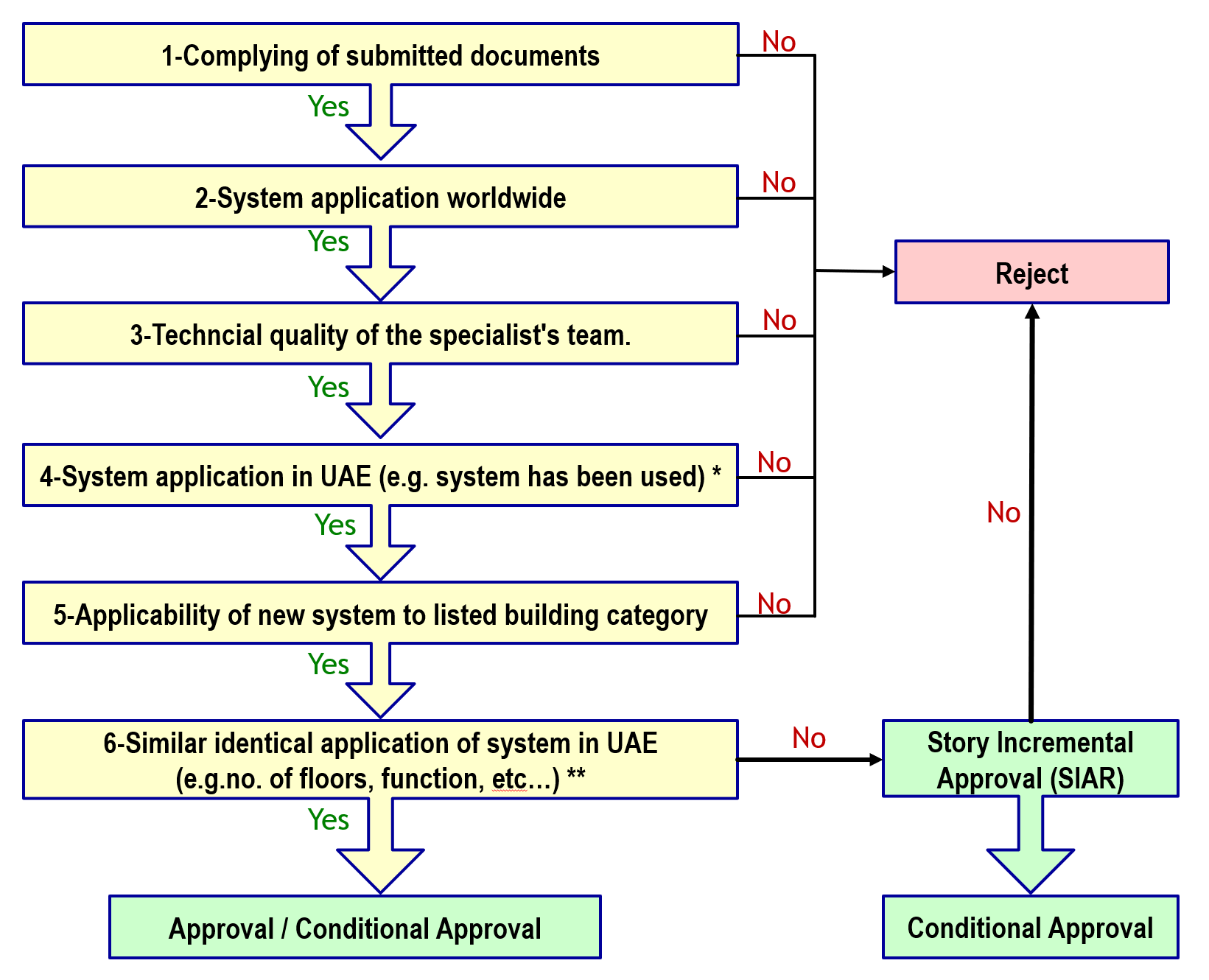
Notes:
* The system has been used in UAE as per relevant authorities' approvals. It has been used but might not be identical to the submitted case (e.g. less number of floors, different function, etc.).
** Similar submitted case has been already constructed in UAE (e.g. same number of stories, same function or similar, etc.).
The enclosed approval process is applicable only to full structural Skelton system.
List of building category that can be studied for new system approval
Applicability (Y/N) | |
Private Residential (single unit) | N |
Educational facilities | N |
Hospitals | N |
Governmental buildings | N |
Multi-story buildings-all functions. (>G+10) | N |
Multi-story buildings-all functions. (<G+10) | Y |
Investment Residential Villas (Complex) | Y |
Resorts & Motels (G+1) | Y |
Hotels | Y |
Multi story building (commercial/residential) | Y |
Retails & show rooms (G+1) | Y |
Malls | Y |
Limited size medial facilities (G+1) | Y |
Limited size Mosques (A<100 m2) | Y |
Labor & staff accommodation (G+1) | Y |
Others (not listed) | Decision as per project nature |
Note:
The list can be revised regularly as needed. Any further exception or deviation from the list shall be agreed in advance with RAK Municipality.
Story Incremental Approval Rule (SIAR)
Story Incremental Approval Rule (SIAR) | |||||
Number of stories | Gradual Approval Sequence | ||||
G+1 | G+2 | G+3 | G+6 | G+10 | |
Note:
The system approval cannot proceed for next number of stories approval unless current existing project in UAE is successfully completed and inspected by the technical committee during operation (minimum 1 year).
Approval Process
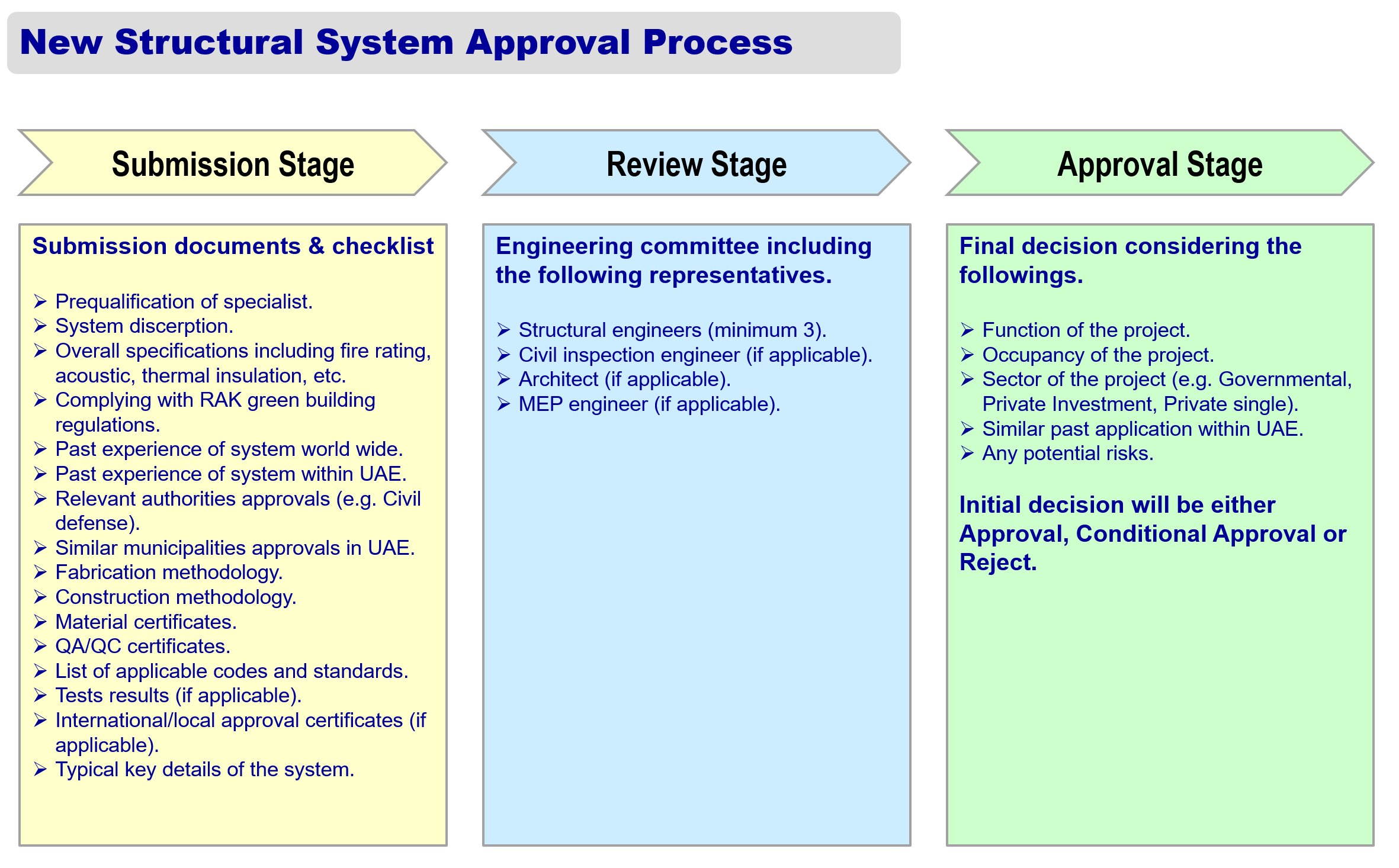
End of Regulations
Recommended sample for piling schedule:
Pile Type | Pile Legend | Number of piles | Pile Diameter (mm) | Cut off level (m) | Toe level (m) | Pile Working Loads (KN) | Piles Test Quantity | ||||||
Case 1 | Case 2 | Working load test | Dynamic tests | Integrity tests | Sonic tests | ||||||||
Maximum Compression | Lateral | Maximum Tension | Lateral | ||||||||||
P1 | O | 100 | 750 | -1.00 | -15.00 | +3000 | 150 | -500 | 100 | 1% | 5% | 100% | 10% |
P2 | |||||||||||||
P3 | |||||||||||||
Total Number | |||||||||||||
Note: The consultant can specify more load cases if deemed required.