To Download the file in PDF format, Click Here.
Resolution No. (7) of 2026
Regarding the Building Conditions and Specifications Regulations in the Emirate of Ras Al Khaimah
The Director General of Ras Al Khaimah Municipality,
After reviewing the Ras Al Khaimah Municipality Law of 1981 and its amendments,
Having reviewed:
Law No. (2) of 2007 Regarding the Establishment of the Environment Protection and Development Authority in Ras Al Khaimah and its Amendments,
Law No. 11 of 2008 regarding advertising inspection;
Law No. 1 of 2009 regarding regulating buildings in Ras Al Khaimah;
Law No. 3 of 2017 regarding the establishment of Public Services Department;
Law No. 3 of 2018 regarding the occupancy of sidewalks and outdoor spaces;
Resolution No. 18 of 2018 regarding building regulations and construction specifications in the emirate of Ras Al Khaimah;
Law No. 8 of 2019 regarding regulating contracting profession in Ras Al Khaimah;
Law No. 10 of 2019 regarding regulating engineering consultancy practices in Ras Al Khaimah;
(Law No. (12) of 2021 concerning the regulation of demolition and removal works in the Emirate of Ras Al Khaimah and its Executive Regulations; and
Law No. (11) of 2023 concerning the regulation of surveying works in the Emirate of Ras Al Khaimah and its Executive Regulations.
Has resolved to issue the following Regulation:
Article (1) – Definitions
For the purpose of implementing the provisions of this Regulation, the words and expressions set out below shall have the meanings assigned to each of them, unless the context indicates otherwise.
The Emirate | The Emirate of Ras Al Khaimah. |
The Department / Municipality | Ras Al Khaimah Municipality Department. |
Director General | The Director General of the Municipality. |
Competent Department | The Licensing Department of the Municipality. |
Concerned Department | The department from which the Competent Department requests a technical opinion on a specific matter, including the departments of the Urban Management Sector within the Municipality. |
Concerned Authority | The local or federal government department or institution from which approval is sought for a matter falling within its jurisdiction. |
Service Authorities | The competent service authorities in the Emirate of Ras Al Khaimah, including: |
Building Conditions and Specifications Regulations | The regulations containing all requirements, specifications, and standards to be followed in the construction of various buildings and structures within the Emirate, including planning, architectural, structural, electromechanical, electrical, water supply, drainage, and other related engineering works. |
Owner / Developer | A natural or juridical person, whether private or public, in whose name the land or building is registered, whether in the capacity of owner or possessor. |
Engineering Office (Consultant) | An engineering consultancy office responsible for preparing drawings, plans, architectural and structural designs, surveying and planning works, supervision of execution, maintenance and operation, quantity surveying and cost estimation, management of engineering activity projects, as well as all other related engineering works, and licensed to practice engineering consultancy in the Emirate. |
Contractor | A natural or juridical person assigned to execute construction works and licensed to practice building contracting activities in the Emirate. |
Inspector (Municipality Inspector) | The person assigned by the Competent Department to inspect and describe the plot of land, including the buildings, components, and uses thereon. |
People of Determination | Any person suffering from a total or partial, permanent or temporary impairment or deficiency in physical, sensory, mental, communicative, educational, or psychological abilities to the extent that limits the ability to meet ordinary requirements compared to persons without special needs. |
Technical Committee | The committee formed within the Competent Department pursuant to a decision issued by the Director General or their delegate to study building permit applications and related matters, issue appropriate decisions thereon, and undertake other duties stipulated under Article (56) of this Regulation. |
Building Permit | The permit issued by the Licensing Department authorizing the construction works intended to be carried out on a specific plot or plots of land in accordance with the approved drawings, specifications, and conditions. |
Plot of Land (Plot) | Any parcel or area of land defined by its boundaries, adjacent properties, unique plot number, and location, designated for construction under any subdivision plan, development project, or any other legally approved method for use, development, or construction as a single unit. |
Private Villa | A detached building designated in all its floors for the residence of a single family, having a ground-level entrance and comprising at least a living hall, two rooms, and their services. It shall be considered the main building on the residential plot and shall have an independent parking space within the plot boundaries. |
Annex | A building attached to or detached from the main building on the plot, the use of which shall be secondary or complementary to the main use of the building. |
Investment Villas | A complex of private villas, connected or semi-connected to one another, designated for rental or investment purposes, and which may include shared outdoor spaces and recreational facilities. |
Collective Housing | A building used as a place for collective accommodation for a number of persons affiliated with a specific entity (university, boarding school, hospital, company, etc.). |
Labour Accomnodation | A building used for the collective accommodation of workers. |
Residential Apartment | A part of a building designated for residential use, comprising one or more rooms with a living hall, designed and prepared for the accommodation of one or more persons. It shall include a place for the preparation and cooking of food (kitchen), as well as at least one bathroom, and shall constitute an independent rental unit. |
Studio | A part of a building designated for residential use, comprising one room and including a place for the preparation and cooking of food and a bathroom. This part shall constitute an independent rental unit. |
Offices (Administrative use) | The building, floor, or unit designated for conducting office activities. |
Kitchen | An enclosed space designated for the preparation, processing, and cooking of food and beverages. |
Open Kitchen | An open space designated for the preparation, processing, and cooking of food and beverages. |
Plot Boundary | The separating line between the boundary of a plot of land and any other property. |
Plot Area | The total area of any plot of land enclosed within its boundaries. |
Front Boundary of the Plot | The boundary of the plot facing the street, in accordance with the planning requirements shown in the approved master plan issued by the concerned department. |
Side Boundary of the Plot | Any boundary of the plot other than the front or rear boundary. |
Rear Boundary of the Plot | The boundary of the plot opposite the front boundary and located at the furthest distance from it. |
Road (Street) | Any route open for public traffic, including all types of roads, public squares, bridges, tunnels, intersections, medians, public parking areas, sidewalks, pedestrian crossings, bicycle lanes, and other operational facilities. |
Local Road (Local Road) | A road designated to provide direct access to plots within residential or local areas. It is characterized by limited traffic volumes and low design speeds and connects to higher-order roads to ensure safe access and traffic safety. |
Road Intersection | The intersection of two or more roads. |
Road Right-of-Way | The public road together with the adjoining strip of land extending to the boundaries of adjacent plots, in accordance with approved plans. |
Center Line | The longitudinal line that divides the street or lane, as approved by the Municipality. |
Lane (Sikka) | A passage separating adjacent plots, as well as separating plots from public facilities. It is used for utility lines and as a primary or secondary pedestrian access route. |
Pedestrian Sidewalks | A raised, hard-surfaced pathway parallel to the road and vehicle traffic lanes, designated for pedestrian movement. |
Adjoining Property | Any adjacent plot of land identified by a specific number, excluding streets and lanes. |
Other Boundaries | All adjoining areas such as lanes, open spaces, and similar areas, excluding streets. |
Fence / Wall | A permanent barrier constructed from any approved material or combination of materials used to enclose a plot of land, for screening, subdivision, or any other approved purpose. |
Fence / Metal Fence | A temporary barrier made of wire or lightweight construction materials used to enclose or subdivide a plot of land or for any other approved purpose. |
Main Gate | The principal entrance to the plot of land, which may be covered or uncovered, designated for vehicle access. |
Secondary Gate | The secondary entrance to the plot of land, which may be covered or uncovered, designated for pedestrian access only. |
Building | Any structure erected or constructed at a fixed location on a plot of land using approved materials designated for building purposes, including foundations, walls, roofs, projections, fences, and similar elements. |
Temporary Building | Any structure that must be removed after the expiry of the period specified for the activity or use for which it was established, and which is originally constructed from materials approved by the Competent Department pursuant to a permit. |
Main Building | The building in which the original or principal use of the plot of land is carried out. |
Heritage Buildings | Buildings containing historical and traditional architectural elements for which demolition, construction, or modification works shall not be permitted except after obtaining the initial approval of the concerned authority. |
Commercial Buildings | Buildings in which commercial use is permitted in accordance with the land use classification and zoning regulations. |
Commercial Residential Buildings | Multi-storey buildings in which the ground floor is designated for commercial and residential use, while the repeated floors are designated for residential use or offices. |
Investment Residential Buildings | Buildings designated exclusively for residential use. |
Permitted Use | Any use of a plot of land or occupancy of a building permitted within a specific area in accordance with the approved planning requirements under the master plan issued by the concerned department. |
Main Use | The principal use of the building in accordance with the approved planning requirements under the master plan issued by the concerned department. |
Secondary Use | Secondary uses established on the same plot of land as the principal use (accessory buildings), such as maid’s rooms, garages, and other secondary uses. |
Shopping Mall | A group of shops, showrooms, or spaces used for commercial purposes opening onto covered and air-conditioned internal courts or corridors, including any retail shop or showroom attracting large numbers of the public. |
Showroom | A relatively large space designated for conducting commercial activities such as displaying goods for wholesale or retail sale. |
Shop | Any space designated for conducting commercial activities such as displaying goods for sale. |
Hospitality Establishment | Hotel, resort, serviced apartment rental, lodge, holiday homes, chalets, and retreats. |
Hotel | Establishments specialized in providing accommodation services to guests on a daily or weekly basis in furnished rooms and suites equipped with all necessary facilities, including maintenance, food and beverage services, laundry services, valet parking, swimming pools, sports and recreational facilities, and meeting and conference halls. |
Resort | It includes specialized facilities constructed in tourist locations such as sea beaches, mountainous or desert areas, and others, for short-term temporary accommodation against rent or a specified daily rate, in buildings equipped for this purpose in the form of chalets or apartments that provide all other hotel services. |
Hotel Apartments | Facilities consisting of residential apartments equipped with all necessary living facilities and amenities, which are leased for permanent accommodation on a daily, monthly, or annual rental basis. |
Lodge | Facilities that provide suitable accommodation for their guests in the form of rooms equipped solely for this purpose, without the other customary services usually provided by hotels, and are rented for temporary stays at specified daily rates. |
Chalets and Rest Houses | Hotel facilities that prepare chalets, cottages, cabins, and rest houses and provide them with all necessary tools and amenities for temporary accommodation, and may offer other services such as the usual hotel services. |
Preparation Kitchen | A space designated for the preparation of light food and beverages and shall not be considered a substitute for the principal kitchen in residential units. |
Guard Room | A room, unit, or residential space established on the same plot of land as the principal building, or located within the building, designated for the accommodation of the guard. It shall include a bathroom and may be located along the principal boundary wall. |
Maid’s Room | A room or a group of attached or detached rooms established on the same plot of land as the principal building and designated for the accommodation of domestic staff serving the occupants of the building. |
Storage Room | A covered portion of a building used for the storage of items. |
Parking Areas | Designated and organized spaces for parking vehicles within or outside the boundaries of the plot of land, whether open, covered, or located within dedicated parking structures, including circulation and maneuvering areas. |
Parking Space | The area occupied by a single vehicle while parked. |
Tandem Parking | A parking arrangement in which two or more vehicles are parked behind one another in a single longitudinal lane, whereby the ability of the inner vehicle to exit depends on moving the outer vehicle positioned ahead of it. |
Mechanical Parking | Vehicle parking areas utilizing advanced technological systems and mechanical or electrical equipment (such as lifts, elevators, hydraulic platforms, or similar systems) for transporting and storing vehicles on multiple levels. |
Vehicle Access | A passage intended to facilitate the entry and exit of vehicles from the public road right-of-way to the building entrance or parking areas. |
Driveway | A vehicular circulation route leading to parking areas or loading and unloading zones within the plot of land. |
Ramp | An inclined structural element designed with a specified gradient to enable the smooth and safe movement of vehicles or persons from one level to another. |
Loading and Unloading Area | A designated area located outside circulation routes and prepared for the temporary parking of service vehicles for loading and unloading goods, ensuring operations are carried out efficiently and safely without affecting traffic movement, pedestrians, or surrounding activities. |
Vehicle Maneuvering Analysis | An engineering analysis using simulation models to verify the efficiency of the design and its ability to accommodate the movement of various vehicles by assessing the flexibility of vehicle entry, exit, and circulation within designated areas such as parking lots, intersections, entrances, and exits. The analysis aims to ensure smooth traffic flow and avoid structural conflicts or complex and unsafe maneuvers. It relies on simulation models or engineering drawings illustrating the vehicle movement path (Turning Path) during turning, reversing, or maneuvering operations. |
Arcade (Liwan) | A continuous covered passageway of a building, open to a street or open courtyard, or connecting more than one building. It typically includes external columns facing the street or courtyard. |
Iwan | A recessed space or distribution area with depth, enclosed by walls on three sides and open on one side to the external air. |
Canopy | A projecting cover extending from the wall of a building, or a roof supported on columns, intended to protect a door, window, or passage from rain or sunlight. |
Pergola | A canopy with a non-solid roof containing openings, typically constructed for architectural enhancement or climatic purposes. |
Veranda | A covered portion projecting from the building and overlooking the surrounding area, sometimes used as an entrance area in front of the main entrance of the building. |
Staircase Room | An enclosed space within a building containing the staircase and provided with a door. |
Waste Collection Room | A space or room designated for the temporary storage of waste prior to its transfer outside the building for disposal. |
Waste Room | A room serving waste disposal openings in repeated floors exceeding three floors above the ground floor and connected to a waste chute transferring waste to the collection room at the ground floor level, or a room provided on each floor in small plots instead of a waste disposal chute. |
Balconies | Covered or uncovered projections extending beyond the vertical plane of the adjacent external walls of the building and accessible from within the building itself. |
Decorative Elements | Elements added to a building for aesthetic, expressive, or symbolic purposes. |
Lighting and Ventilation Openings | Openings that provide natural lighting, natural ventilation, or both, for any facility within the building, and located in any roof or external wall thereof. |
Secondary Ventilation (Intermittent Ventilation) | Ventilation provided through an opening or shaft for rooms whose depth exceeds three times their width, in order to provide natural ventilation and lighting to the internal portions thereof. |
Internal Courtyard | A space open to the external air from above and surrounded by buildings on three or more sides, onto which living spaces from one or more residential or office units overlook. |
External Courtyard (Pocket Shaft) | A shaft or internal courtyard open to a lane or street. |
Shaft | A space open to the external air from above and surrounded by buildings on three or more sides, onto which only service facilities overlook. |
Service Duct | An enclosed space through which utility and service pipelines pass and which contains access openings for maintenance and repair. |
Building Coverage Ratio | The percentage resulting from dividing the ground floor area of the buildings by the total plot area. |
Term | Definition |
Setback | The horizontal distance extending between any front, side, or rear boundary line of a plot of land and the nearest wall or occupied projection of the building constructed thereon. |
Building Projection | Any part of a building projecting beyond the vertical plane of the external walls of the floor below such part. Such projections typically commence from the first floor above the ground floor, or above the ground floor and mezzanine floor, if any. |
Building Height | The vertical distance measured from the approved design level to the highest point of the building, including the roof parapet (Warash), staircase room roof, mechanical equipment, or service installations located on the uppermost roof. |
Floor Area | The total covered area of the building measured between the external faces of the building boundaries, including balconies, projections, and any other covered areas such as parking spaces, circulation corridors, shafts, unloading areas, service floors, swimming pools, and any other structures on the plot fully covered by reinforced concrete roofs or equivalent materials. |
Net Area | The usable area of the building excluding service areas such as corridors, distribution halls, staircases, walls, elevators, bathrooms, and similar spaces. |
Floor | The portion of a building enclosed between the upper surface of any floor slab and the upper surface of the floor slab directly above it. |
Basement Floor | A floor located wholly or partially below the ground floor or the approved reference level. Multiple basement floors may be permitted in accordance with the studies and drawings submitted by the project consultant. The basement shall be properly insulated against moisture and water leakage in accordance with approved technical specifications and shall not extend beyond the boundaries of the plot. |
Ground Floor | The first floor of the building, the finished floor level of which shall be above the approved reference level of the plot by no more than 1.50 m for private residential buildings and 1.20 m for other buildings. It shall contain the principal entrance to the building. The Competent Department may permit the classification of more than one ground floor in special cases, such as significant variations in plot levels requiring entrances from different levels or for the purpose of achieving a unique design concept. |
Mezzanine Floor | An intermediate floor located between the ground floor and the first floor or podium (if any), in accordance with the applicable planning requirements, provided that its area does not exceed the area of the ground floor. It may either be connected to the commercial activity on t |
Repeated Floor | A floor located directly above the ground floor, mezzanine, or podium floor (if any), and which, together with the remaining repeated floors, constitutes the principal use of the building. The concerned department shall determine the number of repeated floors in accordance with the approved planning requirements. |
Connecting Floor (Building Bridge) | A floor or group of repeated floors connecting two or more buildings, enhancing accessibility and interconnectivity between buildings. Its use shall be consistent with the use of one of the connected floors or for appropriate service functions. |
Service Floor | A floor located between repeated floors in buildings where such floors are permitted, designated for services and not counted among the repeated floors specified in the applicable planning requirements. It shall, however, be included within the total permitted building height. |
Penthouse Floor | The uppermost floor of the repeated floors of a building as specified in the applicable planning requirements, designated for one or more residential units providing a high degree of privacy, with setbacks from the building boundaries allowing use as external terraces and providing views for the overlooking unit. |
Roof Floor | A floor located above the uppermost floor of the building, typically used for building service rooms. Additional activities compatible with the principal use of the building may also be permitted, provided that the area does not exceed the maximum allowable area specified for each building type in relation to the total area of the uppermost floor. |
Floor-to-Floor Height | The distance measured from the finished floor level of one floor to the finished floor level of the floor directly above it. |
Clear Floor Height | The clear vertical distance measured from the finished floor level to the underside level |
Excavation Level | The average level of ground points representing the level on which building foundations will be constructed. |
Roof Parapet Wall (Roof Screen) | A wall or barrier made of approved materials constructed around the roof perimeter for safety and protection, and sometimes used to conceal air-conditioning units or other mechanical equipment. |
Advertising Signboard | Any sign, text, drawing, or other visual medium installed, written, or displayed directly or indirectly on any building, structure, or land plot to attract attention to any activity, product, or similar purpose. |
Reference Standards and Codes | Technical references and specifications used by consultants, contractors, and laboratory technicians responsible for the design, execution, and testing of building materials and elements, including internationally recognized standards approved by the authority. |
Occupant Load Factor | The total number of persons expected to occupy a given area, varying according to the type of space usage and safety requirements as specified in Appendix (1). |
Traffic Impact Study (TIS) | A study used to evaluate the impact of a proposed project on the surrounding transportation network in terms of traffic volume, safety, efficiency, parking demand, and required mitigation measures. |
Access and Circulation Study | A study focused on organizing site entrances and exits and internal circulation planning to ensure safe and efficient movement of vehicles and pedestrians, and proper integration with the surrounding road network, including parking layout and internal design guidance. |
Article (2): Scope of Application
The provisions of this Regulation, together with the requirements, standard specifications (“Code”), and referenced documents cited therein, shall apply to all construction works, buildings, and structures within the Emirate.Article (3) – Interpretation of the Regulation Provisions
In the event of any dispute concerning the interpretation of any technical provision contained in this Regulation, or where any specifications or standards are unclear, the technical interpretation issued by the competent authority through the Technical Committee shall be deemed the approved and binding interpretation of such provision or specification.
Architectural Requirements |
Article (4) – Planning Parameters
No building shall be constructed on any plot of land unless it complies with the planning requirements approved in the master plan issued by the concerned authority. Based on these requirements, the permitted building use, allowable floor area ratio, authorized height, number of floors, external setbacks, projections, and required parking provisions shall be determined.
Article (5) – Areas
The area of all covered parts in each floor shall be calculated regardless of the use beneath the roof. The area shall be measured from the outer boundaries of the slab of each floor
However, for the ground floor of investment residential buildings and commercial residential buildings, the area shall be calculated based on the outer boundaries of the external walls of the ground floor, as stated in the approved Area Calculation Manual
First: Residential Buildings Requirements |
Article (6) – Private Residential Buildings
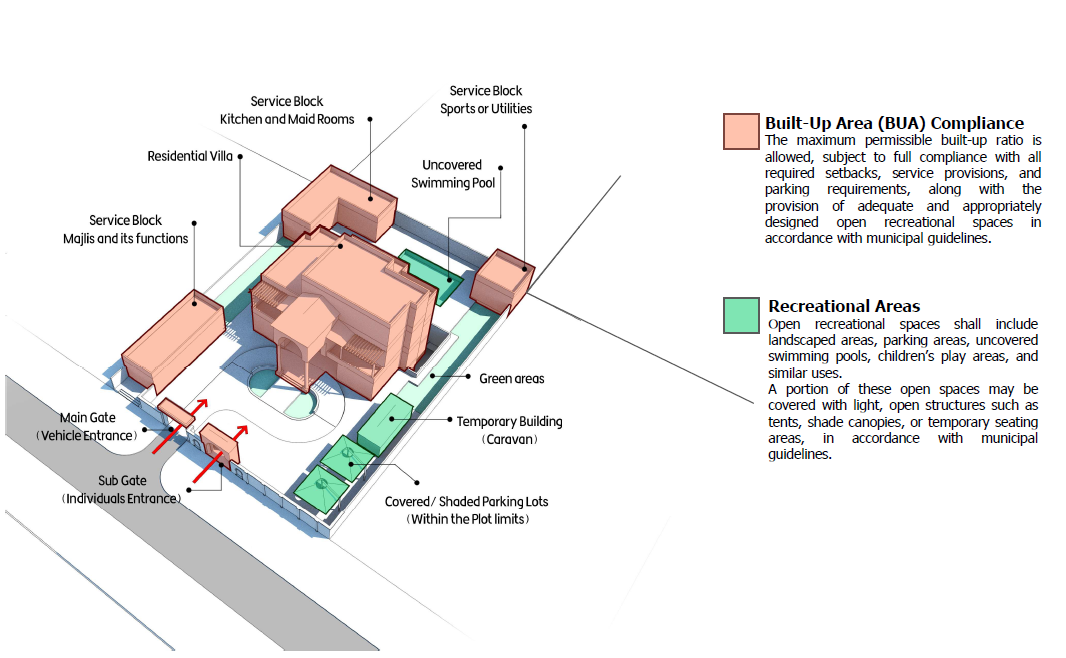
Built Up Ratio
The prescribed building coverage ratio shall be applied in accordance with the planning requirements approved in the master plan issued by the concerned authority. In the absence of a specified ratio, the following provisions shall apply:
The maximum permissible building coverage ratio of the plot area shall be allowed, provided that the required setbacks, services, entrances, and parking spaces are provided, together with adequate open recreational areas such as landscaped green spaces, uncovered swimming pools, children’s play areas, and similar facilities. Part of these open and recreational spaces may be covered with open lightweight structures such as tents, traditional “Bayt Al Sha’ar,” internal canopies, or temporary majlis structures.
Construction in a “townhouse” configuration between adjacent plots shall be permitted in accordance with the conditions issued by the Municipality.
Buildings Included in the Built-Up Area Ratio
Residential Villa
Only one residential villa shall be permitted on each plot. The villa shall comprise, at a minimum, a living room, two bedrooms, and the associated service facilities, and shall be deemed the principal building on the residential plot. Only one family suite within the villa shall be permitted on each floor.
Service Block
Construction of service blocks shall be permitted in accordance with Clause (6-4) of Article (6) of these Regulation
|
Figure No. (1) Built Up Ratio of the Residential Private Plot. |
|
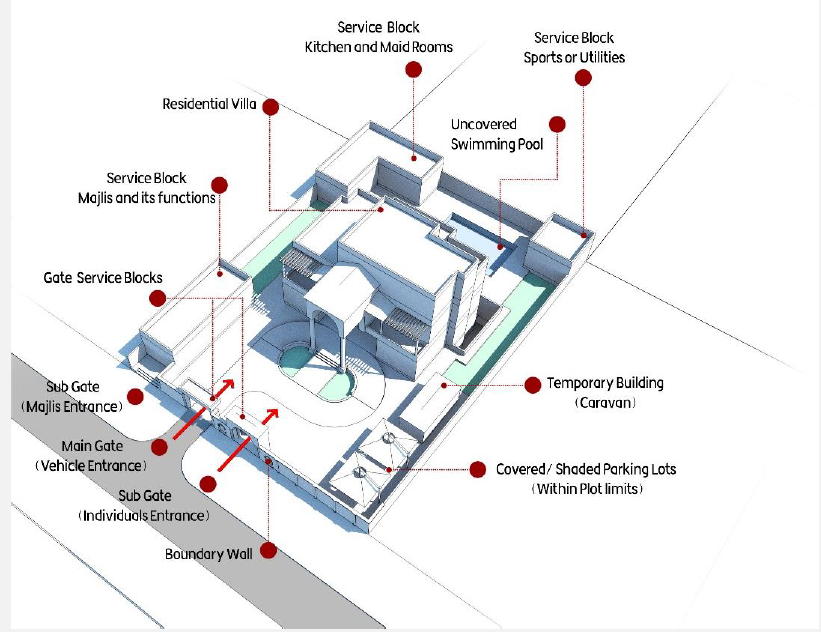
Figure No. (2) Components of Residential Private Plot |
Setbacks
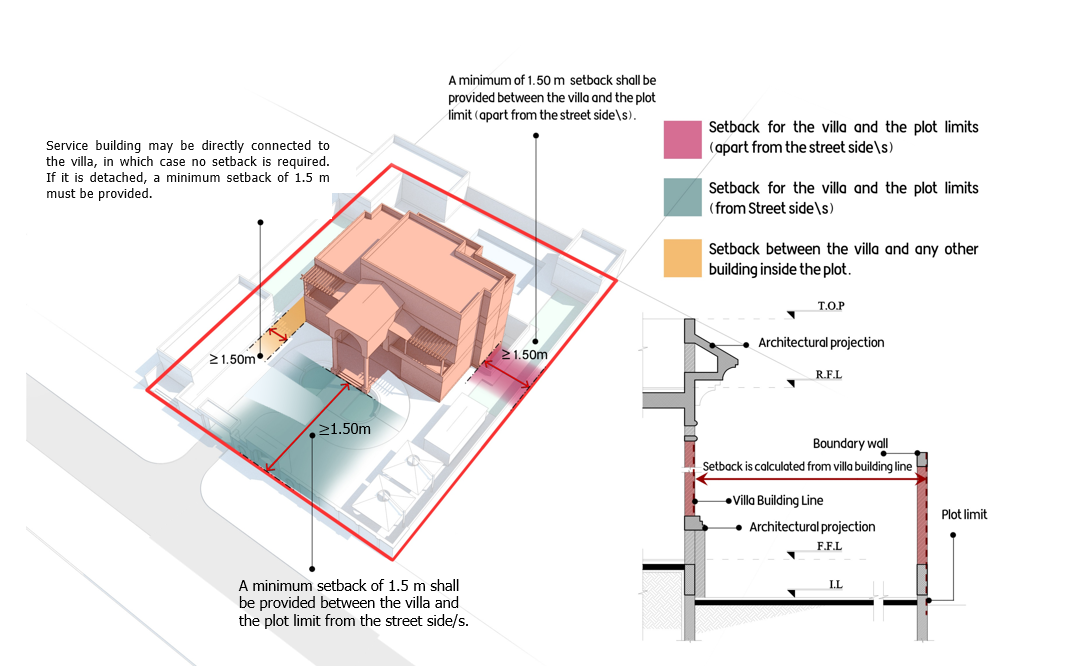
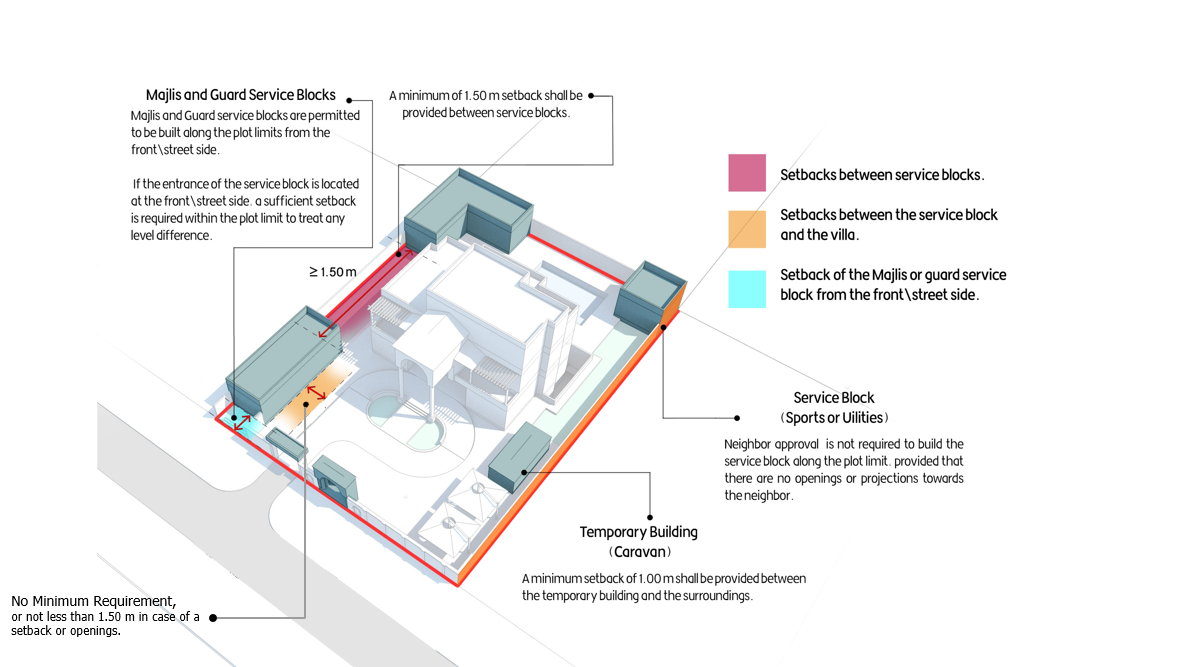
Setbacks shall be applied in accordance with the planning requirements approved under the general master plan issued by the concerned authority. Where such setbacks are not specified, the setbacks indicated in the following table shall apply.
Table 1 Minimum Setback Requirements for Private Residential Buildings.
Building | Minimum setbacks from plot limit | Service Block | ||
Street or building line | Neighbourhood and other Boundaries | |||
1 | Residential Villa | (1.50) m | N/A Or not less than (1.50) m in case of a setback or openings | |
2 | Majlis service block/ Guard service block | N/A | ||
3 | Service Block | N/A Or (1.50) m in case of openings or when not building on the plot boundary | ||
Compliance with the first-floor setback requirements shall be ensured in cases where the majlis, guard room, or garage is constructed on the front plot boundary without setback, whether as part of or as an extension to the villa, provided that vehicular access, egress, and manoeuvring are not adversely affected.
The setback requirements applicable to the residential villa shall apply in cases where service blocks are integrated with the villa, and such requirements shall be applied to the outer boundaries of the building after integration.
With the exception of open shelters (such as pergolas, arbors, and similar structures) and open car parking spaces, the construction of any structures within the required setback areas is not permitted.
When applying setbacks from streets, lanes, adjacent plots, and other boundaries, utility service lines shall be taken into consideration, and the structural design shall not allow any architectural or structural elements to extend beyond the plot boundaries.
|
Figure No. (3) Setbacks of Residential Villa |
|
Figure No. (4) Setbacks for Service Blocks |
Levels, Heights, and Number of Floors
The final finished floor level of the ground floor for residential villas and service blocks shall not exceed (1.50) m above the approved design level facing the street adjacent to the main entrance, and shall not be less than (0.90) m above the external ground level. The final finished floor level of the majlis and guard room attached to the boundary wall shall not be less than (0.30) m above the sidewalk level outside the plot boundary.
Where the plot is located on one street or on two or more streets with varying levels, the excavation level of service blocks attached to the plot boundaries shall be referenced to the lower approved design level between the two adjacent plots, provided that the difference between the two approved design levels does not exceed (1.50) m.
The consultant shall provide the necessary engineering solutions to address any difference between the approved design level of the plot and the existing or future road level, where applicable and in accordance with the approved level certificate, in a manner consistent with the site conditions. All remedial works and related constructions shall be designed and executed strictly within the plot boundaries or within areas designated by the concerned authority for such purposes. No works, treatments, or steps shall be permitted outside the plot boundaries.
Approved building heights and the number of floors shall be applied in accordance with the planning requirements approved under the general master plan issued by the concerned authority. Where not specified, residential villas shall be permitted to consist of a ground floor, first floor, roof floor, and basement, while service blocks shall be limited to a ground floor and basement only.
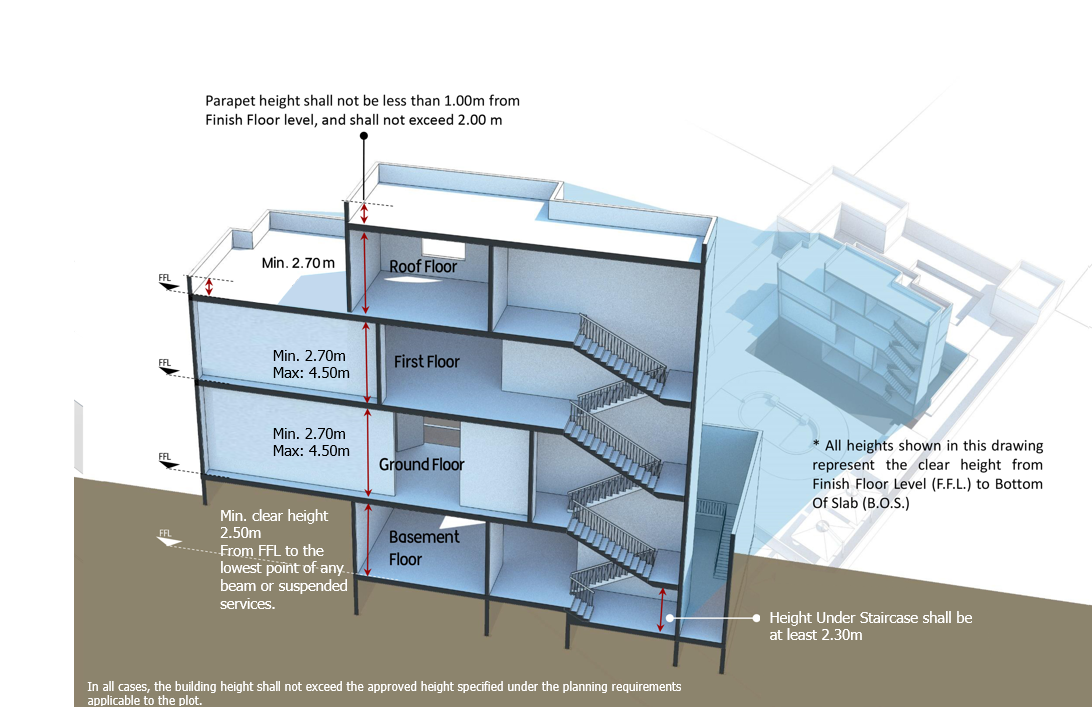
The minimum height of the roof parapet wall in buildings shall not be less than (1.00) m after final finishing and completion of all insulation layers, and shall not exceed (2.00) m. The concerned authority may apply flexibility measures to encourage architectural innovation and creativity in cases involving unique façade designs.
The clear internal height of each floor, measured from the final finished floor level to the underside of the structural ceiling, shall comply with Table No. (2) and Figure No. (6).
|
Figure No. (5): Residential Villa Level Requirements |
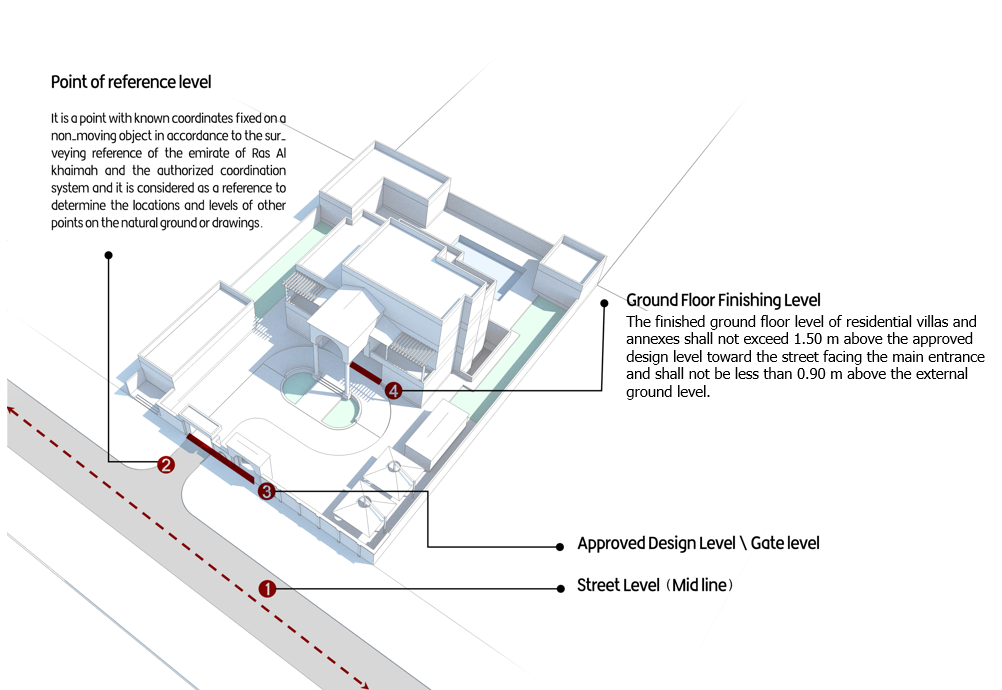
Table 2 : Minimum and Maximum Permissible Clear Internal Heights
No. | Floor Type | Minimum Clear Internal Height | Maximum Clear Internal Height |
1 | Residential Floor | (2.70) m | (4.50) m |
2 | Basement Floor | (2.50) m (clear height below beams and suspended utilities) | (3.50) m |
3 | Roof Floor | (2.70) m | (3.50) m |
4 | Clear Height Below Staircase | (2.30) m | Not Applicable |
In all cases, the building height shall not exceed the approved height specified under the planning requirements applicable to the plot. | |||
|
Figure No. (6): Clear Internal Height Requirements for Residential Villa Floors |
Services Blocks
The construction of service Blocks associated with residential villas shall be permitted as follows:
Majlis and associated facilities.
Kitchen service blocks and associated facilities (storeroom, ironing room, and laundry room).
Maid’s bedroom service blocks and associated facilities.
Guard or driver room service block
Gatehouse or garage service block
Sports service blocks and associated facilities
Service blocks, such as an electrical room where required by the concerned authority, or a swimming pool pump room.
The following conditions shall be complied with:
One additional bedroom may be provided within each of the majlis annex and kitchen annex.
Service blocks shall be used solely for serving the residential villa and shall not be used independently or for any commercial purposes. The roofs of service blocks may be used for the installation of water tanks, air-conditioning units, and similar service equipment. Main staircases leading to the roofs of service blocks adjoining neighbouring plots, or private entrances directly connected to the street, shall not be permitted unless specifically approved.
In the case of applications for the construction of service blocks on a vacant (undeveloped) plot, the following requirements shall apply:
At least one service block shall contain residential components comprising, as a minimum, a living room and two bedrooms.
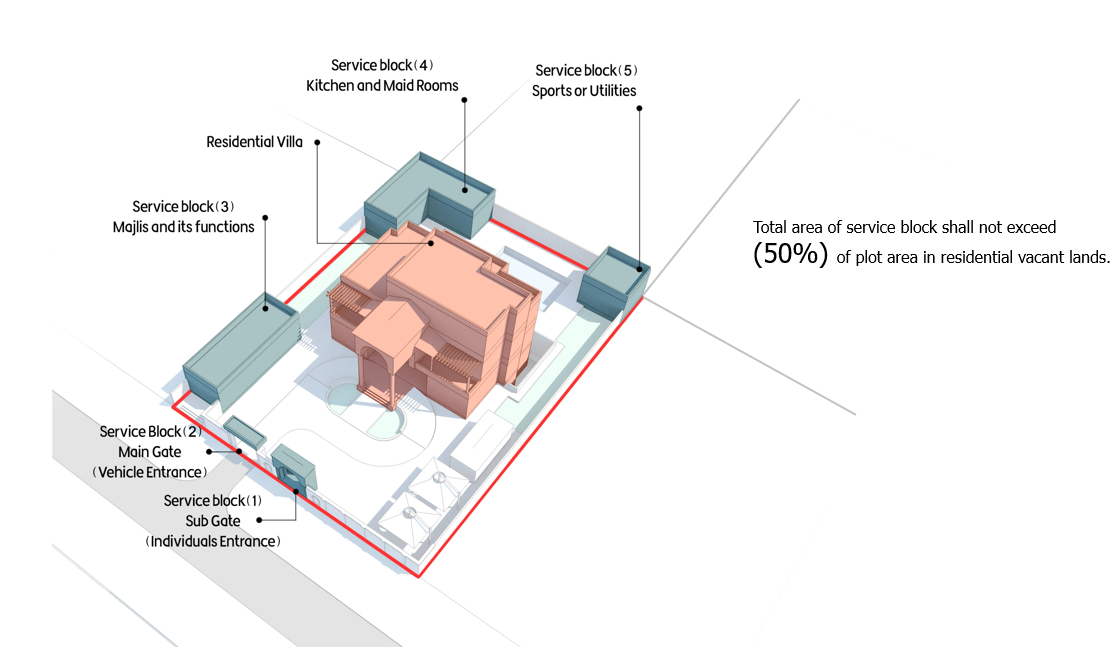
The total area of service blocks shall not exceed (50%) of the total plot area.
The main distribution element for service spaces should be a corridor, liwan, or lobby.
A gate shall be considered a service block where it is provided with a roof having a minimum width of (1.00) meter. Gates consisting solely of decorative columns without a roof covering shall not be considered service blocks.
The frontage occupied by service blocks shall not exceed (50%) of the total length of the boundary wall facing the street. Service blocks may be designed in a linear arrangement adjoining the boundary wall or in an “L-shaped” configuration, provided that such arrangement does not adversely affect vehicle access, egress, or manoeuvrability.
Openings for service rooms (including bathrooms and kitchens) and the installation of air-conditioning units shall not be permitted facing streets or alleyways. Rainwater drainage from service blocks adjoining neighbouring plots shall not be directed toward adjacent properties.
An extension of the first floor above the service blocks may be permitted as an expansion of the residential villa, subject to the following conditions:
Extensions above service blocks attached to the boundary wall may be permitted, provided that the setbacks applicable to the residential villa are complied with in accordance with Clause (6.2) and Table No. (1).
All requirements stipulated under this Article shall apply, and in such cases the service block shall be subject to the same provisions applicable to the residential villa.
Access to such extension/addition shall be provided exclusively through the residential villa.
|
Figure No. (7) illustrates the service blocks attached to the private residential villa. |
Basement Floor
Basement construction is permitted, provided that a minimum setback of (1.50) meters from the plot boundary is maintained on all sides for the residential villa.
The basement floor shall be permitted for approved uses, excluding residential, living, and kitchen functions, unless architectural solutions are provided, including appropriate level differences and the provision of natural lighting and ventilation through open-to-sky courtyards acceptable to the competent authority. An emergency escape and rescue exit shall be provided, and relevant Civil Defence requirements shall apply in relation to kitchen areas.
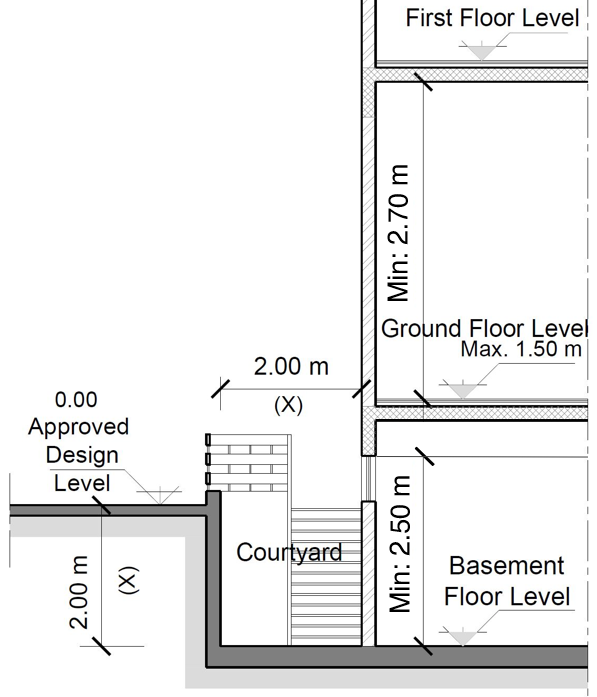
The basement shall be connected via an internal staircase from the villa or service block. In all cases, at least one external courtyard shall be provided for emergency escape and rescue purposes. Where the courtyard height exceeds (1.20) meters, the length of its shortest side shall not be less than the height of the portion below the approved design level of the plot. A secondary emergency exit, independent from the main escape staircase, shall be provided in accordance with Article (40) of this regulation governing stair requirements and specifications.
Necessary measures shall be taken to prevent groundwater seepage through basement walls or floors, and to prevent stormwater from external areas entering the basement.
The basement shall not be used as an independent unit separate from the villa and shall comply with the general basement requirements stipulated under Article (25) of this regulation.
Where the basement or part thereof is used for parking, the requirements of Article (31) shall apply, including parking dimensions, ramp slope, and width requirements for access ramps to the basement level.
|
Figure No. (8) Ventilation and emergency requirements for the basement of residential private villas. |
Roof Floor
The following conditions and specifications shall be observed for the roof floor:
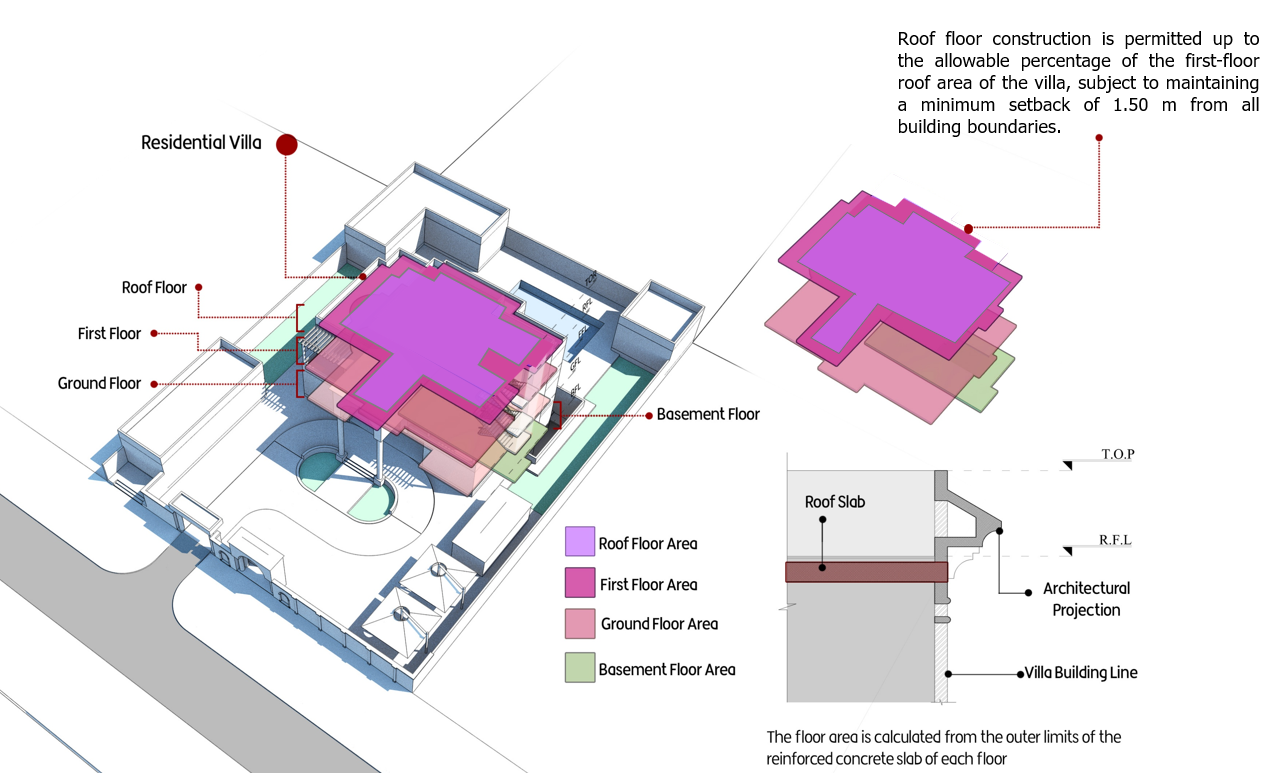
Construction of the roof floor shall be permitted up to the maximum allowable area of the ceiling of the first floor of the villa, provided that a setback of not less than (1.50) meters is achieved from all building boundaries, and that the structural framework is constructed of reinforced concrete or an equivalent approved material.
Residential rooms and living spaces shall be permitted on the roof floor of the villa, in addition to other ancillary services.
A distribution lobby shall be provided in front of the elevator, where it extends to the roof floor, or in front of the staircase, to ensure access to the various spaces at that level. Such lobby shall be securely enclosed to provide adequate protection against rainwater and varying climatic conditions.
Construction of a swimming pool on the roof floor shall be permitted, along with its associated pergolas, provided that the height of the swimming pool shall not exceed (2.40) meters above the roof floor level.
No structures shall be permitted above the ceiling level of the roof floor or above the level of the swimming pool. Exceptions to this restriction shall be limited to the elevator machine room at its minimum required height, water tanks, and central air conditioning equipment.
|
Figure No. (9) — Floor Areas for Private Residential Buildings and Decorative Ornamental Elements |
Ventilation and Natural Lighting
All habitable spaces shall be provided with natural ventilation and daylight openings directly facing open spaces or through an internal or external courtyard. The area of ventilation and lighting openings shall comply with Article (28).
Where internal courtyards are used to provide natural lighting and ventilation, they shall comply with the requirements specified in Article (29).
The width of the external courtyard shall not be less than its depth.
Openings overlooking an external courtyard shall not be counted among the designated ventilation and natural lighting openings for living spaces if the distance between the farthest point of the window and the building boundary exceeds the distance between the two opposing sides of the external courtyard.
Boundary Walls
Construction of boundary walls shall be permitted along the plot boundaries in all directions, including all structural works. Aesthetic projections beyond the street boundary shall be permitted in accordance with Clause No. (6.4)
The boundary wall may be set back within the plot from the street side for the purpose of architectural treatment, aesthetic enhancement, or to accommodate level difference steps for the entrance of the majlis or guard room service block relative to the approved design level. Steps shall not be permitted outside the plot boundaries.
Internal boundary walls within the residential plot are not permitted.
The height of the boundary wall shall be reviewed and approved based on the submitted full perimeter wall design.
No service openings overlooking the exterior shall be permitted for any service block, buildings situated on the boundary wall, or any entrances, with the exception of the majlis entrance and windows, the guard room service block window, and pedestrian and vehicular entrances overlooking the sikka.
An electricity room may be constructed on the front boundary wall and may be connected to the service block at the same height thereof.
Entrances, Gates and Parking Lots
The locations of entrances and gates for plots shall be determined in accordance with the planning requirements issued by the relevant authority, with due consideration of the following conditions:
Vehicular Entrance
The location of the vehicular entrance shall be determined in accordance with the approved planning requirements or the site plan.
Entrance locations shall comply with those specified in the site plan or the issued development system requirements. Where the planning requirements do not specify particular locations for entrances and gates, only one vehicular entrance shall be permitted.
For plots overlooking two roads of different classifications, it is preferable to orient the vehicular entrance from the lower-classified road (local road), so as to ensure traffic flow continuity and minimize interference with the main traffic stream, unless otherwise specified in the site plan or planning requirements.
Vehicular entrances or exits shall not be opened onto plot corner chamfers (beveled plot edges), due to their adverse effect on traffic visibility.
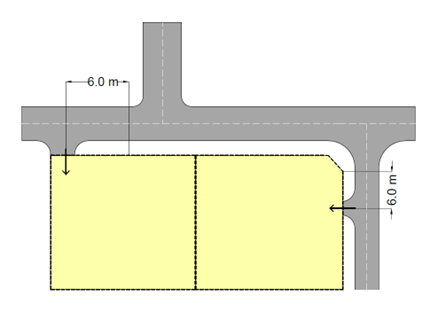
The minimum distance between any vehicular entrance or exit and any local road intersection shall not be less than (6) meters from the edge of the chamfered plot corner, as illustrated in Figure No. (10).
The vehicular entrance shall not face a three-way intersection, and the distance between the entrance and the end of the intersection shall not be less than (6) meters.
The clear width of the vehicular entrance shall not exceed (6.10) meters and shall not be less than (3.00) meters. The minimum clear height of the main gate canopy shall be (4.50) meters. A reduction in the gate canopy height may be permitted, provided that the distance between the stopping point of a fire appliance at the gate and any point within the plot does not exceed (60) meters, in accordance with fire protection and life safety requirements.
Pedestrian Entrance
The width of any pedestrian entrance shall not exceed (2.00) meters and shall not be less than (1.00) meter.
A maximum of two (2) pedestrian entrances only shall be permitted facing the road opposite the main entrance, and only one (1) pedestrian entrance shall be permitted from the side of other roads and sikka.
Parking
A minimum of two (2) car parking spaces shall be provided within the plot.
The prescribed parking requirements shall be applied as stipulated in Article (31) of this Regulation.
|
Figure No. (10) - Location of the Vehicular Entrance Relative to Adjacent Intersections |
Stairs
At least one internal staircase shall be provided, connecting all floors, constructed of any acceptable structural material, provided that the material is fire-resistant for a minimum period of not less than two hours. The consultant shall be required to submit the structural design, specifications, calculations, and data pertaining to the staircase, prepared by a specialized company, to the competent authority.
An external staircase may be permitted for maintenance purposes, provided that it is not located on a facade overlooking a street.
Figure No. (11) Residential villa and basement stairs requirements |

Corridors
The clear width of internal corridors between rooms and residential spaces shall not be less than (1.10) meters.
Areas and Dimensions of Spaces
The floor area and dimensions of any space or room within the villa and its annexes shall not be less than those specified in the following table:
Table 3: Minimum Permissible Areas and Dimensions for Residential Spaces, Services, and Rooms
No. | Space Type | Min Area (m²) | Min Dimension (m) |
1 | Living Room – Dining Room | 12.00 | 3.00 |
2 | Bedroom | 12.00 | 3.00 |
3 | Office | 10.00 | 2.50 |
4 | Kitchen (Open Kitchen) | 7.00 | 2.50 |
5 | Pantry/Preparation Kitchen | 4.00 | 1.80 |
6 | Guard/ Servant Room | 7.00 | 2.20 |
7 | Bathroom / Maid or Guard Bathroom | 3.00 | 1.50 |
8 | Toilet (WC) | 1.80 | 1.10 |
Sanitary Rooms
The villa shall be provided with all necessary sanitary installation fixtures, including bathrooms, toilets, and kitchens.
Projections
An unutilized aesthetic projection within the setbacks of residential villas and annexes shall be permitted to a maximum of (0.30) meters inside the plot boundary, at a height commencing from the window sill level and not less than (1.00) meter.
An unutilized aesthetic projection of (1.00) meter shall be permitted for the roof parapet of residential villas.
An unutilized aesthetic projection for boundary wall ornamental elements shall be permitted facing the street only, to a maximum of (0.30) meters from the plot boundary, provided that the height thereof is not less than (2.50) meters above the approved design level. Ornamental element projections of a maximum of (0.15) meters shall be permitted below this height.
No aesthetic projections or structural works for buildings and boundary walls shall be permitted outside the plot boundary on the side of neighbouring plots and other boundaries.
Building Colours and Façades Symmetry
Architectural façade design guidelines and the surrounding urban context shall be considered in accordance with Article (21), ensuring compatibility with the plot location and overall appearance requirements. Visual coherence between building façades and boundary walls shall be maintained, or as stipulated in the approved architectural façade design guidelines issued by the competent authority.
Design Requirements
The subdivision of a residential villa into apartments or independent units is strictly prohibited. The villa and its annexes shall be designed exclusively for private residential use and shall not be utilized for commercial purposes.
In the case of a proposed extension to the residential villa, the connection shall be through a direct primary internal space across all floors. A single main entrance shall be provided for the villa, and the façade design of the proposed extension shall be fully integrated and consistent with the existing villa façades.
The villa and service blocks may be constructed using modern structural systems, subject to approval by the competent authority. A combination of approved structural systems is permitted to achieve the required design life and structural safety priorities, provided that all systems are fire-resistant in accordance with Civil Defence requirements and applicable regulations.
Article (7): Investment Housing:
Built up Ratio
The prescribed building coverage ratio shall be applied in accordance with the planning requirements approved under the master plan issued by the competent authority.
Setbacks
Setbacks shall be applied in accordance with the planning requirements issued by the relevant authority. In the absence of such specifications, the following setbacks shall apply:
As stipulated in Table No. (4).
The construction of the required utilities annex and the electrical transformer room shall be permitted in accordance with the requirements of the Union Water and Electricity Company.
Reference shall be made to the general requirements set forth in Article No. (22) of this Regulation.
Table 4 : Setbacks for Investment Residential
No | Buildings | Setbacks from Plot Boundary | Setbacks Between Buildings | |||
Street | Neighbouring Plot | Other Boundaries | Villa | Service Blocks/Annex | ||
1 | Residential Villa (Investment Residential) and its services such as service blocks | 2.00 m | 1.50m | 1.50m | 3.00m | Service Blocks may be built adjacent to villas with no setback, or 1.50 m if a setback exists |
2 | Utilities, Service Blocks | None | None | None | 1.50m | 1.50m |
3 | Buildings (Investment Residential) | In accordance with the planning requirements issued by the relevant authority | ||||
The width of firefighting and emergency vehicle access routes shall not be less than 6.00 meters and shall comply with the requirements of the Civil Defence Authority. | ||||||
Levels, Heights and Number of Floors
The final finished floor level of the ground floor shall not exceed (1.20) meters above the approved design level.
The mechanism for addressing level differences, where applicable, shall be applied as stipulated in Paragraph No. (3) of Clause (6-3) of this Regulation.
All prescribed internal clear heights set out in the floor height requirements for private residential villas under Clause No. (6-3) of Article No. (6) of this Regulation shall apply, in accordance with Table No. (2), Figure No. (5), and Figure No. (6).
Investment villas shall be permitted to have a ground floor, first floor, and roof, in addition to a basement, unless the approved planning requirements stipulate otherwise. The number of floors for residential buildings shall likewise be applied in accordance with the planning requirements issued by the relevant authority.
Utilities Blocks
The construction of private recreational service blocks (gymnasium, swimming pool service blocks, and children's game room), in addition to a waste collection room serving the residents of the investment villa complex, shall be permitted, with access from within the plot, provided that the required setbacks are applied as set out in Table No. (4) under Clause (7-2) of Article (7).
A door for the electrical transformer room that is adjacent to the plot boundary on the street side shall be permitted; however, no other openings on the street side shall be allowed.
Basement Floor
For Investment Villas: Construction of a basement shall be permitted within the building footprint designated for the ground floor, subject to compliance with the basement floor requirements stipulated under the private residential provisions.
For Investment Buildings: Construction of a basement floor shall be permitted across the entire plot area, provided that the ceiling level of the basement in areas outside the ground floor footprint does not exceed the approved design level, and that the prescribed clear height is maintained. Construction outside the approved building line shall not be permitted. The requirements set forth in Article No. (31) of this Regulation regarding the dimensions of parking spaces and the gradient and width of the ramp leading to the basement floor shall apply.
The general basement requirements set out in Article No. (25) of this Regulation shall be observed.
Roof Floor
Investment Villas: The requirements prescribed for the roof floor under the private residential provisions of Clause (6-6) shall apply.
Residential Investment Buildings:
Construction of the maximum permissible roof floor area shall be permitted based on the footprint of the uppermost floor, provided that a setback of not less than (1.50) m from all building boundaries is achieved, and that the structural framework is of reinforced concrete or equivalent. All other requirements set out in Article No. (27) of this Regulation shall apply.
Residential rooms and living spaces shall be permitted on the roof floor, in addition to other ancillary services.
At least one staircase shall provide access to the roof, fulfilling the roof access and emergency requirements stipulated in Article (40) pertaining to staircases
Boundary Walls
For Investment Villas:
Boundary walls along plot limits shall comply with the same requirements applicable to private residential villas under Item (8-6) of Article (6). Where a request is made not to construct a boundary wall along the adjoining property line, prior approval from the adjacent property owner shall be obtained. Internal separating walls between villas are permitted, provided that their height does not exceed the height of the main boundary wall.
For Investment Buildings:
Construction of boundary walls along any plot boundary shall not be permitted unless otherwise required under planning regulations issued by the competent authority.
Entrances and Car Parking
The locations of entrances and gates for plots shall be determined in accordance with the planning requirements issued by the relevant authority.
A single entry and exit point for vehicles shall be maintained. The competent authority may, in certain cases, permit a main gate facing the road for each investment villa, subject to the surrounding plot conditions and the approval of the relevant authority, provided that parking space is available for the villa within the plot boundary, and that the maximum longitudinal gradient of the parking area does not exceed (5%).
A dedicated vehicle access lane with a clear width of not less than (3) meters shall be provided where vehicular movement around buildings is required, in addition to a safety clearance of (0.25) meters in height on both sides of the lane.
The requirements prescribed for car parking shall apply as set out in Article (31) of this Regulation.
The required number of car parking spaces shall be determined in accordance with the following table:
Table 5: Minimum Required Car Parking Spaces for Investment Residential
Residential Unit Type | Minimum Number of Parking Spaces |
Studio | 1 parking space per unit |
1-bedroom or 2-bedroom unit | 1 parking space per unit |
3-bedroom or 4-bedroom unit | 2 parking spaces per unit |
5-bedroom unit | 3 parking spaces per unit |
People of Determination Parking | 1 parking space for every 33 required parking spaces. If the total number of parking spaces is less than 33, a minimum of 1 accessible parking space shall be provided. |
Areas and Dimensions of Spaces
All space areas and dimensions applicable to private residential units under Clause (6-12) of Article No. (6) of this Regulation shall apply, in addition to the studio and bedroom areas as set out in the following table:
Table 6: Minimum Area Requirements for Different Spaces
Space Type | Minimum Area (m²) | Minimum Dimension (m) | |
1 | Studio (without services) | 18.00 | 3.50 |
2 | Bedroom | 12.00 | 3.00 |
3 | Entrance hall for residential buildings | Minimum entrance width: 2.40 m | |
Projections
The requirements of Clause (6-14) of Article (6) shall apply to investment villas, and the requirements of Article No. (23) of this Regulation shall apply to investment buildings.
Sanitary Rooms
The minimum sanitary fixtures required to be provided in investment residential units shall be as follows:
Table 7: Minimum Sanitary Fixtures Required for Investment Residential
Unit Type | Sanitary Installations Requirements |
Residential Apartment | Each apartment shall be provided with the necessary sanitary installations, including bathrooms, toilets, and kitchens. At least one bathroom (or a toilet, where more than one bathroom is provided) shall be accessible from outside the living rooms. |
Studio | Each studio unit shall be provided with a bathroom and a kitchenette/preparation kitchen within the building. |
Staircases and Stairs
For Investment Villas:
The requirements set out in Clause (6-10) of Article No. (6) of this Regulation shall apply.
For Investment Residential Buildings:
The requirements set out in Article (40) of this Regulation shall apply.
Corridors
The minimum net width of internal corridors between rooms and residential spaces shall not be less than (1.10) meters.
The minimum width of common corridors shall comply with the requirements applicable to residential-commercial buildings as specified in Table No. (17), Clause (10-12) of Article (01) of this regulation.
Article (8): Labor Accommodation
Location
Labour accommodation complexes are permitted on plots designated for this purpose or on industrial land, in accordance with the approved planning requirements issued under the master plan by the competent authority, and in compliance with the requirements of the Ministry of Human Resources and Emiratisation.
The location of labour accommodation — where designated for single male workers — shall not be adjacent to family residential areas and shall be situated away from girls' schools and female student accommodation.
Built up Ratio
The built-up ratio shall be applied in accordance with the planning requirements issued by the relevant authority.
Where the built-up ratio is not specified in the planning requirements, the maximum permissible area for workers' accommodation on industrial lands shall not exceed (25%) of the plot area.
Setbacks
Setbacks shall be applied in accordance with the planning requirements issued by the relevant authority.
Construction directly on the plot boundary shall not be permitted unless otherwise stipulated in the approved planning requirements.
Where setbacks are not specified in the planning requirements, the setbacks set out in the following table shall apply:
Table 8: Setbacks for Labour Accommodation
Building Type | Minimum Setbacks from Plot Boundaries | ||
Street | Neighbourhood and Adjacent Plots | Industrial & Other Buildings* | |
Labour Accommodation | (6.00) m | (3.00) m | (6.00) m |
The internal setback between buildings within the same site shall not be less than (6.00) meters. The setback between labour accommodation buildings and hazardous materials warehouses shall comply with the requirements of the Civil Defence authority | |||
Levels, Heights and Number of Floors
The finished floor level of the ground floor shall not exceed (1.20) m above the approved design level.
The mechanism for addressing level differences, where applicable, shall be implemented in accordance with Clause (3) of Item (6-3) of this regulation.
The minimum clear floor-to-ceiling height shall not be less than (3.00) m.
The number of floors shall be determined in accordance with the planning requirements issued by the competent authority.
Basement Floor
Labour Accommodation Plots:
The construction of a basement floor is permitted over the entire plot area, provided that the basement roof level for portions extending beyond the ground floor footprint does not exceed the approved design level and the prescribed clear height requirements are maintained. Construction outside the approved building line shall not be permitted. The basement use shall be limited to the services permitted under Article (25) of this regulation. Parking layout, ramp slopes, and ramp widths shall comply with Article (31) of this regulation.
Industrial Plots
A basement is permitted for labour accommodation within the ground floor building footprint only. The basement use shall be limited to the permitted services, and the general basement requirements stipulated under Article (25) of this regulation shall apply.
Roof Floor
The roof floor shall be restricted to service rooms only (elevator room, water tanks, central air conditioning equipment, etc.). The requirements set out in Article No. (27) of this Regulation shall apply.
Boundary Walls
A boundary wall shall be constructed along all plot boundaries for labour accommodation, with a minimum height of (2.20) m and a maximum height of (4.00) m. The walls shall be finished and painted in a manner that does not compromise the visual quality of the urban environment.
A separating wall between industrial activities and labour accommodation is permitted where both uses exist within the same plot (industrial land), provided that the height of the separating wall does not exceed (1.80) m.
Entrances and Parking
Main building entrances and room doors shall be provided within the plot boundary only.
Parking requirements shall comply with Article (31) of this regulation.
The minimum number of parking spaces shall be provided in accordance with the following:
Table 9: Minimum Car Parking Requirements for Workers' Accommodation Buildings
Detail | Minimum number of parking spaces required | |
1 | For every (50) workers accommodated in a single collective labour accommodation facility. | 1 (One Bus) |
2 | Each (5) rooms of supervisors or employees | 1 |
Areas and Dimensions
Space areas and dimensions shall comply with the following table:
Table 10: Room and Space Areas for Workers' Accommodation
Type Of Room / Space | Minimum Area Requirement |
Workers’ Rooms | (3.00) m² per worker, with a maximum occupancy of (8) persons per room. |
Dining Hall | (1.40) to (1.60) m² per worker, serving (30%) of the total workers. |
General Kitchen | (0.50) m² per worker for (30%) of the total workers, with a minimum width of 3.20 m. |
Laundry Room | (0.50) m² per worker for (30%) of the total workers, with a minimum width of 3.20 m. |
First Aid / Isolation Room | 12 m² |
Internal Courtyard |
|
Space areas and dimensions not mentioned above shall apply as set out in Table No. (3).
Dining halls shall be provided as specified in the above table, and their design shall comply with the public health requirements issued by the Public Health Department of the Authority.
Residential rooms with independent services (non-shared) for workers' supervisors may be provided at a rate of one room per (40) workers within the accommodation building.
Projections
Subject to the provisions of Article No. (23) of this Regulation, first floor corridor projections shall be permitted to extend by (1.50) meters into the setbacks between buildings and external setbacks. Enclosure of these corridors at the projection shall not be permitted.
Sanitary Installations
The minimum number of sanitary installations for labour accommodation shall be calculated as follows:
The minimum number of sanitary installations shall be determined based on the occupant load factors specified in Tables No. (A-01) and (A-02).
One or more kitchens shall be provided for food preparation. The design and fit-out of kitchens shall comply with the health requirements stipulated in the public health and occupational safety regulations issued by the Public Health Department of the competent authority.
Corridors
The minimum clear width of common corridors in labour accommodation shall comply with the following table:
Table 11:Minimum Clear Width of Common Corridors for Labour Accommodation Buildings
Use | Clear Corridor Width | |
Labour accommodation | (1.50) m One-way Rooms | (1.80) m Two-way Rooms |
General Requirements
A. Necessary emergency measures shall be adopted in workers' accommodation, and fire prevention, safety, alarm, and firefighting requirements shall be applied in accordance with the approved systems and specifications of the Civil Defence Authority.
Bathrooms or preparation kitchens shall not be permitted within workers’ rooms. Service areas, including kitchens, laundry rooms, bathrooms, and toilets, may be grouped in one or more locations within the labour accommodation building or in a separate building within the plot boundary.
For agricultural uses, a labour accommodation service block may be permitted, with its area determined based on the number of workers approved for the farm. The applicable space areas and dimensions shall comply with Table No. (3) under Article (6) and Item (9-8) of Article (8) of this regulation.
Labour accommodation buildings shall ensure adequate health and environmental conditions, including proper air circulation, freedom from dust and smoke, access to sunlight, and elevated floor levels to prevent flooding.
Structural systems and roof constructions shall be made from materials approved by the competent authority and the Civil Defence authority.
Caravans, prefabricated lightweight structures, or temporary buildings shall not be permitted for labour accommodation use.
A refuse room or open waste collection area for waste containers shall be provided within the plot boundary in accordance with the waste room requirements stipulated in this regulation. Such waste collection area may be located within the front setback facing the street.
Article (9) Staff Accommodation
Location
Staff residential complexes shall be permitted on plots designated for this purpose in accordance with the approved planning requirements set out in the master plan issued by the relevant authority.
Staff accommodation buildings for families may be constructed on plots in accordance with the requirements applicable to each building type, or within real estate development projects, subject to the approval of the relevant authority, provided that they are separate from the project.
Built up Ratio
Built up ratio shall be applied in accordance with the planning requirements issued by the relevant authority for the total buildings on the plot, including staff accommodation.
Setbacks
Setbacks shall be applied in accordance with the planning requirements issued by the relevant authority.
Where setbacks are not specified in the planning requirements, the setbacks from the plot boundary shall apply as set out in the following table:
Table 12: Setbacks for staff accommodation
Building Type | Minimum Setbacks from Plot Boundaries | ||
Street | Neighbourhood and Adjacent Plots | Between Buildings | |
Labour Accommodation | (6.00) m | (3.00) m | (6.00) m |
The internal setback between buildings within the same site shall not be less than (6.00) meters. The setback between labour accommodation buildings and hazardous materials warehouses shall comply with the requirements of the Civil Defence authority | |||
Levels, Heights and Number of Floors
The finished floor level of the ground floor shall not exceed (1.20) metres above the approved design level.
The level difference treatment mechanism — where applicable — shall be applied in accordance with Paragraph (3) of Clause (6-3) of these Regulations.
The clear floor-to-ceiling height of any storey shall not be less than (3.00) metres.
The number of floors shall be determined in accordance with the planning requirements issued by the competent authority.
Basement Floor
A basement floor may be constructed within the building area allocated to the ground floor of the staff accommodation, provided that its use is limited to the approved service functions only. The general basement requirements stipulated under Article (25) of these Regulations shall be complied with.
Roof Floor
The roof floor shall be limited to service rooms only (such as lift room, water tanks, central air-conditioning equipment, etc.), and the requirements stipulated under Article (27) of these Regulations shall apply.
Fences / Boundary Walls
Boundary walls shall be constructed around the staff accommodation plot from all sides. The wall height shall not be less than 2.20 m and shall not exceed 4.00 m. These walls must be painted in a manner that does not distort or negatively affect the general appearance.
Entrances and Parking
Entrances and exits to the buildings shall be located within the plot boundary.
The parking requirements stipulated under Article (31) of these Regulations shall apply.
The minimum required number of parking spaces shall be as follows:
Table 13: Minimum Required Parking Spaces for Staff Accommodation Buildings
Description | Minimum Required Number of Parking Spaces | |
Staff Accommodation / Family Housing | The requirements for determining the number of required parking spaces for investment residential buildings shall apply in accordance with “Table No. 5 | |
Staff Accommodation / Bachelor Housing | One room for every 2 persons: | One parking space for every two rooms |
One room for every 3 persons or one room for every 4 persons: | One parking space for each room | |
Every 50 rooms: | One bus parking space | |
A minimum number of parking spaces equivalent to at least 30% of the total number of employees shall be provided. | ||
Accessible Parking Spaces (People of Determination) | Parking spaces for People of Determination shall be provided in accordance with Table No. (59). | |
Space Areas and Room Dimensions
The number of occupants shall not exceed (4) persons per room. A first aid room and a medical isolation room shall be provided within the facility.
Table 14: Areas of Rooms and Spaces for Staff Accommodation
No. | Room / Space Type | Minimum Area |
1 | Single Room | 10 m² (excluding bathroom or pantry/kitchenette) |
2 | Room for 2 Persons | 12 m² (excluding bathroom or pantry/kitchenette) |
3 | Room for 3 Persons | 15 m² (excluding bathroom or pantry/kitchenette) |
4 | Room for 4 Persons | 18 m² (excluding bathroom or pantry/kitchenette) |
5 | Bathroom | 3.00 m² (minimum width: 1.50 m) |
6 | Pantry / Kitchenette Attached to the Room | 3.00 m² |
7 | Shared Kitchen | 0.50 m² per employee for 30% of the total number of employees, with a minimum width of 3.20 m |
8 | Laundry Room | 0.50 m² per employee for 30% of the total number of employees, with a minimum width of 3.20 m |
9 | First Aid Room / Medical Isolation Room |
|
The areas and dimensions of spaces not mentioned above shall be applied as per Table No. (3).
Where dining halls are provided, they shall be proportionate to the number of staff and shall have a minimum capacity of one-third (1/3) of the total number of staff at any one time, with a minimum area of 1.50 square meters per staff member. The dining hall design shall comply with the public health and occupational safety requirements as stipulated in the relevant legislation issued by the Public Health Department of the Authority.
Projections
Subject to Article No. (23) of this Regulation, projections of first floor corridors are permitted up to 1.50 meters within the setbacks between buildings and external setbacks, provided that the setback shall not be less than 6.00 meters, and the height of such corridors shall not be less than 3.00 meters. The enclosure of these corridors at the projection is not permitted.
Sanitary Rooms
The following shall be observed regarding sanitary fixtures in staff accommodation:
For the residential component: The sanitary fixture requirements for investment residential buildings as stated in Table No. (7) shall apply.
For staff/bachelor accommodation, the following shall be observed:
Each room shall be provided with a dedicated private bathroom.
A kitchenette/Pantry may be provided for each room for food preparation in the absence of communal dining halls, provided that the design and fit-out of the kitchen shall comply with the public health and occupational safety requirements stipulated in the relevant legislation issued by the Public Health Department of the Authority, as well as the requirements of the Civil Defence Department.
Corridors
The clear width of public corridors in staff accommodation shall not be less than the following table:
Table 15: Minimum Clear Width of Public Corridors for Staff Accommodation
Use | Minimum Clear Corridor Width | |
Labor accommodation | 1.50 m One-way rooms | 1.80 m Two-way room |
General Requirements
Provision of communal recreational facilities (gymnasium, television lounge, outdoor courts) shall be ensured in proportion to the number of staff in the building.
Various health factors shall be observed in staff accommodation, including adequate air ventilation, freedom from dust and fumes, access to natural sunlight, and elevated floor levels to prevent flooding.
Caravans, lightweight prefabricated structures, or temporary structures for staff accommodation shall not be permitted.
A refuse room/garbage room or an open enclosure for waste containers shall be provided within the plot boundary in accordance with the refuse room requirements stipulated in this Regulation. Such enclosure may be located within the front setback facing the street.
Necessary emergency procedures shall be observed in staff accommodation, along with full compliance with fire prevention, safety, alarm, and firefighting requirements in accordance with the approved regulations and specifications of the Civil Defence Department.
Article: Residential Commercial buildings
Built up Ratio
The permissible built-up ration shall comply with the planning regulations approved in the master plan issued by the relevant authority.
Setbacks
Setbacks for (residential–commercial) buildings shall comply with the planning regulations issued by the competent authority.
Levels, Heights, and Number of Floors
The finished floor level of the ground floor shall not exceed 1.20 m from the approved design level. External steps or level adjustments outside the building footprint are not permitted.
Level difference handling, if any, shall comply with Clause (3) of Item (3-6) of this regulation.
Net floor heights shall comply with Table No. (2) for residential floors, and with Table No. (18) for ground floor and mezzanine levels (commercial and administrative uses).
Number of floors shall be defined according to the planning regulations issued by the competent authority.
A service floor is permitted between typical floors in buildings exceeding 20 floors above ground level. It shall be dedicated to mechanical, electrical, and plumbing services and shall not exceed 3.50 m in height, with a minimum net height of 2.50 m. It shall not be counted within the permitted floor count, provided the overall approved building height is maintained.
Basement Floor
Construction of a basement floor is permitted over the full plot area, provided that the ceiling level of the basement for portions outside the ground floor footprint does not exceed the approved design level, and the prescribed clear height is maintained. Construction outside the approved building line shall not be permitted. The requirements of Article (31) of this Regulation regarding parking space dimensions, ramp gradients, and ramp widths leading to the basement floor shall apply.
The use of the basement floor shall be limited to uses permitted by the competent authority, and the general basement requirements of Article (25) of this Regulation shall be observed.
Mezzanine Floor
The requirements prescribed for the mezzanine floor as outlined in the commercial building’s requirements under Item (11-5) of Article (11) of this Regulation shall apply.
The Authority may permit the change of administrative use on the mezzanine floor to residential use in accordance with the needs of the area and its sufficiency of administrative (office) activities, subject to a study submitted by the consultant based on serious and substantive grounds and considerations for such change, while fulfilling all required services and conditions resulting from this change.
A variety of activities may be permitted on the mezzanine floor, if entrances and circulation elements for each activity are separated and approval is obtained from the competent authority.
Podium Floor
Podium floor requirements, if applicable, shall comply with Article (26) of this regulation.
Roof Floor
The requirements of Article (27) of this Regulation shall apply. Construction of a maximum roof floor area is permitted based on the roof area of the topmost floor, provided that a minimum setback of 1.50 meters is achieved from all building boundaries, and that the structural framework is of reinforced concrete or equivalent. Residential rooms and living spaces may be constructed on the roof floor in addition to other service facilities.
At least one staircase shall reach the roof, fulfilling the roof access and emergency requirements stipulated in Article (40) pertaining to staircases.
Boundary Walls
Boundary walls shall not be permitted along any plot boundary unless expressly required or approved under the planning regulations issued by the competent authority.
Car Parking
The minimum required number of parking spaces shall be determined in accordance with the following table:
Table 16: Minimum Parking Requirements for (Residential–Commercial) Buildings.
Use | Minimum Parking Requirement | |
Residential Apartments | Parking shall be provided in accordance with the parking requirements for investment residential buildings as specified in Table No. (5). | |
Offices and Retail Units | Parking shall be provided in accordance with the parking requirements for commercial and administrative buildings as specified in Table No. (19). | |
Accessible parking for People of Determination | Accessible parking spaces for People of Determination shall be allocated within the above parking provisions as follows: | |
10 – 200 spaces | 1 space per 50 parking spaces (minimum 1 space) | |
201 – 1000 spaces | 1 space per 100 parking spaces | |
> 1000 spaces | 1 space per 200 parking spaces | |
Electric and hybrid vehicle charging stations shall be provided in accordance with the requirements stipulated in Item (403.03) and Table No. (15) of the Green Building Requirements Regulation for the Emirate of Ras Al Khaimah "Barjeel. | ||
The requirements prescribed for vehicle parking shall be applied as stipulated in Article (31) of this Regulation
Areas and Dimensions of Spaces
All areas and dimensions of spaces designated for residential uses shall be applied in accordance with Item (6.12) pertaining to private residential use, in addition to the requirements for investment residential buildings as prescribed in Item (7.9) and Table No. (6), as well as the requirements for determining the areas of administrative and commercial uses for commercial buildings as prescribed in Item (9.11) and Table No. (20).
The area of a storage room annexed to a shop or commercial showroom shall not exceed 30% of the total commercial area of the shop or showroom.
Projections
Projections shall be applied in accordance with the planning requirements issued by the competent authority, with adherence to the provisions of Article (23) of this Regulation.
The mezzanine floor is permitted to project beyond the ground floor boundary on the street side by the same approved projection amount as the typical floors, for the purposes of urban coordination of the Emirate, up to a maximum height of "Ground + Mezzanine + 4 Floors.
Sanitary Fixtures
For The Residential Component: The sanitary fixture requirements for investment residential buildings as stated in Table No. (7) shall apply.
For The Office and Commercial Component: The sanitary fixture requirements for commercial buildings as stated in Table No. (21) shall apply.
Corridors
The clear width of internal corridors between residential or administrative rooms and spaces shall not be less than 1.10 meters.
The clear width of public corridors shall not be less than what is stated in the following table:
Table 17: Minimum Clear Width Requirements for Public Corridors in Residential–Commercial Buildings
No | Use | Clear Corridor Width | |
1 | Residential and Administrative Buildings | 1.50 m for residential or administrative corridors with doors on one side only | 1.80 m for residential or administrative corridors with doors on both sides |
2 | Corridors In Front of Elevators | Shall be based on the width of the main corridor leading to them and whether elevators are located on one side or both sides. The dimensions of corridors in front of elevators shall not be less than those specified in Figure No. (41), Clause (38-1), Article (38). | |
|
Figure No. (12): Floor Designation Symbols for Different Levels in a Multi-Storey Building. |
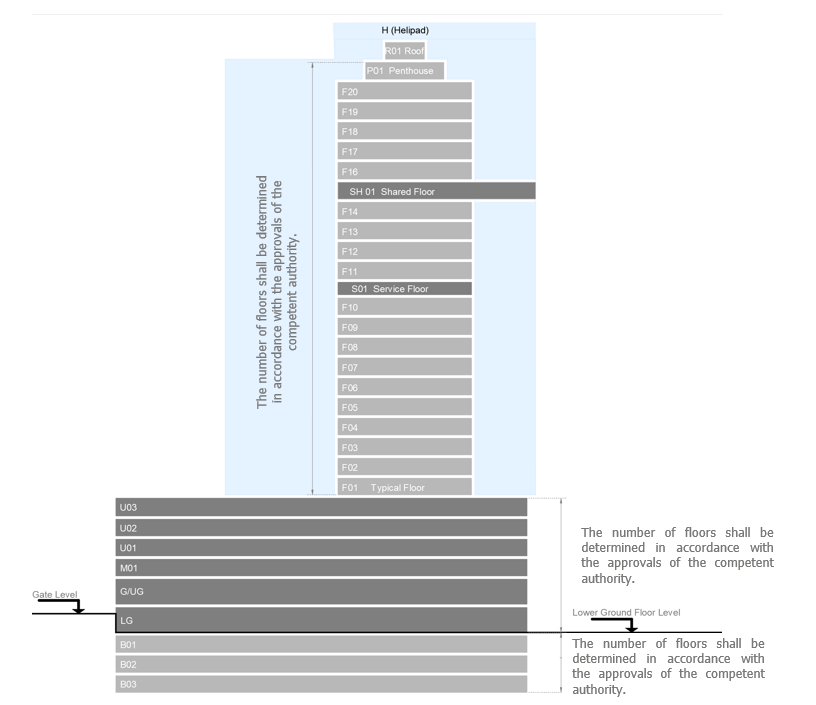
Symbol | Description | Symbol | Description |
H | Helipad | S | Service floor |
R | Roof floor | U | Podium floor |
P | Penthouse floor | M | Mezzanine floor |
SH | Interconnecting floor | G / UG | Ground floor / Upper ground floor |
F | Typical floor | LG | Lower ground floor |
B | Basement floor | ||
Figure No. (12): Description of floor level symbols used in multi-storey buildings | |||
Second: Commercial Buildings Requirements |
Article: Commercial Buildings Requirements
Built up Ratio
The built-up ratio shall be applied in accordance with the planning requirements issued by the competent authority.
Setbacks
Setbacks for commercial and administrative buildings shall be applied in accordance with the planning requirements issued by the competent authority.
Levels, Heights and Number of Floors
The final finished floor level of the ground floor shall not exceed 1.20 meters above the approved design level. No external steps or works shall be permitted outside the building footprint boundaries.
The floor-to-floor heights of commercial and administrative floors shall be applied as per Table No. (18).
The number of floors shall be determined in accordance with the planning requirements issued by the competent authority.
The consultant shall be obligated to submit the necessary engineering solutions to address the difference between the approved design level of the plot and the road level (existing or future), if any and in accordance with the approved level certificate, in a manner consistent with the nature of the site. All treatment works and constructions shall be designed and implemented within the plot boundaries only, or within areas designated by the competent authority for this purpose.
Where a half-mezzanine floor exists (open to the ground floor), the maximum clear height of the ground floor (for the open space) shall be 8 meters plus the thickness of the intermediate slab including finishes, and the minimum clear height of the ground floor shall be 6 meters plus the thickness of the intermediate slab including finishes, as shown in Figure No. (13).
|
Multi story buildings Multi story buildings Multi story buildings |
Figure (13): Internal Clear Height for Single-Storey and Multi-Storey Buildings (Commercial and Administrative Uses) |
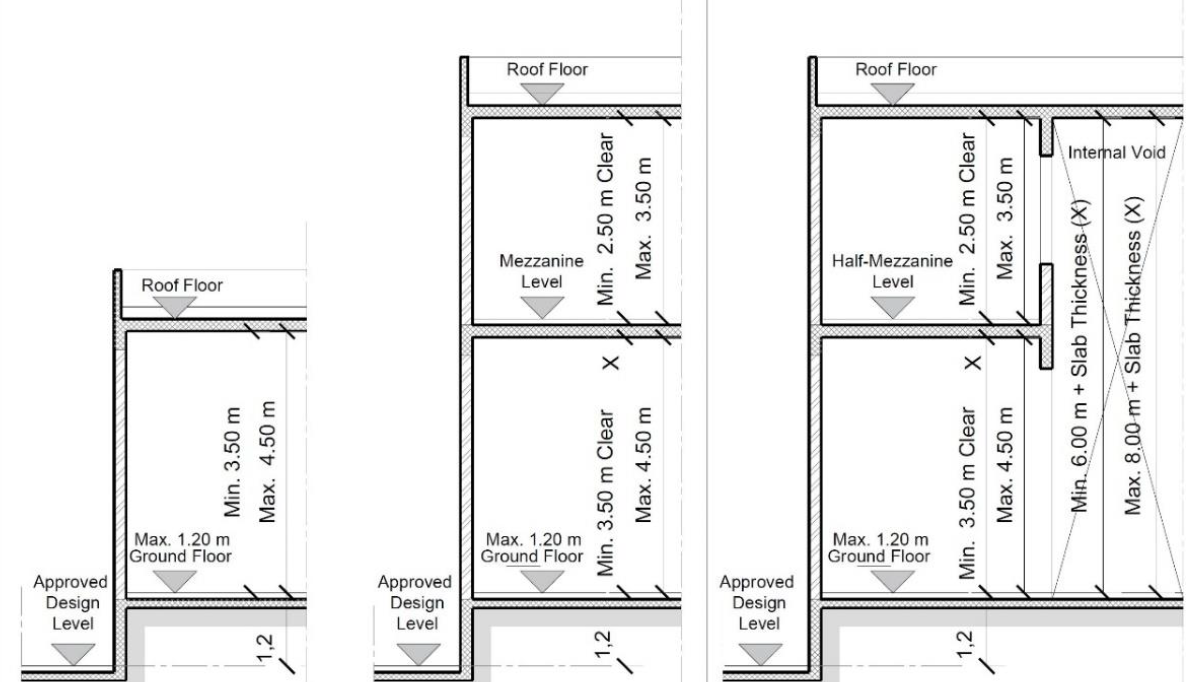
Table 18: Minimum and Maximum Clear Heights for Commercial and Administrative (Office) Uses
S. No | Commercial & Administrative Uses | Minimum Net Height | Maximum Net Height |
1 | Ground floor |
(In the case of adding a half-mezzanine, it shall be 2.50 meters.) |
|
The competent authority may approve higher heights for special considerations | |||
2 | Full mezzanine / partial mezzanine | 2.50 m | 3.50 m |
3 | Basement floor (clear height below beams and suspended services) | 2.50 m | Not applicable |
Basement Floor
The general basement requirements of Article (25) of this Regulation shall be observed.
The maximum ceiling level of the basement shall not exceed 1.20 meters measured from the approved design level towards the street adjacent to the main entrance of the building.
Mezzanine Floor
Construction of a mezzanine floor is permitted up to 100% of the ground floor area on plots where a mezzanine floor is approved in accordance with the planning requirements of the master plan issued by the competent authority.
The mezzanine floor is permitted to be used independently as 100% offices, parking, or for building service purposes. A variety of activities may be permitted on the mezzanine floor, if entrances and circulation elements for each activity are separated and approval is obtained from the competent authority.
The mezzanine floor is permitted to be used entirely for commercial purposes (100%) where the ground floor and mezzanine floor are used together as a shopping centre. In such case, an internal vertical circulation element and an escalator between the two floors, or elevators of adequate capacity, shall be required.
No additional mezzanine shall be permitted within the ground floor where the original mezzanine floor has been separated and used independently.
Terraces, projections, or balconies on the mezzanine floor shall not be permitted.
Roof Floor
The roof floor shall be restricted to service rooms only (elevator machine room, water tanks, central air conditioning equipment, etc.), in accordance with the ratios and conditions stipulated in Article (27) of this Regulation.
Boundary Walls
Boundary walls shall not be permitted on commercial plots.
Car Parking
The minimum required number of parking spaces shall be determined in accordance with the following table:
Table 19: Minimum Required Number of Parking Spaces for Commercial Buildings
# | Use | Criteria | Minimum Parking Requirement |
1 | Offices | 1 space per 70 m² of net office area excluding corridors and service areas | 1 |
2 | Restaurants | 1 space per 50 m² of net area | 1 |
3 | Commercial uses (small shopping centres < 930 m², shops, showrooms, etc.) | 1 space per 70 m² of net area | 1 |
4 | Fully commercial buildings (retail centres > 930 m² or equivalent uses) | 1 space per 70 m² of net area. Ground floor may be fully allocated for parking | 1 |
| |||
Space Areas and Dimensions
The areas and dimensions of commercial and administrative spaces shall not be less than the following table:
Table 20: Minimum Areas and Dimensions of Commercial and Administrative Spaces
Space Type | Minimum Area (m²) | Minimum Dimension (m) | |
1 | Commercial shop | 18.00 | 3.00 |
2 | Exhibition showroom | 80.00 | 8.00 |
3 | Office room (administrative and office use) | 10.00 | 2.50 |
4 | Office space (separate rental unit) | 18.00 | 3.50 |
5 | Open-plan office area (open workspace) | 50.00 | 3.50 |
6 | Toilet (WC) | 1.80 | 1.10 |
The storage area attached to a commercial shop or showroom shall not exceed 30% of the total commercial area of the shop or showroom.
Sanitary Fixtures
The minimum required sanitary fixtures for commercial and administrative buildings shall be provided in accordance with the following table:
Table 21: Minimum Sanitary Fixture Requirements for Commercial Buildings
Buildings | Sanitary Fixtures | ||||
1 | Administrative buildings, shops, and showrooms | Offices | The minimum number of sanitary fixtures for offices shall be calculated based on the occupancy load factors specified in Table No. (A-01) and Table No. (A-02). Sanitary facilities are permitted within the office unit if the minimum net office area is 50 m² or more, subject to the same calculation criteria stated above. | At minimum, a public toilet shall be provided, and its specifications and dimensions shall comply with the requirements for a toilet for People of Determination | |
Shops and showrooms | Net commercial area up to 200 m2 | A dedicated toilet shall be provided for each shop/showroom, or a public toilet shall be provided, provided that its specifications and dimensions comply with the requirements for a toilet for People of Determination. | |||
Net commercial area greater than 200 m². | The minimum number of sanitary fixtures for shops shall be calculated based on the occupancy load factors specified in Table No. (A-01) and Table No. (A-02). | ||||
2. | Shopping centres and public entertainment buildings | The minimum number of sanitary fixtures shall be calculated based on occupancy load factors specified in Table No. (A-01) and Table No. (A-02). | |||
Corridors
Public corridors in commercial buildings shall comply with the following minimum clear widths:
Table 22: Minimum Clear Width of Corridors for Commercial Buildings
Use | Clear Corridor Width | |
Commercial corridors | 2.40 m (shops on one side only) | 3.00 m (Shops on both sides) |
Kiosks may be permitted in commercial corridors, provided that a clear pedestrian passage of 1.50 m is maintained on both sides of each kiosk. Kiosks shall not be continuous for more than 6.00 m, a minimum separation distance of 3.00 m shall be maintained between kiosks, and the kiosk width shall not exceed 1.80 m. | ||
Loading/ Unloading Spaces
The requirements stipulated in Article (43) governing the determination and design of vehicle loading and unloading areas within the plot boundaries shall apply.
General Requirements
Prayer areas for men and women shall be provided in shopping centres and entertainment buildings with an area exceeding 900 square meters, with the minimum required facilities for both genders to be provided in accordance with Article (16).
Service rooms such as a nursing room and baby changing facilities shall be provided in shopping centres.
The required utility services shall be provided as requested by the relevant authorities (electricity room, telephone room, pump room, water tank, and the like).
A services floor is permitted between typical floors in buildings exceeding twenty (20) floors, designated exclusively for mechanical, electrical, and plumbing services and their related components. The height of such floor shall not exceed 3.50 meters and shall not be less than A services floor is permitted between typical floors in buildings exceeding twenty (20) floors, designated exclusively for mechanical, electrical, and plumbing services and their related components. The height of such floor shall not exceed 3.50 meters, with a minimum clear height of 2.50 meters. This floor shall not be counted within the permitted number of floors for the plot, provided that the total approved building height is maintained.
Article (12): Health Requirements for Establishments Engaged in
(Restaurants, Beverage Shops, and Food Retail Activities)
Restaurants, beverage outlets, and food retail establishments (restaurants, cafeterias, cafes, juice shops, fruit and vegetable shops, confectionery shops, refreshment shops, mills, roasteries, refrigerated, frozen and dry food storage facilities, bakeries, grocery stores, supermarkets, seafood shops, and other similar establishments) shall be designed in accordance with the health conditions issued by the competent authority. The consultant shall refer to these conditions when preparing designs.
The floors, walls, and ceilings of restaurants, beverage outlets, and food retail establishments shall be made of smooth, non-absorbent, fire-resistant, light-coloured, non-toxic, and crack-free materials that are easy to clean. Floors shall have appropriate gradients to facilitate water drainage and ease of cleaning. All corners between walls, between walls and floors, and between walls and ceilings shall be sealed and rounded to facilitate cleaning.
Adequate ventilation and lighting shall be provided for all interior areas in accordance with the provisions of this Regulation.
Shelves, electrical appliances, sinks, storage areas, exhaust hoods, service counters, and pest and rodent control measures on doors, windows, and other openings shall be provided and installed in accordance with the health conditions issued by the competent authority.
The ceilings of restaurant kitchens and similar establishments shall be of reinforced concrete or any other equivalent fire-resistant building material, in accordance with the requirements of the Civil Defence Department.
Restaurants, beverage outlets, and food retail establishments shall be equipped with the necessary sanitary plumbing installations in compliance with the health conditions and plumbing works requirements.
Chimneys for bakeries, restaurants, and roasteries shall be positioned on the rear lane side or through the building's light wells only, in order to preserve the general appearance of the building. They shall extend to a minimum height of 4 meters above the building roof and shall be equipped with environmental treatment measures so as not to affect neighbouring properties or detract from the general appearance.
Refrigeration and freezer rooms shall be provided with a thermometer installed in a manner that allows reading from the outside, and their doors shall be equipped to open from both the inside and outside.
Article (13): Occupancy of Roadside Pavements and Public Spaces
(for Cafés, Restaurants, and Similar Uses)
The design and permitting of the use of road pavements and public open spaces by cafés, restaurants, and similar establishments shall comply with the requirements and specifications set out in the approved Executive Regulations of Law No. (3) of 2018 concerning the use of road pavements and public squares.
Article (14): Hotel Facilities Requirements
Location
Hotel establishments of various categories are permitted in areas designated for such uses, in accordance with the approved planning regulations in the master plan issued by the competent authority.
Built up Ratio
The permitted building coverage shall comply with the planning regulations issued by the competent authority.
Setbacks
Setbacks shall comply with the planning regulations issued by the competent authority.
Levels and Heights
The finished floor level of the ground floor shall not exceed 1.20 m from the approved design level.
Level difference handling, if any, shall comply with Clause (3) of Item (3.6) of this regulation.
Residential floor heights shall comply with Table No. (2).
For hotels exceeding 10 floors above ground level, a service floor is permitted. It shall not exceed 3.50 m in height and shall not be less than 2.50 m net height. It shall be dedicated to mechanical services and plumbing connections. The service floor may be repeated every 10 floors subject to approval of the competent authority and shall not be counted within the total number of floors, while maintaining the overall building height.
Parking Requirements
Parking requirements shall comply with Article (31) of this regulation.
The minimum required number of parking spaces shall be determined in accordance with the following table:
Table 23: Minimum Parking Requirements for Hotel Establishments
Use | Details | Minimum Parking Requirement |
Hotel Facilities | Hotel rooms | 1 parking space / 4 rooms |
Hotel suite / serviced apartment (1 bedroom) | 1 parking space / 2 suites | |
Hotel apartments (2 bedrooms and above) | 1 parking space / apartment | |
Hotel rooms (100 rooms) | 1 Bus parking / 100 rooms | |
Offices, shops, and restaurants associated with hotel establishments. | 1 parking space per 50 m² of net area. | |
Banquet halls / function halls or meeting rooms (multi-purpose). | ||
An additional bus parking space shall be provided at a rate of 1 bus per 100 hotel rooms for 4- and 5-star hotels, with minimum dimensions of 4.00 m × 12.00 m. | ||
Two (2) taxi parking spaces shall be provided for tourism establishments and 4- and 5-star hotels. | ||
Shaded parking spaces shall be provided for hotel developments in accordance with the Green Building Regulations (Barjeel). | ||
Accessible parking spaces shall be provided in accordance with Table No. (59). | ||
Electric and hybrid vehicle charging stations shall be provided for 5-star hotels and resorts in accordance with Clause (403.03) and Table No. (15) of the Green Building Regulations of Ras Al Khaimah “Barjeel”. | ||
Space Areas and Dimensions
The minimum areas and dimensions of accommodation rooms in hotel buildings shall comply with the following:
In Hotels, the minimum net room area shall comply with the following table:
Table 24: Minimum Net Hotel Room Areas (Including Bathrooms and Excluding Entrance and Balcony Areas)
Hotel Rating | Room Type | Minimum Room Size (with bathroom) | |
1 | One Star/ Two-star Hotel | Single Room | (13) m2 |
Double Room | (17) m2 | ||
Minimum bathroom area including a shower is (3.50) m2 | |||
2 | Three-star Hotel | Single Room | (16) m2 |
Double Room | (20) m2 | ||
Minimum bathroom area is (3.50) m2 in case of a shower only, or (3.80) m2 in case of a shower + bathtub in the bathroom. | |||
3 | Four-star Hotel | Single Room | (22) m2 |
Double Room | (26) m2 | ||
Suites | (38) m2, not including living room | ||
Minimum bathroom area is (3.50) m2 in case of a shower cubicle only, or (3.80) m2 in case of a shower + bathtub in the bathroom. | |||
4 | Five-star Hotel | Single Room | (30) m2 |
Double Room | (34) m2 | ||
Suites | (48) m2, not including Living Room | ||
Minimum bathroom area is (3.80) m2 in case of a shower cubicle only, or (4.00) m2 in case of a shower + bathtub in the bathroom. | |||
For Resorts (no resort classification below three-star category):
Table 25: Minimum net area requirements for motel rooms, inclusive of bathrooms and exclusive of balconies and entrance areas.
Resort Rating | Room Type | Minimum Room Size (with bathroom) | |
1 | Three-star Resort | Single Room | (20) m2 |
Double Room | (22) m2 | ||
Suites | (32) m2 | ||
Minimum bathroom area including a shower is (3.50) m2 | |||
2 | Four-star Resort | Single Room | (26) m2 |
Double Room | (28) m2 | ||
Suites | (42) m2, not including living room | ||
Minimum bathroom area is (3.50) m2 in case of a shower only, or (3.80) m2 in case of a shower + bathtub in the bathroom. | |||
3 | Five-star Resort | Single Room | (33) m2 |
Double Room | (36) m2 | ||
Suites | (52) m2 | ||
Minimum bathroom area is (3.80) m2 in case of a shower only, or (4.00) m2 in case of a shower + bathtub in the bathroom. | |||
In a Motel, Net Area of rooms must not be less than the following
Table 26.1: Minimum Net Motel Room Areas, Including Bathrooms and Excluding Balconies and Entrances
Room Type | Minimum Room Size (with bathroom) | |
1 | Single Room | (9) m2 |
2 | Double Room | (11) m2 |
3 | Minimum bathroom area including a shower is (3.50) m2 | |
Each room in the motel must have a separate private bathroom.
In Chalets, bedroom areas shall comply with the following minimum requirements:
Table 26.2: Minimum Net Room Areas (Including Bathrooms and Excluding Room Entrance and Balcony Areas)
Room Type | Minimum Room Area (Including Bathroom Only) | |
|---|---|---|
1 | Single room | 13 m² |
2 | Double room | 17 m² |
3 | Bathroom | Minimum area: 3.50 m², including shower compartment (shower). Each chalet room shall have a private, independent bathroom. |
In a Hotel Apartment, Net Area of rooms must not be less than the following:
Table 27: Minimum Net Area for Hotel Apartments
Space Type | Standard Hotel Apartments | Luxury Hotel Apartments | ||
|---|---|---|---|---|
1 | Studio which includes (living area, bed area and open kitchen only) excluding bathroom and entrance hall | (17) m2 | (20) m2 | |
2 | Living Room | (15) m2 | (20) m2 | |
3 | Bedrooms | Main Bedroom | (15) m2 | (16) m2 |
Additional Bedroom | (12) m2 | (12) m2 | ||
4 | Toilet | Minimum bathroom area is (3.50) m2 in case of a shower only, or (4.00) m2 in case of a shower + bathtub in the bathroom. | Minimum bathroom area is (3.80) m2 in case of a shower only, or (5.00) m2 in case of a shower + bathtub in the bathroom | |
5 | Kitchen | (6) m2, while providing suitable space for cooking for the unit's occupants. | ||
Table 27.1: Minimum Number of Rooms/Unit 1
Establishment Type | Minimum Number of Units | |
1 | Hotel (4/5 stars) | Minimum 100 hotel rooms |
2 | Three-star hotel | Minimum 50 hotel rooms |
3 | Economy hotel | Minimum 30 hotel rooms |
4 | Resort (3/4/5 stars) | Minimum 100 hotel rooms |
5 | Lodges and rest houses | Minimum 20 rooms, maximum 30 rooms |
6 | Chalets | Minimum 10 chalets |
7 | Tourist hotel apartments (Standard) | Minimum 20 apartments or studios |
8 | Tourist hotel apartments (Deluxe) | Minimum 30 apartments or studios |
9 | Tourist hotel apartments (Luxury) | Minimum 50 apartments or studios |
Corridors
The clear width of public corridors in hotel establishments shall not be less than 1.80 meters.
Loading and Unloading Areas
The requirements stipulated in Article (43) governing the determination and design of vehicle loading and unloading areas within the plot boundaries shall apply. In all cases, a minimum of one (1) loading and unloading area shall be provided for tourism establishments and hotels.
General Requirements
Preliminary approval from the Ras Al Khaimah Tourism Development Authority shall be obtained as a condition for issuance of a building permit for any hotel establishment, in accordance with the hotel classification system approved by the Authority.
The consultant shall refer to the conditions issued by the Ras Al Khaimah Tourism Development Authority regarding hotel establishment classification criteria prior to commencing the preparation of designs for any hotel establishment.
The elevator requirements stipulated in Article (41) of this Regulation and the people of determination requirements stipulated in Article (33) of this Regulation shall be observed.
Security and Safety Requirements
Security and safety measures shall be provided in accordance with the conditions approved by the competent authority.
Self-illuminated directional signage shall be installed in all corridors, staircases, halls, entrance lobbies, and public areas to guide occupants to emergency staircases and exits in the event of fire. No materials, barriers, or obstructions that impede evacuation movement to the outside shall be placed.
Signage shall be placed behind the door of each guest room indicating the locations of staircases and a schematic layout of the access route to ensure safe evacuation in the event of fire.
Fire extinguishers shall be placed in clearly visible and easily accessible locations with directional signage, and no barriers, materials, or obstructions that impede the use of such equipment shall be permitted.
Fourth: Industrial Buildings Requirements |
Article (15): Requirements for Industrial Buildings (Factories – Warehouses – Workshops)
Location
Industrial establishments shall be permitted only in zones designated for such purposes in accordance with the planning requirements approved in the master plan issued by the competent authority in the Emirate.
Built up Ratio
The total Built up ratio shall be applied in accordance with the planning requirements issued by the competent authority. Where not specified, the building coverage ratio shall not exceed 50% of the plot area.
The construction of the buildings listed below within the plot boundaries is permitted, and the Built-up ratio shall not be less than the following (unless otherwise stated in the issued building regulations):
30% of the plot area where the plot use is warehouses only, in accordance with the planning requirements issued by the competent authority.
18% of the plot area where factories only are to be constructed.
15% of the plot area where workers' accommodation and/or staff accommodation is to be constructed.
10% of the plot area where workshops are to be constructed at contractor sites and transportation sites only.
The construction of the following buildings alongside the industrial building within the plot boundaries is permitted:
Warehouses.
Office building serving the industrial activity — up to 10% of the industrial building area.
Service annexes and utility services.
Showroom for the display of factory products only — up to 10% of the industrial building area, where this ratio is not specified in the planning requirements issued by the competent authority, provided that its entrance is from within the plot with the same applicable setback.
Workers' accommodation and/or staff accommodation — up to 25% of the industrial building area.
In all cases, the total area of all buildings shall not exceed the prescribed Built-up ratio for the plot.
The Built-up ratio, building heights, and office areas for large factories and uses of a special nature shall be applied in accordance with the nature of the use and the planning requirements of the plot.
Setbacks
Setbacks for industrial buildings shall be applied in accordance with the planning requirements issued by the competent authority.
Where not specified, buildings shall be set back from street frontages, neighbouring boundaries, other boundaries, and internal buildings as per the following table:
Table 28: Setbacks for Industrial Buildings from Streets, Adjacent Boundaries, and Between Buildings
Building Type | Setbacks | ||
Street | Neighborhood & Other Borders | Within Plot (Internal Setbacks) | |
Industrial Buildings | (3.00) m | Adjacent plots / other boundaries — Internal setback shall comply with the UAE Fire and Life Safety Code. | |
Internal setbacks for fire and emergency access routes shall comply with Civil Defence requirements for industrial buildings. Construction is not permitted directly on the plot boundary. | |||
Levels and Heights
The finished floor level of the ground floor shall not exceed 1.20 m above the approved design level.
Any level differences, if applicable, shall be addressed in accordance with Clause (3) of Item (3.6) of this regulation.
The minimum net internal height of any warehouse, workshop, factory, and its associated services shall not be less than the values specified in the following table:
Table 29: Minimum Net Internal Height for Industrial Buildings and Their Ancillary Facilities
Use | Minimum Clear Height | |
|---|---|---|
Industrial uses and workshops | 4.50 m | |
Commercial or administrative uses (ancillary) | Ground floor and mezzanine heights shall comply with Table No. (13) under Article (10) of this regulation for commercial and administrative uses | |
Worker’s accommodation (if applicable) | Shall comply with the requirements of workers’ accommodation under Article (8) of this regulation | |
Service annex | 3.00 m (minimum) | 4.50 m where service ducts are provided |
Mezzanine Floor
A mezzanine floor is permitted within warehouses, workshops, or factories within the height of the warehouse, workshop, or factory, provided that its use is ancillary to the ground floor and its entrance is from within the ground floor itself. Separate entrances to the mezzanine shall not be permitted.
Boundary Walls
Boundary walls shall be constructed on all plot boundaries with a minimum height of 2.20 meters and a maximum height of 4.00 meters. Such walls shall be painted in a manner that does not detract from the general appearance, except for plots subject to special regulations. The minimum width of the main entrance gate in the boundary wall shall not be less than 6.10 meters, and the minimum clear height of the main gate canopy (roof), if provided, shall not be less than 4.50 meters. The competent authority may approve special architectural designs for front boundary walls.
Car Parking
The requirements prescribed for vehicle parking as stipulated in Article (31) of this Regulation shall apply.
Parking spaces shall be provided within the plot boundaries at a rate of one parking space per 70 square meters of net office area or the annexed and licensed showroom area, excluding corridors and various service areas.
Space Areas and Dimensions
International standards and specifications applicable to the required industrial activity shall be applied for space areas and dimensions.
A first aid/health isolation room of not less than 12 square meters shall be provided.
Sanitary Fixtures
The minimum number of sanitary fixtures to be provided shall be calculated as follows:
Table 30: Minimum Sanitary Fixture Requirements for Industrial Buildings
Use | Minimum Sanitary Requirements |
Warehouses and workshops | The minimum sanitary fixtures shall be calculated based on the occupancy load factors specified in Table No. (A-01) and Table No. (A-02). Drainage provisions shall be provided at loading areas with proper ventilation. |
Workers’ Accommodation | Sanitary fixture requirements shall comply with Article (8) of this regulation. |
Loading/ Unloading Spaces
The requirements stipulated in Article (43) governing the determination and design of vehicle loading and unloading areas within the plot boundaries shall apply.
General Requirements
Environmental requirements set out in Article (34) of this regulation shall apply to any uses involving storage, handling, or activities that may cause environmental impact. The consultant shall comply with public safety, fire protection, and life safety requirements and obtain approvals from the relevant authorities.
A service annex may be permitted in a linear form. A security guard room is allowed at the main boundary wall for monitoring purposes, and an electrical room may also be located along the main boundary wall.
Natural ventilation and daylight shall be provided at a minimum of 5% of the ground floor area for any warehouse, workshop, or factory. For associated administrative offices, this percentage shall not be less than 10% of the office floor area.
A CCTV surveillance system shall be provided for industrial facilities and warehouses in accordance with the requirements and procedures of the competent authority.
Fifth: Other Buildings Requirements |
Article (16) Masjids (Mosques)
Built up Ratio
The permitted building coverage shall comply with the planning regulations issued by the competent authority.
Setbacks
Setbacks for mosques shall comply with the planning regulations issued by the competent authority.
In case they are not specified, the following table shall apply:
Table 31: Minimum Required Setbacks for Mosques and Their Annexes from Streets, Lanes, and Neighbouring Boundaries
Building | Setbacks from Plot Boundary | Setbacks from Buildings | ||||
Street | Other Boundaries | Adjacent Uses – Neighborhood | Mosque | Blocks & Services | ||
1 | Mosque | 1.50 m In case of alley or open area, no setback required | N/A | 1.50 m from the residential 3.00 m from other buildings | ||
2 | Block Accommodation for Imam, Mu’azzin - Masjid worker | 1.50 m | 1.50 m | 1.50 m | 1.50 m (no windows facing mosque) | 3.00 m from other blocks and services |
3 | Utilities Block (Toilets – Ablution and Mortuary washroom) | Not required (provided no service windows face streets, roads, or adjacent plots) | 3.00 m | 3.00 m | ||
4 | Electrical room | N/A | N/A | N/A | 3.00 m | 3.00 m |
Levels and Heights
The final finished floor level of the ground floor of all buildings shall not exceed 1.20 meters above the approved design level.
The mechanism for addressing level differences, if any, shall be applied as stated in Clause (3) of Item (3.6) of this Regulation.
The minimum internal clear height of the mosque shall be proportionate to the capacity of the prayer hall (excluding false ceilings and in accordance with the area and dimensions of the main prayer hall), with a minimum clear height of 4.50 meters for the prayer hall. The maximum height shall be in accordance with the design and area of the mosque. The minimum clear height for mosque service elements shall be 3.00 meters and the maximum shall be 4.00 meters.
The minimum height of the minaret shall be equal to three times the height of the main prayer hall, as shown in Figure No. (14), and shall be proportionate to the area and height of the mosque building.
Where a mezzanine exists within the mosque interior, its minimum clear height shall not be less than 2.50 meters and shall not exceed 3.50 meters. In such case, the minimum clear height of the ground floor below the mezzanine portion shall not be less than 3.00 meters.
The height of parapet walls (roof edging) in buildings shall not exceed 1.50 meters after final finishing and various insulation layers, except in cases of architectural facade treatment and subject to approval of the competent authority.
The use of any drawings or decorative elements that contradict Islamic Sharia shall be avoided. Abstract geometric patterns are preferred and shall be placed at a level above 1.80 meters to avoid distracting worshippers.
|
Figure (14): Minimum Minaret Height in Proportion to the Height of the Main Prayer Hall |
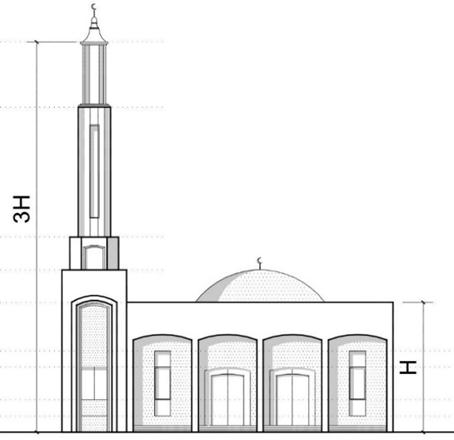
Minarets, Domes and Mihrab
A minimum of one minaret shall be provided for mosques accommodating more than 100 worshippers, with a minimum height of three times the total height of the main prayer hall. Appropriate openings and glazed windows shall be provided to achieve adequate lighting within the minaret, along with a dedicated entrance.
The minaret shall serve as a prominent landmark within the urban area surrounding the mosque. The design of mosque minarets shall be in accordance with the local Islamic architectural character approved by the competent authority.
A main dome shall be provided for mosques accommodating more than 300 worshippers. Multiple domes are permitted provided architectural harmony between them is achieved.
A mihrab room and a dedicated rear entrance for the imam shall be provided in the congregational mosque with a minimum capacity of 400 worshipper.
Mezzanine Floor
A mezzanine is permitted as part of the mosque structure, and the same conditions stipulated in Clause (3) of Item (16.3) of this Article shall apply.
Boundary Walls and Entrances
An external boundary wall surrounding the mosque may be constructed on the plot boundary at an appropriate height not exceeding 1.20 meters above the approved design level. The ratio of solid to open portions shall be 2:1.
A boundary wall surrounding the imam's and muezzin's residence is permitted at a maximum height of 2.50 meters to ensure their privacy. The imam's and muezzin's residences shall be separate from and independent of the mosque and its main entrance. A dedicated external entrance and an entrance facing the mosque shall be permitted for their use.
Pedestrian entrances to the mosque are permitted from all sides facing streets and lanes. A main vehicular gate capable of accommodating emergency vehicles when required for service shall also be permitted.
Car Parking
The minimum required number of parking spaces shall be determined in accordance with the following table (based on the number of worshippers):
Table 32: Minimum Required Number of Parking Spaces for Mosques
Minimum Number of parking Lots | |
Minimum Number of Parking Lots | One parking space per every 20 worshippers, plus parking spaces for the imam and muezzin where residential accommodation is provided for them. + Parking spaces for people of determination shall be designated as per Table No. (51) of Article (33) of this Regulation. + A parking space for the funeral vehicle shall be designated in proximity to the body washing room annex, where this facility is included within the mosque elements. |
Electric and hybrid vehicle charging stations shall be provided in accordance with the requirements stipulated in Item (403.03) and Table No. (15) of the Green Building Requirements Regulation for the Emirate of Ras Al Khaimah "Barjeel". | |
The competent authority may reconsider the required number of parking spaces for mosques where dedicated public parking for the mosque exists, where the plot area designated for the mosque is limited, or in cases of replacement of an existing mosque.
The requirements prescribed for vehicle parking shall be applied as stipulated in Article (31) of this Regulation.
Space Areas and Dimensions
The areas and dimensions of mosque spaces shall not be less than the following:
The area designated for prayer shall include all covered areas comprising the main and secondary prayer halls, entrance, and covered external portico (liwan), and shall exclude uncovered areas or areas outside the mosque space. The number of worshippers shall be calculated based on 1.00 m2 per person.
A storage room annexed to the mosque shall be provided with a minimum area of 6 square meters, subject to approval of the competent authority.
The addition of certain secondary uses is permitted subject to approval of the competent authority, such as: a multipurpose hall representing 20% of the total number of worshippers at 1 square meter per worshipper for congregational and grand mosques; a library with a minimum area of 30 square meters; an imam's office with a minimum area of 9 m² for the grand mosque; Quran memorization circles — in urban areas and areas of high population density — with a minimum classroom area of 15 m² and a minimum classroom width of 3.60 meters; an electrical, mechanical, and plumbing equipment room; a body washing room. The addition of certain commercial activities is also permitted subject to approval of the competent authority.
Mosques accommodating more than 600 worshippers are permitted to include Quran memorization circles (classrooms) with a minimum classroom area of 15.00 square meters and a minimum classroom width of 3.60 meters.
Doors
The number of doors shall be determined based on the mosque capacity in accordance with the following table:
Table 33: Minimum Number of Main Façade Doors for Mosques
Mosque Capacity | Number Of Main Façade Doors | |
1 | Up to 200 worshippers | 2 doors |
2 | 201–700 worshippers | 3 doors |
3 | 701–999 worshippers | 4 doors |
4 | 1000 worshippers and above | 3 doors at the main façade + 2 side doors |
Projections
Subject to the provisions of Article (23), building projections shall comply with the planning regulations issued by the competent authority.
Sanitary Installations
When designing mosques, the following service components shall be provided according to the mosque type, location, and number of worshippers
Table 34: Minimum Mosque Service Requirements Based on Mosque Capacity (Number of Worshippers)
Mosque Capacity | Toilets (Minimum) | Washbasins (Minimum) | Ablution (Minimum) | Accommodation (Minimum) | ||||
1 | Up to 600 | One Toilet / 50 Prayers | 1 hand wash basin / 50 worshippers | One Ablution Unit/ 40 Prayers Min 2 Units | Imam and Worker | |||
2 | 601–1000 | Imam- Muezzin and Worker | ||||||
3 | More than 1000 | Imam- Muezzin and Worker | ||||||
4 |
| |||||||
The minimum sanitary fixtures required for women’s prayer facilities shall comply with the following table.
Table 35: Minimum Number of Services Spaces in Female Prayer Hall
Female Prayer Hall Capacity | Toilets (Minimum) | Wash Basins (Minimum) | Ablution Units (Minimum) |
|---|---|---|---|
15% of total worshipper capacity | 1 toilet per 50 worshippers | 1 hand wash basin per 100 worshippers | 1 ablution unit per 50 worshippers, with a minimum of 2 ablution units |
Toilets should preferably be separated from the mosque building and provided with an independent entrance. They shall not be in the direction of the Qibla, in accordance with Islamic principles, and are preferably located at the south-eastern corner. At least half of the toilets shall be of the squat type (Arabic style). Ablution facilities shall be provided as an essential component of the mosque. In addition, a storage room for cleaning equipment with a minimum size of (1.50 x 2.00) shall be provided adjacent to the toilet facilities.
General Requirements
Approval shall be obtained from the General Authority of Islamic Affairs and Endowments and any other authorities specified by applicable laws, regulations, or the competent authority for the construction, modification, or extension of mosques.
Mosque dimensions shall be designed in accordance with the approved standard specifications and dimensions issued by the competent authority, ensuring compliance with Islamic requirements.
Mosque façade design shall reflect Islamic cultural identity and local architectural character, with colour schemes harmonized with the surrounding environment.
Design and supervision shall be carried out by qualified Muslim professionals experienced in Islamic architecture, and the project manager for both consultant and contractor shall be Muslim.
The main prayer hall is preferably rectangular, with the longer side oriented toward the Qibla. Openings should preferably be avoided on the Qibla wall. Columns within the prayer hall should be minimized to ensure uninterrupted prayer صفوف, and the site layout shall include an open courtyard behind the mosque.
Mosques may include courtyards (open-air sahn) and covered arcades (liwan) at entrances as part of the mosque design. Provision shall be made for cold water dispensers and covered shoe storage areas.
A women’s prayer area shall be included within the main mosque structure, with full separation from the men’s prayer area, each having independent entrances and exits.
Vertical expansion is permitted where land availability is limited, subject to approval of the competent authority.
Requirements for People of Determination and elderly users shall be considered in prayer halls and entrances, including ramps, accessible circulation, and accessible toilets, in accordance with Article (33) of this regulation.
Mosque entrances and circulation routes shall be designed to ensure full separation of male and female movement, with efficient access to ablution facilities without overlap.
External and internal finishing materials shall be appropriate for the dignity of the mosque and resistant to environmental conditions.
Sanitary fixtures for prayer areas in commercial centres exceeding 900 m² shall be provided based on worshipper capacity in accordance with Tables No. (35) and (36).
Directional signage shall be provided for all entrances, circulation routes, and service areas within the mosque.
Shelving for Qurans shall be integrated into internal mosque wall design.
Maximum worshipper capacity, hall size, and geometry shall be considered in HVAC design, lighting uniformity, and acoustic distribution. Lighting and sound systems shall be designed by a specialized consultant.
Elements of accommodation for imam, muezzin, and mosque worker shall be determined by the competent authority. In case not specified, the following table shall app
Table 36: Minimum Housing Elements for Imam, Muezzin, and Worker.
Bedroom | Living Room | Kitchen | Bathroom | |
Imam Housing | 2 | 1 | 1 | 1 |
Muezzin Housing | 1 | 1 | 1 | 1 |
Worker Housing | 1 | N/A | Pantry | 1 |
Article (17) Educational Buildings
Location
Schools, kindergartens, or nurseries shall be located in areas designated for such use in accordance with the approved planning regulations in the master plan issued by the competent authority. The site shall not be used for any non-educational activity.
Built up Ratio
The permitted building coverage shall comply with the planning regulations issued by the competent authority.
Setbacks
Setbacks for educational buildings shall comply with the planning regulations issued by the competent authority.
Levels and Heights
The finished floor level of the ground floor shall not exceed 1.20 m above the approved design level.
Level difference handling, if any, shall comply with Clause (3) of Item (3-6) of this regulation.
The minimum net internal heights for educational buildings shall comply with the following table:
Table 37: Minimum Net Internal Heights for Educational Buildings (Private Schools)
Uses | Minimum Clear Height |
Shools & kindergarten |
|
Roof Floor
The roof floor shall be limited to service rooms only (elevator room, water tanks, central air-conditioning equipment, etc.), in accordance with the ratios and conditions specified in Article (27) of this regulation.
Boundary Walls and Entrances
A boundary wall shall be provided around the entire plot with a minimum height of 2.20 m.
Separate entrances shall be provided for student/student accommodation or staff accommodation in university housing, independent from other entrances.
A minimum of two entrances/exits shall be provided per 500 students or as required by traffic studies.
Parking Requirements
Parking and bus spaces shall be provided within the plot boundaries in accordance with the following table:
Table 38: number of parking lots required for educational buildings (private schools)
Use | Detail | Minimum Parking Lots |
Schools & Educational Buildings | For every class | 1 |
Each (45) m2 of net area of administrative spaces | 1 | |
For every (3) Classes | One Bus (1) | |
Students Accommodation | Per 5 rooms or 46 m² of net floor area (whichever is greater) | 1 |
People of Determination Parking | As per Table No. (51) of Article (33) of this regulation | |
Parking requirements shall comply with Article (31) of this regulation.
No vehicles or buses shall be permitted to enter areas designated for students or children. Entrances, exits, and circulation routes shall be fully separated from student movement paths, and bus access routes shall be independent from car circulation routes.
Clear traffic signage and directional boards shall be provided to regulate the movement of vehicles, buses, and pedestrians, with appropriate pavement markings and speed control measures where required.
Safe pedestrian walkways shall be provided with non-slip surfaces and adequate width, with controlled crossings at road intersections.
Safe and clearly defined pick-up and drop-off zones shall be provided for students, fully separated from traffic flow, ensuring direct access to buildings without crossing vehicle circulation routes.
Access for emergency vehicles (ambulance and civil defence) shall be ensured to all parts of the school without obstruction.
Parking or stopping of vehicles is prohibited in bus lanes or in front of entrances and exits of educational facilities.
Space Areas and Dimensions
The minimum areas of spaces in educational buildings (private schools) shall not be less than the following tables:
Table 39: Minimum Areas and Dimensions of Educational Spaces (Private Schools
Minimum Area in m2 | Space | # |
|---|---|---|
50 m2 | Classroom for 25 Students | 1 |
It can accommodate (50%) of the school’s students, and its area shall not be less than (200) m2. | Multi-purpose Hall(s) | 2 |
(60) m2, One Computer Lab/ (20) Classes. | Computer Lab | 3 |
(50) m2, in addition to a preparation room and a storeroom, a lab for each (10) classes and minimum of (2) Labs. | Science laboratory for basic education level | 4 |
(60) m2, in addition to a preparation room, a store with a capacity of (9) m2. Chemistry laboratory shall be attached to a storage room for storing chemicals with a capacity of (9) m2 and a preparation room. One Lab/ (10) classes, with a minimum of (3) Labs. | Science laboratory (chemistry, physics, biology, geology) for secondary level | 5 |
50 - 70 m2 for elementary and preparatory stages Or a Learning resource center in secondary stage with an area of not less than (100) m2 | Library | 6 |
(50)% of the school’s students, and its area is not less than (200) m2. | Multipurpose hall or multiple halls | 7 |
60 m2, with an average of one activity room for every (10) classes, and no less than two rooms. | Summer Activities Rooms | 8 |
(12) m2, and (4) m2 / employee. Number shall be proportional to the number of teachers and supervisors, their number is estimated at a rate of (1.50) times the number of classes. | Staff or Supervisors Room | 9 |
(30)m2, with a place for ablution attached to it or near one of the toilets. More than one prayer room can be provided in case of multi-gender schools. | Mosque or Prayer Room | 10 |
(50) m2 | Restaurant or Dining Hall | 11 |
(12) m2 | Clinic or Doctor's Room | 12 |
It shall not be less than twice the area allocated for classes, with a minimum of (150) m2 | Courtyards (Yards) and Playgrounds | 13 |
The areas required for each unit of the building shall be proportionate to the increase in student numbers, with a allocation of 1.5 m² per student in primary schools and 2 m² per student in middle, secondary, and kindergarten levels. | ||
Table 40: Minimum Laboratory Space Requirements for Ministry Curriculum (Cycles 2 and 3)
Minimum Area in m2 | Laboratory Type | # |
120 m2 , including a preparation room and a storeroom of 12 m2. | (Biology - Physics - Geology) Labs | 1 |
120 m2, including a preparation room and an equipped storeroom for storing chemicals. | Chemistry Lab | 2 |
86 m2 | General Science Lab | 3 |
60 m2 | Innovation Lab | 4 |
168 m2 | Design and Technology Lab | 5 |
120 m2 | Business Department Lab - Scientific Health and Safety Lab - Creative Media Lab - Projects Lab - Robot Lab | 6 |
60 m2 | Computer Lab | 7 |
200 m2 | Manufacturing Lab | 8 |
Projections
Projections for educational buildings shall be applied in accordance with the planning requirements issued by the competent authority.
Article (23) of this Regulation shall be referred to.
Sanitary Fixtures
The minimum sanitary fixtures to be provided in educational buildings shall be as follows:
Table 41: Minimum Sanitary Rooms That Must Be Provided in Educational Buildings.
Educational Unit | Sanitary Rooms | ||
1 | Schools & Educational Buildings | Students | Restrooms and washbasins shall be provided for students in accordance with the rates stated in Table No. (A-01) and Table No. (A-02), at a rate of one per classroom of 25-30 students, with chilled drinking water units distributed within wings and in shaded areas of courtyards. |
Teachers & Staff | Restrooms and washbasins shall be provided for teachers and staff in accordance with the rates stated in Table No. (A-01) and Table No. (A-02), with a minimum of 2 per gender | ||
2 | Kindergarten | Students | Restrooms and washbasins shall be provided for children in accordance with the rates stated in Table No. (A-01) and Table No. (A-02). Sanitary fixtures shall be of appropriate dimensions for children in accordance with approved standard specifications. |
Teachers & Staff | Restrooms and washbasins shall be provided for teachers and staff in accordance with the rates stated in Table No. (A-01) and Table No. (A-02), with a minimum of 2 per gender. | ||
3 | Nurseries | Students | Restrooms and washbasins shall be provided in accordance with the rates stated in Table No. (A-01) and Table No. (A-02). |
Teachers | Restrooms and washbasins shall be provided for teachers and staff in accordance with the rates stated in Table No. (A-01) and Table No. (A-02), with a minimum of 2 per gender. | ||
4 | Others | People of Determination | A restroom equipped in accordance with the standard requirements of Article (33) of this Regulation shall be provided. |
School Clinic | Toilet shall be provided. | ||
Watchman | Toilet shall be provided. | ||
Drivers | Restrooms shall be provided in drivers' rooms with a minimum of one toilet and one washbasin. | ||
Complete separation between male and female restrooms shall be maintained from kindergarten through all educational levels. | |||
Corridors
The clear width of public corridors in educational buildings shall not be less than the following table:
Table 42: Minimum Clear Width of Public Corridors for Educational Buildings
Use | Corridors Clear Width | |
Educational buildings (Schools, Institutes, Universities) | (2.50) m One-way Classrooms & Activity Rooms | (3.00) m Two-way Classrooms & Activity Rooms |
General Requirements
Preliminary design approval shall be obtained for new educational buildings, modifications to any existing school building, future horizontal or vertical expansions, or phased construction from the competent authority (Ministry of Education, Ministry of Energy and Infrastructure, or the Knowledge Department in Ras Al Khaimah, depending on the type of educational building).
School, kindergarten, and nursery spaces shall be designed in accordance with the requirements of the competent authority and the conditions set out in this Regulation. Where not specified, internationally approved standard specifications shall be referred to.
All security and safety requirements of the Civil Defence Department shall be provided throughout the building.
All parts and elements of the building shall comply with the health conditions stipulated in the public health legislation in force in the Emirate. The use of timber, asbestos, or any building material harmful to public health shall not be permitted.
A separate building or section shall be allocated for each educational level and each gender from Grade Five onwards. Several sections may share the use of educational facilities (laboratories, library, activity halls) without prejudice to the gender separation requirement.
Natural ventilation, lighting, and air conditioning shall be provided in accordance with approved standard specifications for all elements of the school, kindergarten, or nursery — particularly classrooms, laboratories, and halls — with lighting and ventilation openings of not less than 20% of the classroom floor area, 10% of administrative offices, and 5% of kitchens and bathrooms.
The direction of lighting shall be observed so that it comes from the left side of the student and not from the direction facing the front teaching board.
Fall protection barriers and guards (railings or parapets) shall be used on balconies, windows, and open corridors
All laboratories in educational buildings shall be provided with powerful exhaust fans or gas chambers for conducting chemical experiments.
An elevator suitable for people of determination shall be provided for access to upper floors, along with dedicated ramps at a gradient not exceeding 1:12 at pavements, external staircases, level-change areas within the building, and entrances, to allow students to access all parts of the building and its courtyards without assistance
Adequate and appropriate service rooms shall be provided (kitchen, storage, etc.).
General Requirements Specific to Schools:
A separate building or section shall be allocated for each educational level and each gender from Grade Five onwards. Several sections may share educational facilities (laboratories, library, activity halls) without prejudice to the gender separation requirement.
The school shall include a library with an area proportionate to the number of students.
The school shall include school administration rooms (assistant principal, supervising principal, secretariat, administrative staff, specialists, accountants), teachers' rooms with an area proportionate to the number of students estimated at 1.50 teachers per classroom, and a dedicated room for the safekeeping of examination papers (control room).
The school shall include laboratories, computer rooms, and activity halls proportionate to the number of students. Laboratories shall be located as far as possible from classrooms.
The school shall include at least one canteen (cafeteria or restaurant) with the necessary services including storage and an air-conditioned dining area proportionate to the distribution and number of students, complying with the health conditions stipulated in the public health legislation in force in the Emirate.
A playground shall be provided for students in schools and kindergartens with a minimum area of twice the total classroom area, with a minimum of 30% of the playground area shaded using materials approved by the competent authority.
The school shall include the necessary sports courts in accordance with the requirements of the Ministry of Education, as well as a free activities hall (multipurpose activities hall).
The school shall include a health clinic comprising at least a school doctor's room and a nurse's room, each with an annexed examination room and a separate restroom, with areas complying with the health conditions stipulated in the public health legislation in force in the Emirate.
Gas cylinders, if any, shall be located on the ground floor and accessible from outside the building.
General Requirements Specific to Kindergartens:
The kindergarten building shall be independent from other educational levels, and classrooms shall be located on the ground floor only. This may be waived where technical justifications are approved by the competent authority, in which case security and safety requirements shall be observed and all applicable general specifications shall be implemented.
The number of students per classroom shall not exceed 25, with a minimum area of 2 m² per student.
The kindergarten shall include administration, teachers', and supervisors' rooms proportionate to the number of students in accordance with the requirements of the Ministry of Education and the competent authority.
The kindergarten shall include a clinic comprising at least two rooms and a separate restroom, equipped with essential medical equipment and first aid supplies for children, with areas complying with the health conditions stipulated in the public health legislation in force in the Emirate.
An enclosed and air-conditioned indoor play hall with a minimum area of 100 m² shall be provided.
A learning resource room shall be provided at a rate of 1 m² per student, with a minimum area of 100 m².
A playground equivalent to twice the classroom area shall be provided, with a minimum of 50% of the playground area shaded, and a portion designated for planting shrubs and flowers and installing age-appropriate play equipment using materials approved by the competent authority.
A student dining hall shall be provided at a rate of 1.50 m² per student, with dining times for Grade One and Grade Two students scheduled separately.
The kindergarten shall include at least one canteen.
One hall shall be designated for free activities.
Swimming pools shall not be permitted in the kindergarten section unless provided in a separate, secure, and isolated area not connected to classrooms and under the supervision of qualified personnel
General Requirements Specific to Nurseries:
The nursery shall be located on the ground floor and shall include open spaces that can be used for children's physical activity. This may be waived where technical justifications are approved by the competent authority, in which case security and safety requirements shall be observed.
A clinic comprising at least two rooms and a separate restroom shall be provided, equipped with essential medical equipment and first aid supplies for children, with areas complying with the health conditions stipulated in the public health legislation in force in the Emirate.
The distance between any two beds in nursery rooms shall not be less than 1.00 meter.
A spacious shaded courtyard covered with sand and planted areas, proportionate to the number of children, shall be provided.
Article (18): Healthcare Buildings
Location
Hospitals and clinics are permitted in zones where such uses are approved in accordance with the planning requirements of the master plan issued by the competent authority.
Pharmacies, fitness centres, massage centres, and slimming centres shall be located in zones where commercial uses are permitted.
Built up Ratio
Built up ratio shall be applied according to the planning requirements issued by the Department Concerned.
Setbacks
Setbacks for healthcare buildings shall be applied in accordance with the planning requirements issued by the competent authority.
Levels and Heights
The final finished floor level of the ground floor shall not exceed 1.20 meters above the approved design level.
The mechanism for addressing level differences, if any, shall be applied as stated in Clause (3) of Item (3-6) of this Regulation.
For hospitals exceeding ten (10) floors above the ground floor, a services floor is permitted for mechanical, electrical, plumbing, and related services, with a maximum clear height of 3.50 meters and a minimum clear height of 2.50 meters. This floor may be repeated every ten (10) floors subject to approval of the competent authority and shall not be counted within the permitted number of floors, provided that the total approved building height is maintained.
The minimum and maximum heights of healthcare buildings shall be in accordance with the following table:
Table 43: Minimum Clear Heights for Healthcare Buildings
Use | Minimum Clear Height |
Hospitals | In accordance with their specific studies |
Pharmacies | 3.50 m |
Fitness, Massages & Slimming Centers |
Basement Floor;
Construction of a basement floor for hospitals is permitted over the full plot area, provided that the ceiling level of the basement for portions outside the ground floor footprint does not exceed the approved design level and the prescribed clear height is maintained. Construction outside the approved building line shall not be permitted. The basement shall be designated for medical and service purposes of the hospital such as storage areas, kitchens, radiology rooms, records rooms, and the like, in accordance with the nature of the design. Any remaining area may be used for parking, with the requirements of Article (31) of this Regulation applied regarding parking space dimensions, ramp gradients, and ramp widths leading to the basement floor.
Roof Floor
The roof floor shall be restricted to service rooms only (elevator machine room, water tanks, central air conditioning equipment, etc.), in accordance with the ratios and conditions stipulated in Article (27) of this Regulation.
Boundary Walls
Boundary walls for hospitals, health centres, and clinics shall be constructed on all plot boundaries at a minimum height of 1.60 meters.
Parking Requirements
The requirements prescribed for vehicle parking as stipulated in Article (31) of this Regulation shall apply.
The minimum required number of parking spaces shall be determined in accordance with the following table:
Table 44: Minimum Required Number of Parking Spaces for Healthcare Buildings
Use | Detail | Min. Parking Lots |
Hospitals | For each designated bed for patients | 1 |
Where outpatient clinics are annexed to the hospital, one additional parking space shall be added per every 70 square meters of the total net clinic area | 1 | |
Fitness, Massage, and Slimming Centres, and Pharmacies | The parking requirements applicable to commercial and administrative buildings shall apply | |
People of Determination Parking | People of Determination parking is determined as stated in table No. (51) in article (32) of this regulation. | |
Space Areas and Dimensions
Table 45: Minimum Permitted Areas and Dimensions for Spaces, Services, and Residential Rooms
# | Use | Space Type | Minimum Area (m²) | Minimum Dimension (m) | |
1 | Hospitals | Reception, patient waiting area, and main entrance lobby | 120 | As per design | |
Commercial activity area | Not exceeding 5% of the ground floor building area. May be utilized as a pharmacy, flower shop, gift shop, cafeteria, optical shop, and other commercial activities required for hospitals | As per design | |||
2 | Outpatient Clinics | Examination Room (consultation and examination) | 12.00 | 3.00 | |
Examination Room (consultation only) — one examination room to be provided per every 2 consultation rooms | 9.00 | 3.00 | |||
Minor Treatment Room (dressing changes and similar) | 11.15 | 3.00 | |||
Treatment Room (injections, nebulizers, and similar) | 7.50 | 2.50 | |||
3 | Private Clinics | Clinic Area — minimum of two rooms and a waiting hall | As per clinic area | ||
Room Area | 12.00 | 3.00 | |||
A separate treatment room and separate waiting halls for male and female patients shall be designated | |||||
4 | Pharmacies | Pharmacy area | 28.00 | As per design | |
5 | Fitness, massage, and slimming centers |
| |||
Projections
Projections for healthcare buildings shall be applied in accordance with the planning requirements issued by the competent authority.
The general requirements of Article (23) of this Regulation shall be referred to.
Sanitary Fixtures
The minimum sanitary fixtures to be provided in healthcare buildings shall be as follows:
Table 46: Minimum Required Sanitary Fixtures for Healthcare Buildings
Healthcare Unit | Sanitary Room | |
1 | Hospitals | Sanitary fixtures shall be provided in accordance with dedicated studies and international standards and specifications, or the requirements of the regulations and guidelines of the Ministry of Health and Community Protection where applicable, and based on the occupancy load factors stated in Table No. (A-01) and Table No. (A-02). |
2 | Private Clinics | The above requirements shall apply, and the clinic shall include a minimum of one restroom. |
3 | Fitness, Massages and Slimming Centers | Restrooms and shower facilities shall be provided for both genders in numbers proportionate to the area of the centre, in accordance with the occupancy load factors stated in Table No. (A-01) and Table No. (A-02). |
Corridors
The clear width of public corridors in healthcare buildings shall not be less than the usage requirements, with a minimum of 2.40 meters. Competent authorities may reduce the clear width of public corridors to 1.80 meters in outpatient clinics.
Loading/ Unloading Spaces
The requirements stipulated in Article (43) governing the determination and design of vehicle loading and unloading areas within the plot boundaries shall apply.
General Requirements
Hospitals
Approval from the Health and Medical Services Department shall be obtained as a prerequisite for issuance of a building permit.
The hospital shall be designed and constructed in accordance with internationally approved standard benchmarks for hospitals.
A study of space areas and their interrelationships, corridor and door widths, required electrical, plumbing, and mechanical installations, and materials used shall be conducted in a manner consistent with the types, specifications, and dimensions of the medical devices and equipment used. The hospital shall be provided with a standby power generator.
Interior furnishing plans shall be prepared indicating the types and dimensions of devices and equipment used in the various departments.
Natural ventilation and lighting shall be provided for patient rooms, waiting rooms, offices, and halls, and mechanical ventilation shall be provided in accordance with approved standard specifications for other areas where natural ventilation is not available.
The lighting intensity (natural or artificial) in all parts of the hospital shall comply with internationally approved standard specifications.
Patient rooms shall be located as far as possible from streets and parking areas, and walls shall be sound-insulated to prevent sound transmission between rooms.
Refuse rooms and means for handling and disposing of medical waste shall be provided in accordance with applicable specifications, with the necessary procedures taken and approvals obtained from the competent authority.
The consultant shall submit a comprehensive study on general elevators and patient elevators as per Article (41) of this Regulation.
Clinics and Pharmacies
Approval from the Health and Medical Services Department shall be obtained as a condition for issuance of a building or fit-out permit.
Floors shall be of smooth, easy-to-clean materials.
Fitness, Massage, and Slimming Centres
Approvals from the relevant competent authorities shall be obtained.
The building shall meet appropriate health conditions in terms of natural lighting and ventilation.
The steam generation system for steam rooms shall be completely separated from the bathroom.
Sports equipment or fixtures that cause stress on walls and ceilings shall not be installed. Only lightweight equipment is permitted, provided it is installed in a safe manner.
Sports halls that generate noise or vibrations (karate, weightlifting, and similar activities) shall be located on the ground floor or mezzanine floor of the building, and their floors and walls shall be fitted with sound-insulating materials.
Article (19) Wedding Halls
Location
The site shall be located in zones where such use is permitted in accordance with the planning requirements approved in the master plan issued by the competent authority.
Built up Ratio
The building coverage ratio shall be applied in accordance with the planning requirements issued by the competent authority.
Setbacks
Building setbacks from surrounding streets, neighbouring boundaries, and other boundaries shall not be less than the distances permitted under the building regulations of the zone, with a minimum of 3 meters.
Boundary Walls
Boundary walls shall be constructed on all plot boundaries at a minimum height of 1.60 meters.
The mechanism for addressing level differences, if any, shall be applied as stated in Clause (3) of Item (3-6) of this Regulation.
Parking Requirement
One parking space shall be provided per every 20 square meters of hall or room area, plus parking spaces for people of determination as stated in Table No. (59) of Article (33) of this Regulation, within the plot boundaries.
Parking shall be secured within an open area or an adjacent plot adjoining the building for parking purposes where parking cannot be provided within the project plot boundaries, provided that the adjacent plot is merged with the project plot. Subsequent de-merging shall not be permitted except in cases where the use is changed to another activity that does not require this condition.
The requirements prescribed for vehicle parking as stipulated in Article (31) of this Regulation shall apply.
The traffic studies stipulated in Article (59) of this Regulation shall be submitted.
Sanitary Fixtures
The minimum number of sanitary fixtures shall be calculated based on the occupancy load factors stated in Table No. (A-01) and Table No. (A-02).
Article (20) Petrol and Fuel Stations
Location
Petrol stations are permitted in zones designated for such purposes in accordance with the planning requirements approved in the master plan issued by the competent authority.
Plots designated for petrol stations shall not be used for any other purposes, except for certain ancillary uses designated for vehicle services, beverage and fast food retail outlets, and similar activities.
Built up Ratio
Built up ratio shall be applied according to the planning requirements issued by the Department Concerned.
Setbacks
Setbacks for petrol station structures shall be applied in accordance with the planning requirements issued by the competent authority.
Where setbacks are not specified in the planning requirements, the minimum setback of such structures from the plot boundary shall be 3.00 meters on the neighbouring and other boundary sides.
All petrol station buildings shall be located at a minimum distance of 20 meters from fuel tank openings, ventilation pipes, and pumps.
Levels and Heights
The final finished floor level of the ground floor shall not exceed 1.20 meters above the approved design level.
The mechanism for addressing level differences, if any, shall be applied as stated in Clause (3) of Item (3-6) of this Regulation.
The heights for retail shops, service annexes, and offices shall be applied as per Table No. (18).
Other heights shall be subject to a dedicated study submitted to the competent authority.
Boundary Walls
Boundary walls shall be constructed on the plot boundaries on the neighbouring and other boundary sides at a minimum height of 1.60 meters.
Entrances and Parking
A service road separate from the main road shall be provided where main roads have speeds exceeding 60 km/h, to enhance traffic safety and improve traffic flow. The competent authority may, based on technical considerations and in accordance with the approved master plan, approve the provision of deceleration and acceleration lanes instead of a service road, in accordance with approved requirements and standards proportionate to the road speed and classification.
The entrance and exit on the same road are permitted on one side for stations located on a straight road, provided that the distance between them is not less than 20.0 meters. For stations located at intersections, the entrance and exit shall be distributed on two separate roads, with the distance between the entrance and the intersection corner not less than 25.0 meters, and the distance between the intersection corner and the exit not less than 15.0 meters, so as to meet traffic safety requirements, maintain clear visibility, and prevent negative impact on traffic flow at intersections.
The width of the entrance and exit shall not be less than 6.0 meters, to provide sufficient space for the safe passage of various vehicle sizes.
Station entrances and exits shall be designed at a 45-degree angle to the road alignment, to ensure smooth entry and exit flow and minimize interference with main traffic.
Turning curves within the station shall be designed with a minimum radius of 10.0 meters to ensure easy access to pumps. The consultant shall submit a vehicle maneuvering analysis where design requirements necessitate the use of radii smaller than this.
The requirements prescribed for vehicle parking as stipulated in Article (31) of this Regulation shall apply.
The clear widths of vehicle traffic lanes within petrol stations shall be maintained, such that the lane width between two pump islands shall not be less than 5.5 meters where one pump is present, and not less than 8 meters where two pumps face each other, to provide sufficient maneuvering space in accordance with the dimensions shown in the figure below.
Parking spaces shall be provided at a rate of one space per every 70 square meters of net retail area (mini-market) and services requiring parking, ensuring that such spaces do not obstruct vehicle movement within the station.
|
|
Figure (15) Design of station entrances and exits. | Figure (16) Display of the path between the two pump islands. |
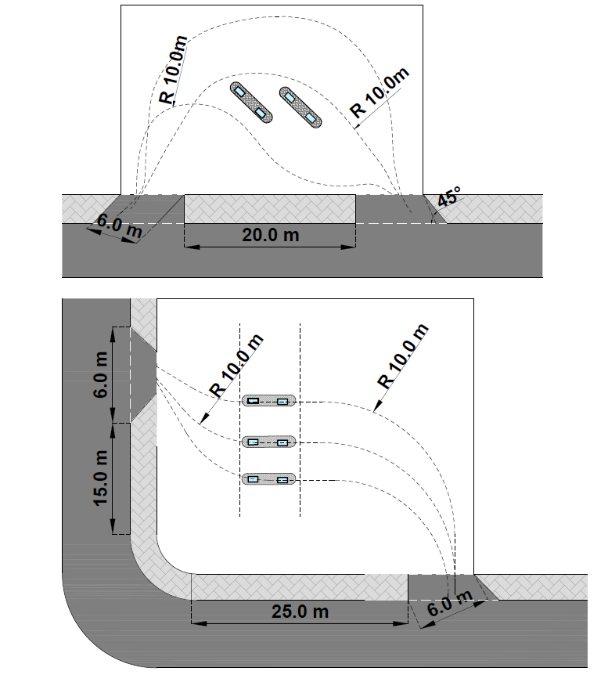
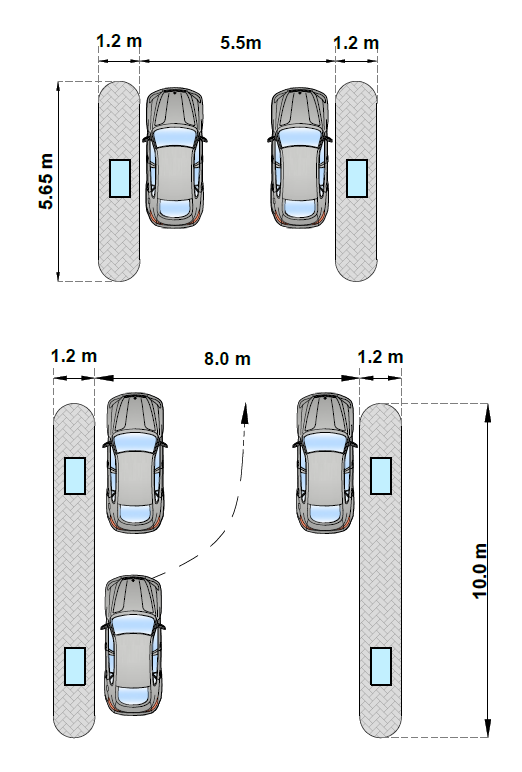
Space Areas and Dimensions
The areas and dimensions of spaces shall not be less than the following:
The area designated for vehicle services, beverage and fast-food retail outlets, and similar activities shall not be less than 150 square meters.
A maximum of three (3) rooms for workers' accommodation is permitted in all stations located outside city boundaries, with the residential space areas and dimensions as per Table No. (3) to be observed. Workers' accommodation rooms shall not be permitted in any stations located within city boundaries.
Sanitary Fixtures
The minimum sanitary fixtures to be provided shall be in accordance with the following table:
Table 47: Minimum Required Sanitary Fixtures for Petrol and Fuel Stations
Services | Minimum Sanitary Room |
Station Staff and Employees | Number of toilets must be proportional to the number of workers, with a toilet and washbasin for every (20) workers and employees. |
General Public and Visitors (Customers) | Separate restrooms for women and men shall be provided, independent from those designated for station employees, comprising a minimum of one toilet and one washbasin for males and one toilet and one washbasin for females, located in an appropriate position. |
Mosque | The sanitary fixture requirements for mosques as stated in Item (16-11) of Article (16) of this Regulation shall be referred to, with a minimum of one restroom, ablution area, and washbasin attached to the mosque. |
Restaurant | A minimum of one restroom and one additional washbasin. |
General Requirements
The consultant shall liaise with the Environment and Development Protection Authority and the Sewerage Authority in the Emirate to obtain preliminary approval prior to finalizing designs and plans.
The security and safety conditions approved by the Civil Defence Department shall be provided. Doors and windows shall be of fire-resistant materials in accordance with the requirements of the Civil Defence Department, and shall open in the direction away from the station and away from sources of hazard.
Vehicle service and car wash stations shall be equipped with appropriate means and equipment for water drainage and purification, such as sand settling chambers, oil traps, and pumps, to ensure water purification before connection to septic tanks or the public network.
Sixth: General Requirements |
Six Article (21): General Design Guidelines for Architectural Façade Elements
To enhance the general appearance and urban aesthetics of the Emirate, a coloured facade plan shall be submitted showing all general details of the design and architectural facade elements for all building types in the Emirate for approval, except for private residential buildings, whether for new buildings or renovation and refurbishment of existing buildings, in accordance with the following design guidelines:
Main Elements Affecting Building Facade Design
Colours
External Cladding (External Finishing Materials)
Openings and Glazing
Shading Elements and Fixtures
Lighting
Entrances
Commercial Shop Signage
Electromechanical Elements and Fixtures
The consultant shall prepare designs that enrich the general appearance of the Emirate guided by these design guidelines, without prejudice to the internationally agreed principles and approaches for architectural facade design.
Colours
To ensure the selection of appropriate colours in proposed designs, the following general guidelines shall be observed:
Use of light and neutral colours.
Use of dark colours in a limited range and for certain architectural elements, not exceeding 10% of the total facade area.
Minimizing the number of colours used on facades, avoiding sharp contrast and a cluttered appearance between the dominant colour and other colours.
Harmony with the surrounding context.
The dominant colour shall constitute not less than 70% of the building's appearance, while secondary colours shall not exceed 30%.
Selection of colours that prevent glare and light reflection, avoiding vivid colours (red, blue, green, and similar).
External Cladding (External Finishing Materials)
Materials used on facades shall be carefully selected with adherence to the following:
Use of materials that help harmonize the building with the surrounding local context.
Recommended use of natural or equivalent artificial stone, paint, Glass Reinforced Concrete (GRC), Glass Reinforced Plastic (GRP), or similar materials.
Polished ceramic is not recommended for use on facades.
The use of aluminium composite panels for external cladding shall be limited.
Tiles shall be fixed using mechanical fixings. Adhesive fixing on upper floors is prohibited, and details of fixing methods shall be submitted to the competent authority upon request.
Compliance with fire-fighting requirements for building facades, building safety requirements, and weatherproofing.
Openings and Glazing
Openings of all types are among the most important elements in defining the architectural character of a building. The following shall be observed:
Use of uniform dimensions for windows and openings, with the number of window types based on area and dimensions not exceeding three (3) types across all building facades to maintain a consistent pattern.
Frameless glass curtain wall systems without visible external frames are preferred.
Selection of glass types with specifications approved by the competent authority.
Glass shall not be defaced with advertising stickers that detract from the general appearance of the city.
The maximum glazing area shall be 40% of the facade area in residential buildings.
The maximum glazing area shall be 50% of the facade area in administrative (office) buildings.
Samples of the proposed glass, including frame finishes and technical glass data (U-value, shading coefficient, and light transmittance), shall be submitted to the competent authority for approval from both aesthetic and technical perspectives.
Shading Elements and Fixtures
These elements are used on facades exposed to direct sunlight (west and south-facing facades) and may be used as elements that enhance the aesthetic appearance and architectural character of the building:
Simple shading elements and architectural treatments are preferred.
Recesses and projections from the building are preferred to create desirable self-shading.
The design of arcades and colonnades on the ground floor of commercial shops is encouraged where the design requires it.
Sun canopies are permitted on the ground floor, not exceeding the approved street projection, provided that the minimum clear height below the canopy is not less than 2.50 meters and the projection does not exceed 1.50 meters and does not encroach on the road right-of-way.
Lighting
Good lighting design enhances the external architectural appearance of the building by drawing attention to distinctive architectural elements and enhancing the building's aesthetic. The proposed design shall consider the following:
Linear (strip) lighting is considered the best type of lighting to be used.
Concealed recessed (non-visible) or warm-coloured directional lighting fixtures are permitted.
Lighting shall not cause visual disturbance or glare.
Lighting design shall focus on architectural elements such as walls, columns, functional elements, canopies, shading fixtures, vertical and horizontal surface edges, balconies, and building entrances.
Concealed warm white lighting within a colour temperature range of 2,700 Kelvin to 3,000 Kelvin is recommended.
The external lighting requirements approved by the Authority shall be followed.
Entrances
The design of entrances shall create a positive impression for building users while ensuring ease of identification and recognition. The following shall also be taken into account:
The main entrance shall be designed to be recessed from the facade level, or with an architectural treatment to distinguish it.
A distinctive canopy over the main entrance is permitted, with a minimum clear height below the canopy of not less than 2.50 meters, and a projection towards the street not exceeding 1.50 meters.
Commercial Shop Signage
Signage is an integral part of any building facade and contributes to enhancing the required architectural character of the building. The following design principles shall be observed:
Signage shall not exceed the boundaries of the shop facade and shall be integrated with the architectural facade design.
The finishing materials and colours of facades shall be maintained so that signage does not distort, conceal, or negatively affect the building's characteristics, visual identity, or various elements.
Signage shall be self-illuminated or incorporate concealed integrated lighting, with unified lighting colour, signage dimensions, and positioning across all signage on the building, while concealing electrical connections and ensuring secure installation.
The design guidelines set out in the signage design manuals approved by the competent authority shall be followed.
Electromechanical Elements and Fixtures
These elements and their fixtures are considered visual factors that positively or negatively affect the general appearance of architectural facades. The following shall therefore be observed:
These fixtures shall be integrated and concealed using simple architectural treatments that complement the facade design.
Projecting cooling units on facades shall not be permitted, and window-type cooling units shall not be used.
Electricity/utility rooms shall be integrated with the architectural style and adequately screened.
Article (21): Building Heights
The floor level of the ground floor of buildings shall not exceed 1.20 meters above the approved design level (except for residential villas), unless otherwise stated.
Building heights shall be determined from the approved design level for calculating the final finished floor level of the ground floor, in accordance with the details of the building heights plan of the Emirate, except for buildings subject to special decisions. The maximum building height shall equal the sum of floor heights as per the planning conditions. In all cases, the building height shall not exceed the height specified in the approved planning requirements.
The height of parapet walls (roof edging) in buildings shall not be less than 1.00 meter after final finishing and various insulation layers, and shall not exceed 1.80 meters, except in cases of architectural facade treatment or in certain buildings whose requirements specify otherwise, subject to approval of the competent authority.
The minimum clear height of other buildings, including covered parking and other buildings, shall be as shown in the following table:
Table 48: Minimum Clear Height for Other Uses
Uses | Min. Clear Height |
Covered Vehicle Parking | 2.50 meters (clear height below beams and suspended service lines) |
Other Buildings | In accordance with their specific studies |
The minimum clear height of internal and public corridors and elevator lobbies for other buildings not previously mentioned shall not be less than:
2.70 meters for residential buildings, workers' accommodation, administrative buildings, and specialized buildings.
3.00 meters for commercial buildings and corridors of educational and healthcare buildings.
For special considerations relating to the nature of certain buildings and architectural designs (exhibitions, cinemas, schools, shopping centres, industrial facilities, and similar), heights referred to in this Article or other articles of this Regulation may be exceeded. Approved standard specifications of the Technical Committee shall apply, along with the needs of people of determination for each use, while ensuring coordination of the heights of such buildings with neighbouring buildings.
For building types where no maximum roof floor height is specified, the minimum height shall be 2.70 meters, and the minimum clear basement height shall be 2.50 meters, excluding the space for suspended services or structural beams.
Parts permitted to exceed the height limit in buildings and structures are defined as follows:
Decorative elements in general, including minarets, domes, decorative and heritage towers.
Chimneys and smoke exhaust systems, water tanks, elevator and staircase shafts, radio and television antennas, cooling towers, open canopies (pergolas), helicopter landing pads, and portions of roof parapets.
Commercial advertising towers, provided they comply with the conditions approved by the competent authority in this regard.
Sloped roofs and structural frameworks (trusses), as well as domes, may exceed the maximum building height and maximum internal clear heights to achieve structural and aesthetic requirements.
The following conditions shall be met for approval to exceed heights in the cases referred to above:
No part of the structures permitted to exceed the height limit shall be used for residential or commercial purposes, and advertising boards shall comply with the heights permitted under the relevant legislation.
The height shall not exceed what is necessary to perform its function as determined by the Technical Committee, and shall not pose a risk to air traffic or cause harm to neighbouring properties. Buildings, towers, or cranes exceeding 60 meters in height shall be equipped with day and night warning lights.
The Civil Aviation Department of the Emirate shall be consulted where a building, tower, or crane exceeds 60 meters in height, and an aeronautical study demonstrating that the building, tower, or crane does not affect aircraft safety shall be submitted where the height is 147 meters or more.
Article (22): Setbacks
Building setbacks as stipulated in the planning requirements approved in the master plan issued by the competent authority shall be observed, and setbacks shall be measured from the plot boundary.
Setbacks shall be applied from the ground floor level for all buildings in accordance with the planning requirements.
Setbacks shall be provided from plot boundaries facing open areas such as setbacks towards lanes, unless otherwise stated.
The setback of buildings, public buildings, or buildings for which no requirements are specified in this Regulation from the plot boundary in all directions shall not be less than 3.00 meters (unless otherwise stated in the planning requirements issued by the competent authority). The internal setback between main buildings shall not be less than 3.00 meters unless otherwise stated, and the setback in vehicle traffic lanes within corridors shall not be less than 3.50 meters to ensure safe clearance distances and traffic safety requirements.
Except for permitted projections in accordance with Article (23), Item (6-14) of Article (6) of this Regulation, and other permitted projections in accordance with the planning requirements, no usable projections within setbacks shall be permitted.
When setting back from streets, lanes, neighbouring boundaries, and other boundaries, various utility service lines shall be observed, and no structural elements shall be permitted to project outside the plot boundaries.
No external steps outside the plot boundaries shall be permitted, and adequate setback within the plot boundaries shall be maintained to accommodate the required staircase for level differences.
A minimum setback of 1.50 meters from the walls of any building shall be maintained for underground water tanks, septic tanks, and similar structures.
A minimum setback of 1.20 meters from the walls of any building shall be maintained for caravans and temporary structures, unless otherwise stated.
The setback of all buildings, regardless of their height, from cemetery boundaries shall not be less than 5.00 meters.
A fire engine access route within the plot boundaries may be required, and a fire engine access route between and around buildings shall be provided as required by Chapter Two of the UAE Fire Prevention, Safety, and Life Protection Code.
Article (23): Balconies and Projections
Projections are permitted in accordance with the building requirements issued by the competent authority.
Structural projections of retaining walls, building foundations and footings, and boundary walls outside plot boundaries shall not be permitted.
Projections are permitted under the following conditions:
Projections within plot boundaries: Projections — other than decorative features less than 15 cm — are permitted within plot boundaries over a lane or road with a minimum width of 7.50 meters. Projections within the minimum boundaries of light wells, courtyards, and setbacks shall not be permitted.
Projections outside plot boundaries: Projections outside plot boundaries facing a road with a minimum width of 15 meters are permitted for plots with residential-commercial, tourism, and multi-storey investment residential (building) uses only, subject to the following conditions:
The projection shall not exceed 10% of the road width, with a maximum of 1.80 meters, provided it is no closer than 0.5 meters from the road edge. A 1.50-meter clearance from the boundaries of neighbouring buildings shall be maintained without any projection.
Projections into another plot shall not be permitted, and projections within public utility boundaries shall not be permitted without prior approval from the competent authority and the service provider using the public utility.
Projections shall extend on typical floors only.
Projections along lanes and planning separators between plots shall not be permitted.
The minimum clear height below the projection shall not be less than 4.50 meters from the approved design level in accordance with the Civil Defence Department requirements.
Podium projections on the road side are permitted as stated in Article (26) of this Regulation.
Non-usable aesthetic projections within the plot are permitted under the following conditions:
A non-usable aesthetic projection of 0.30 meters is permitted starting from the sill level of the ground floor windows, at a minimum of 1.00 meter above the approved design level.
A non-usable aesthetic projection of a maximum of 0.20 meters is permitted within courtyards and light wells with dimensions exceeding 4.60 × 4.60 square meters.
Non-usable aesthetic projections within arcades are permitted in accordance with Article (39) of this Regulation.
Non-usable aesthetic projections for boundary wall decorative features towards the street only are permitted up to a maximum of 0.30 meters from the plot boundary, provided their height is not less than 2.50 meters from the approved design level. Decorative feature projections of a maximum of 0.15 meters are permitted below this height.
No aesthetic projections or structural works for buildings and boundary walls outside the plot on neighbouring and other boundaries shall be permitted.
The competent authority may approve unrestricted aesthetic projections where the Technical Committee approves the submitted building design, provided that such aesthetic projections do not exceed the plot boundaries.
Article (24): Pergolas and Car Parking Sheds
Open Canopies (Pergolas, Trellises, and Similar)
Open canopies around buildings are permitted in open areas of the plot and within setbacks, provided that the open void ratio is not less than 50% of their total area and their height does not exceed 3.00 meters.
Open canopies for covering rooftop swimming pools are permitted, provided that the setback from the building boundary is not less than 1.50 meters, the projection beyond the swimming pool boundary does not exceed 1.50 meters, and the height does not exceed 3.00 meters above the swimming pool level.
Parking Canopies
Applications for permits to construct parking canopies outside plot boundaries, in all areas of the Emirate, shall be subject to study and review by the competent authority, with the following requirements to be fulfilled:
One canopy per plot is permitted, not exceeding the equivalent of three standard parking spaces as a maximum, and its length shall not exceed 50% of the plot frontage facing the road.
Canopy uses shall be restricted to parking only, without creating any exclusive right to occupy or use public spaces, which shall remain public parking available to all.
Canopies shall be suspended (fixed to the plot wall) or supported by structural columns adjacent to the wall, with the distance between the column and the plot boundary not exceeding 40 cm, and in compliance with the heights and dimensions specified by the competent authority.
Canopies shall not obstruct traffic flow, pedestrian movement, or driver visibility at intersections, and a minimum distance of 6.00 meters shall be maintained between the chamfered plot edge and the nearest point of the canopy.
Coverage of pedestrian or vehicle entrances or exits is prohibited, and construction of canopies in lanes in a manner that impedes their operational function is prohibited.
Canopies shall not conflict with public utilities and services, and emergency and civil defence vehicle access shall be ensured with an access distance to the building entrance not exceeding 15 meters.
Structural calculations for canopies shall be prepared in accordance with approved engineering standards, ensuring resistance to all loads (dead, live, wind, and thermal).
Architectural aspects and uniformity of general character shall be observed in accordance with the competent authority's requirements, with colour coordination between the canopy and the building's external facade. Light colours are preferred.
Covers made of high-quality, UV-resistant, and fire-resistant materials such as HDPE, PVC, PVDF, PTFE, or equivalent shall be used. Aluminium sheets and asbestos are prohibited. Solar panels are permitted subject to compliance with approved technical standards.
Metallic elements of the canopy shall be protected from corrosion using approved systems such as hot-dip galvanizing or appropriate industrial coatings, and a minimum warranty of ten (10) years for the structural framework and covering materials against defects and corrosion shall be provided.
Applications and designs shall be submitted through consulting offices or companies accredited and registered with the competent authority.
The Authority reserves the right to request removal of the canopy at any time where it conflicts with future projects or public services, without any obligation to provide compensation
Granting of a permit is subject to the discretion of the competent authority, based on the project location, nature of use, and the planning and traffic requirements of the area.
| |
Figure (17): Location of Vehicle Entrance to the Plot in Relation to Neighbouring Intersections | |
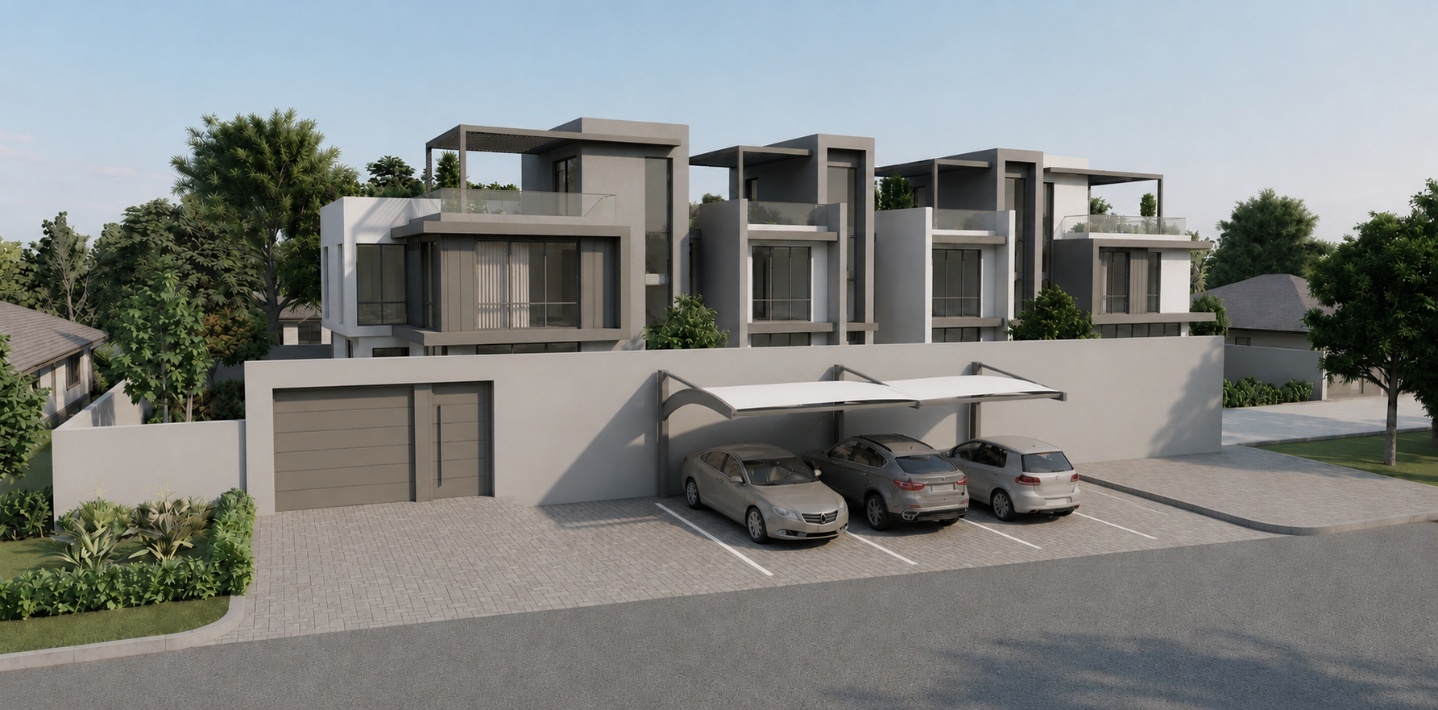
Article (25): Basement Floor (Underground)
Where no specific basement requirements are stated, the general conditions for basement floor construction shall be as follows:
Construction of a basement floor is permitted over the full plot area, provided that the ceiling level of the basement for portions outside the ground floor footprint does not exceed the approved design level and the prescribed clear height is maintained. Construction outside the approved building line shall not be permitted, and the requirements of Article (31) of this Regulation regarding parking space dimensions, ramp gradients, and ramp widths leading to the basement floor shall apply. Exception: for workers' accommodation on industrial plots and staff accommodation, construction shall be limited to the ground floor footprint area only.
The basement area shall not be counted within the permitted building coverage ratio. More than one basement level for parking purposes is permitted, except for workers' accommodation where only one basement floor is permitted.
The basement floor shall not be used for residential, living, office, or commercial purposes, and shall not be used independently from the main building. Its use shall be restricted to the following service purposes only:
Vehicle parking.
Building utility services (electricity room, telecommunications, water tanks, pumps, and similar).
Recreational services specific to the building such as children's playrooms, sports training, health club, and related services.
Services specific to specialized building types such as hotels and hospitals (storage areas, services, parking, laundry room, clothes drying, swimming pool, health club, and related services).
The basement floor is permitted to be used for approved purposes other than residential, living, and kitchen uses, provided that architectural solutions such as level treatments and natural lighting and ventilation are provided through open-to-sky spaces acceptable to the competent authority, along with emergency escape and rescue exits.
The maximum finished ceiling level of the basement shall not exceed 1.20 meters above the approved design level.
Ventilation and lighting in the basement floor shall be provided in accordance with the requirements of Articles (28, 29, and 30) of this Regulation.
No part of the basement floor or its foundations shall project outside the plot boundaries or outside the approved building line on the street side. All access elements to the basement, including entrances and ramps, shall be within the plot boundaries, and no part thereof shall be constructed outside the plot boundaries.
When constructing excavation shoring, the use of neighbouring land shall not proceed without obtaining written approval from the neighbouring owner. Shoring shall not project outside the plot boundaries onto streets, lanes, and open areas without submitting its structural design to the competent authority and obtaining approval from the relevant authorities. All safety conditions for neighbouring structures shall be observed during excavation, concrete pouring for basement floors, dewatering, and pile foundation construction. The basement shall be waterproofed using appropriate technical methods to prevent infiltration of external water from any source, in compliance with approved technical specifications.
The basement floor shall be equipped with the necessary means and equipment for water drainage.
Article (26): Podium Floor
Construction of a podium floor for multi-storey buildings is permitted, taking into account the suitability of the plot area and the specialized engineering studies submitted by the consultant, in accordance with the following criteria and requirements:
Number of Podium Floors
The number of podium floors shall be determined by the competent authority based on the following:
The building height, heights of neighbouring buildings, and building mass ratios of the project.
Required parking spaces.
Specialized project studies submitted by the consultant.
Location of the Podium within the Building
The location of the podium within the building shall be determined as follows:
For buildings without a mezzanine floor, the podium shall be located above the ground floor.
For buildings with a mezzanine floor, the podium location shall be either: a. Above the mezzanine floor: the podium shall be designated for parking. The competent authority may approve the occupation of certain spaces on the floor for any other appropriate activities approved by the competent authority, provided that the required services and parking spaces for such activities are provided and Civil Defence requirements are met. b. Below the mezzanine floor: with the same service, commercial, or recreational activities, while fulfilling the requirements stated in Clause (a) above.
Projections
Podium projections on the roadside are permitted starting from the first floor above the mezzanine, provided that distinctive facades are designed for the podium and the approved projection amount is observed.
General Requirements
The following shall be observed when designing the podium:
To enhance external facades, the outer perimeter of the podium floor shall be occupied by commercial activities as an extension of the ground floor, or by residential, office, or recreational activities in accordance with the submitted design.
Distinctive architectural facade designs shall be submitted to achieve architectural harmony between the podium mass and the overall building design, ensuring facade treatment that achieves visual distinction.
Appropriate engineering solutions and treatments shall be provided to address the implications of air conditioning units on the podium floor.
The use of the podium roof in buildings for recreational activities and outdoor seating is permitted, subject to the following:
The podium roof shall not be covered structurally.
Complete separation between incompatible activities shall be provided where multiple activities exist on the podium floor.
Partitions of not less than 1.80 meters in height shall be provided between adjacent apartments overlooking the podium roof.
Article (27): Roof Floor
Where no specific roof floor requirements are stated, the general conditions for its construction shall be as follows:
The roof floor shall be designated for the construction of elevator machine rooms, staircase enclosures, water tanks, pump rooms, electricity and telecommunications rooms, air conditioning equipment, certain decorative canopies (pergolas), and other approved service uses as determined by the competent authority. Residential and living rooms are permitted in cases stipulated in this Regulation.
The area of the roof floor shall not exceed 35% of the total area of the topmost floor, including all constructions on the roof floor. The structural framework shall be of reinforced concrete or equivalent, and the setback from the front building boundary shall not be less than 1.50 meters.
The height of parapet walls (roof edging) in buildings shall not be less than 1.00 meter after final finishing and various insulation layers, and shall not exceed 1.80 meters. The competent authority may apply the principle of flexibility and encourage architectural innovation and creativity in cases of unique architectural facade designs.
The locations of tanks, satellite dishes, and equipment such as air conditioning units, facade cleaning equipment, and similar items on the roof floor shall be determined, and the necessary detailed plans shall be submitted for architectural facade treatment in a manner that does not detract from the general appearance of the Emirate. The appropriate parapet height shall be determined in accordance with the planning requirements.
The placement of advertising boards on the roof is permitted in accordance with the conditions stipulated in the relevant legislation.
Service structures constructed on the roof floor shall not be used for any commercial purposes by any means.
Article (28): Natural Lighting and Ventilation Openings
Window Requirements
Every room (residential or non-residential), stairwell, kitchen, hall, or corridor shall be provided with a lighting and ventilation opening. The total area of lighting and ventilation openings shall not be less than 10% of the floor area of rooms designated for residential use, and 5% of the floor area of service areas (kitchens, bathrooms, toilets, storage rooms, and staircases).
Ventilation and lighting openings of the same ratios stated in the preceding clause may be provided in the ceiling, provided that such openings are directly connected to external air, the area containing these openings is not designated for sleeping, and the openings are equipped with mechanical opening devices at a height of 1.00 meter from the room floor.
Ventilation and lighting openings shall be provided in the main staircase of the building for each floor from the first to the topmost floor. Exception: for residential villas, indirect ventilation and lighting for the staircase is permitted. The competent authority may, for technical reasons, permit mechanical ventilation and artificial lighting subject to Civil Defence Department approval.
Natural ventilation and lighting openings shall be provided in industrial facilities such as warehouses and workshops at a ratio of not less than 5% of the floor area. Warehouse doors are considered part of this ventilation and lighting. Where an office (administrative) section is annexed to the industrial facility, the ratio of natural ventilation and lighting openings shall not be less than 10% of the floor area of the administrative spaces.
Door Requirements
The minimum door widths shall be as follows
Table 49: Minimum Door Widths for Architectural Spaces
Architectural Spaces | Minimum Door Width | |
1 | Main door of residential units and offices — staircases | (1.10) m |
2 | Bedrooms and Office Rooms | (1.00) m |
3 | Kitchens | (1.00) m |
4 | Bathrooms - Toilets | (0.90) m |
5 | Commercial shops | (1.10) m |
6 | Workshops and Warehouses | (3.00) m |
7 | Patient rooms in healthcare buildings | (1.20) m |
The minimum door height shall be 2.20 meters, and doors on typical floors shall not open directly to external air or staircase steps | ||
General Requirements
All rooms, halls, corridors, staircases, kitchens, and bathrooms of any building shall be provided with the natural lighting and ventilation specified in this Article, as well as secondary or cross ventilation where the room depth exceeds three times its width.
Where lighting and ventilation of any entrance or corridor is required through available rooms, its area shall be added to the area of those rooms to determine the required ventilation amount.
Natural ventilation and lighting may be substituted with mechanical ventilation and artificial lighting for toilets, staircases, bathrooms, small preparation rooms with an area below the minimum kitchen area, corridors, halls, and rooms for certain specialized projects that require this, provided that mechanical lighting and ventilation conditions are met.
Kitchens may form part of the living room space, provided that the required ventilation in accordance with this Regulation is provided for the living room from the side opposite the kitchen, along with mechanical ventilation for the kitchen.
Ventilation or lighting openings towards neighbouring properties shall not be permitted unless the required setbacks are achieved.
The following shall be observed when providing openings in buildings:
Fall protection guards (railings or parapets) shall be used on balconies, rooftops, and at level and height change points exceeding 1.00 meter.
The sill height of windows shall not be less than 1.00 meter, except where balconies exist in front of these windows on the exterior, or where fall guards (railings) of not less than 1.00 meter in height are provided.
The consultant shall study the height of fall protection guards (railings) in a manner proportionate to the type and height of windows and balconies.
Any openable part of a window, or any door designed to remain open, shall be considered a lighting and ventilation opening. In all cases, the opening shall be connected to external air across its full area. Accordingly, any opening associated with a mechanical device (air conditioning unit) shall not be considered a ventilation opening under the provisions of this Regulation.
Article (29): Light Wells and Internal Courtyards
Light Wells
The conditions for natural lighting and ventilation for uses overlooking light wells and internal courtyards shall be as follows:
Bathrooms: The light well area shall not be less than 0.64 square meters and its width shall not be less than 0.80 meters. The natural lighting and ventilation requirements may be waived where an integrated mechanical ventilation and artificial lighting system is provided in accordance with approved specifications.
Enclosed Kitchens: The light well area shall not be less than 7.00 square meters and its width shall not be less than 2.00 meters regardless of the building height. Mechanical ventilation in accordance with approved specifications and conditions shall be provided where the building height exceeds ground plus seven (7) floors.
Open-Plan Kitchens: Open-plan kitchens opening onto living areas are permitted without providing ventilation light wells for all building heights, provided their location faces the main ventilation and lighting openings of the living areas, except for villas (where a main kitchen exists), with mechanical ventilation provided in accordance with approved specifications.
Preparation Kitchens: The light well area shall not be less than 0.64 square meters and its width shall not be less than 0.80 meters on any side, or mechanical ventilation shall be provided in accordance with approved specifications.
Internal Courtyards
The area of the internal courtyard shall vary according to the condition of the rooms or offices overlooking it as follows:
Where all rooms of a residential unit or office room derive their lighting and ventilation from the same courtyard, the courtyard area shall not be less than the square of half the total height of the floors in which these rooms are located, measured from the floor of the first floor, with a minimum of 4.50 meters on any side and a minimum area of 20.25 square meters.
Where some rooms overlooking the courtyard belong to an office or residential unit whose other rooms face a road, lane, courtyard, or legal setback, the courtyard area shall not be less than the square of one-third of the floor height of the floors in which these rooms are located, with a minimum of 3.00 meters on any side and a minimum total area of 9.00 square meters.
Where kitchens from one or more residential units or office units that have frontage onto a street, courtyard, lane, or setback overlook the courtyard on the same floor, the courtyard area shall not be less than the product of (half the height × one-third the height) of the floors in which these rooms are located, measured from the floor of the first floor, with a minimum of 3.00 × 4.50 square meters.
In apartments with an area exceeding 150 square meters, natural ventilation and lighting for domestic workers' rooms may be provided through light wells with minimum dimensions of 3.00 × 3.00 square meters regardless of the building height, provided that mechanical ventilation is provided in accordance with the approved specifications and conditions of the competent authority where the height exceeds ground plus seven (7) floors, or from any other courtyard without affecting its dimensions.
Where domestic workers' rooms and kitchens overlook the same light well, the dimensions of the domestic workers' light well shall apply, with minimum dimensions of 3.00 × 3.00 square meters on any side and a minimum total area of 9.00 square meters regardless of the building height, provided that mechanical ventilation is provided in accordance with the approved specifications and conditions of the competent authority where the height exceeds ground plus seven (7) floors.
General Requirements:
Every light well or courtyard in a building, regardless of its area, shall be provided with an appropriate access point (minimum width 0.70 meters) at its floor level to ensure maintenance and cleaning. Light wells shall be covered in a manner that allows access for maintenance, to prevent accumulation of insects and waste.
Every light well or courtyard shall be equipped with the necessary fittings for rainwater drainage.
The thickness of light well walls separating it from other building spaces shall be 20 cm.
All light wells and courtyards shall be open at the top. Where any roof or structure is placed over them, the following conditions and requirements shall apply:
Where the roof is transparent, lateral openings connected to the exterior shall be provided, with the total area of such openings not less than the area of the courtyard or light well.
Where the roof is non-transparent, lateral openings connected to the exterior shall be provided, with a total area not less than one and a half times the area of the courtyard or light well.
The roof may extend beyond the area of the courtyard or light well by a distance not exceeding half the height of the available openings on its sides.
These openings shall be provided with appropriate opening and closing mechanisms and shall be covered with protective screens against rodents and birds.
Table 50: Minimum Dimensions and Areas of Light Wells and Internal Courtyards
Shafts | |||
|
|
| |
Mechanical ventilation must be provided if the building height exceeds (G + 7 Floors). | Mechanical ventilation must be provided if the building height exceeds (G + 7 Floors). | Bathrooms/Toilets shall be provided with mechanical lighting and ventilation, according to the approved specifications and requirements | |
Min. Shaft Area = 9.00 m 2 | Min. Shaft Area = 7.00 m 2 | Min. Shaft Area = 0.64 m 2 | |
Maid’s Room | Apartments above 150 m2 | Closed Kitchen | Prep. Kitchens (Pantry) or Baths/ Toilets |
Maid/worker Room + Kitchen | |||
Courtyard | |||
|
|
| |
Min. Area = 20.25 m2 | Min. Area = 9.00 m2 | Min. Area = 13.50 m2 | |
Area = (1/2 H) 2 | Area = (1/3 H) 2 | Area = (1/2 H × 1/3 H) 2 | |
All residential unit / office rooms that are overlooking it only | Some residential unit / office rooms that are overlooking it | Some bedrooms / Offices + Kitchens | |
Bedrooms / Office Rooms Or (Bedrooms / Offices) + Kitchens | Bedrooms / Office Rooms | (Bedrooms / Offices) + Kitchens | |
All rooms do not overlook the external space | Some rooms do not overlook the external space | Some rooms do not overlook the external space | |
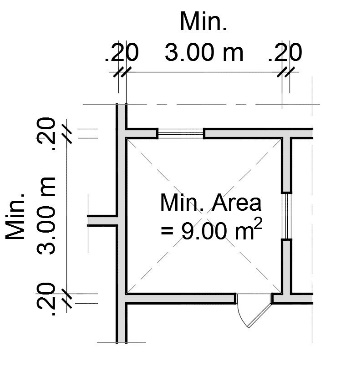
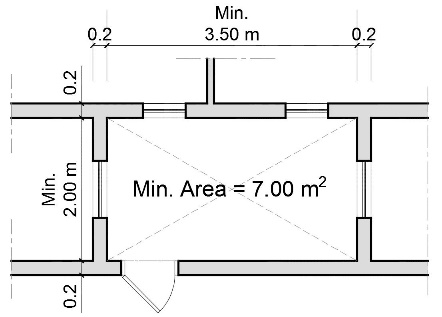
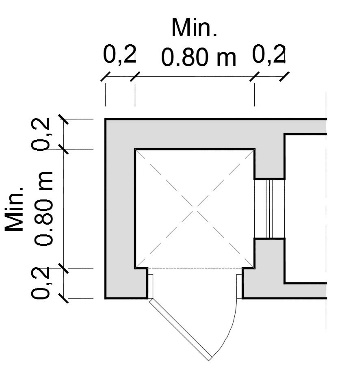
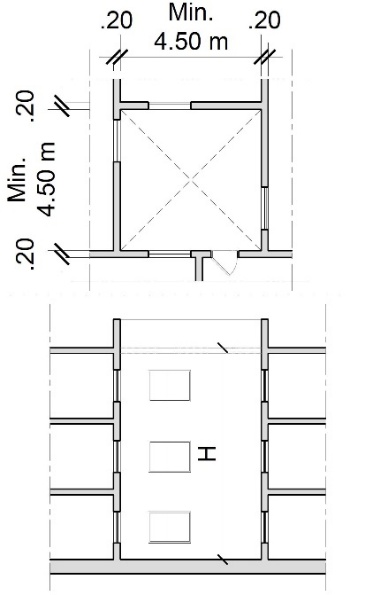
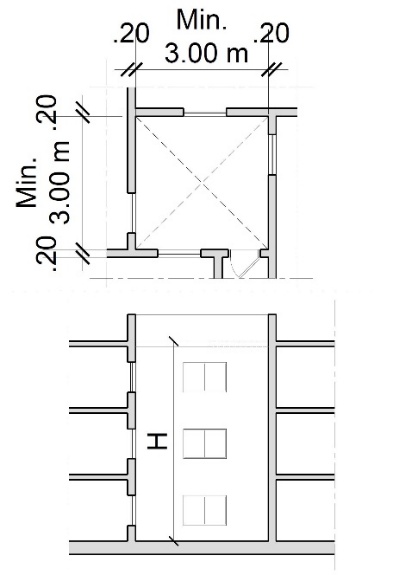
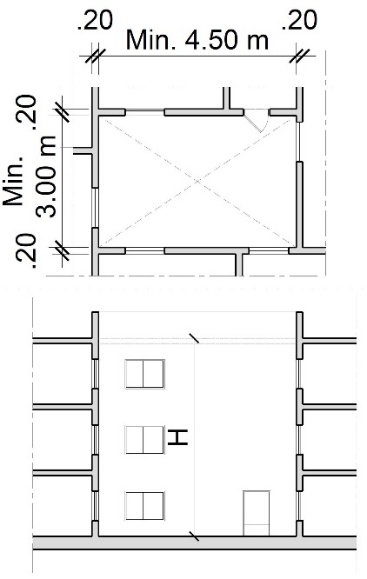
Article (30): Artificial Lighting, Mechanical Ventilation, and Central Air Conditioning
Where natural lighting and ventilation cannot be provided in certain buildings such as cinemas, halls, shopping centres, restaurants, specialized buildings, and public and private building services, they may be replaced by artificial lighting and mechanical ventilation, subject to the following:
A central air conditioning system and electrical lighting shall be provided in all parts of the building.
All air conditioning design works shall be prepared ensuring that the required temperature, relative humidity, air purity, air quantity, pressure differential control, sound insulation, and vibration isolation are provided within the spaces to be air conditioned, in compliance with the air conditioning and cooling specifications and systems approved by the competent authority and international standards.
The external air intake shall be located sufficiently far from any source of pollution, and insect protection screens shall be installed on the air intake at an appropriate height above ground level.
Air filters with an efficiency of not less than 99% shall be used in surgical operating rooms, serum laboratories, pharmaceutical factories, and similar applications that require this. The filter shall be connected to an appropriate alarm system to indicate the need for replacement when its resistance reaches maximum limits.
Acoustic lining shall be used to insulate noise generated by air conditioning equipment, along with the necessary vibration isolation systems to ensure the structural safety of the building is not affected.
The area and specifications of light wells overlooking kitchens with mechanical ventilation shall be in accordance with the preceding Article regarding lighting and ventilation conditions for uses overlooking light wells and internal courtyards.
The specifications and conditions set out in the Green Building Requirements Regulation "Barjeel" approved by the competent authority shall be applied with regard to thermal insulation, ventilation specifications and calculations, air conditioning, and lighting.
Article (31): Parking Requirements
General Requirements
Entrance locations shall be in accordance with the requirements of the competent authority and as specified in the site plan or issued development system requirements. Where the planning requirements do not specify particular entrance and gate locations, only one vehicle entrance shall be permitted. In all cases, the proposed location of entrances and exits shall not conflict with the entrances and exits of neighbouring existing buildings.
For plots fronting two roads of different classifications, the vehicle entrance shall preferably be oriented from the lower-classification road to ensure traffic flow and minimize interference with the main vehicle flow, unless the site plan or planning requirements specify another location or as required by a traffic impact study.
Parking spaces (open or covered) shall be provided within the plot boundaries on which the building is constructed.
The number, dimensions, specifications, and design of parking spaces shall be in accordance with the standard conditions and specifications stated in Item (31-2) of this Regulation.
No modifications to the number, dimensions, specifications, or design of parking spaces approved in the building permit shall be made without prior approval from the competent authority. The contractor and engineer shall bear responsibility for any changes not previously approved by the competent authority, even if such modifications are technically and engineering acceptable. The owner shall bear responsibility for any modifications made after the building completion certificate is issued without prior approval from the competent authority.
The competent authority may require the permit applicant to conduct a Traffic Impact Study (TIS) for projects expected to generate high traffic loads affecting the flow of the surrounding road network. This includes development projects with special approvals, shopping centres, complexes, educational establishments of all types (schools, universities, colleges), healthcare facilities, and any other specialized projects deemed necessary by the competent authority, in accordance with the guidelines for conducting traffic impact studies and entrance and movement studies.
Vehicle entrances or exits shall not be placed on pedestrian lanes or on plots designated for public parking or utilities, unless access from neighbouring streets is not possible or for technical reasons approved by the competent authority.
Plans submitted with the building permit application shall include the following:
General site plan including:
Streets, lanes, pavements, and surrounding road network.
Levels of existing lanes and streets.
Design level of the plot and neighbouring plots.
Traffic movement on streets surrounding the plot, plus locations of traffic signs, intersections, roundabouts, obstacles affecting vehicle entrances and exits, and lighting poles.
Vehicle parking plans for all floors including:
A comparative study showing the total number of required parking spaces for the project versus the operational capacity provided by the proposed design solutions.
A plan showing all site entrances and exits and their connection to existing and proposed surrounding roads, identifying user categories (private vehicles, service vehicles, emergency, pedestrians, bicycles) and passenger drop-off locations.
A detailed parking plan showing the distribution of spaces by user category, number of spaces per floor, details of internal ramps, and corridors.
A vehicle manoeuvring analysis plan showing movement paths, entry and exit routes within the parking area, turning movements, and any potential conflicts with pavements, structures, or parking spaces.
Plans showing directional signage, ground markings, and necessary traffic control measures. f. A plan of pedestrian movement elements such as pavements and pedestrian crossings.
A traffic impact study in accordance with the guidelines for conducting traffic impact studies and entrance and movement studies.
Any other details required by the competent authority.
Adequate natural lighting and ventilation shall be provided, and where this is not possible, artificial lighting with an effective mechanical ventilation system shall be provided in accordance with the approved standard specifications of the competent authority.
Necessary drainage installations for rainwater shall be provided at the ends of entry and exit ramps, and floor drains and appropriate gradients shall be provided in parking floor surfaces.
If it becomes apparent after the building permit is issued that there is a conflict with neighbouring entrances, exits, or surrounding traffic movement, the competent authority shall have the right to request modification of the entrances or exits in a manner consistent with the existing conditions.
Parking floor surfaces shall be covered with an appropriate concrete layer that is easy to clean, non-absorbent, non-combustible, appropriately graded, and equipped with an effective drainage system.
Plans showing the excavation protection method shall be submitted to the competent authority for approval where excavation works are on the plot boundary on the neighbouring side, and to the competent authority where excavation works are on the plot boundary on the street and lane sides.
A plan of the external pavements surrounding the plot shall be submitted showing dimensions and reference levels for approval by the competent authority. Lanes surrounding the building shall be paved to their midpoint at a level 0.15 meters above the approved design level. Pavement cladding materials shall be determined in accordance with the competent authority's requirements.
Electric and hybrid vehicle charging stations shall be provided in accordance with the requirements stipulated in Item (403.03) and Table No. (15) of the Green Building Requirements Regulation for the Emirate of Ras Al Khaimah "Barjeel".
Technical Requirements
Technical Requirements and Controls
Parking areas shall be provided with separate entry and exit lanes.
Various parking floors shall be provided with ground markings and traffic signs installed in clearly visible locations indicating the direction of entry, exit, and traffic movement within the parking areas (in accordance with Item 31-1), in addition to potential vehicle conflict points where traffic calming strategies shall be applied.
A traffic safety assessment shall be conducted for movement within parking areas, and appropriately sized reflective mirrors shall be installed to enhance visibility in areas where adequate sight distances are not available.
Wheel stops shall be installed where parking spaces face boundary walls, walls, buildings, or pedestrian pavements. The maximum height of wheel stops shall be 12 cm with a minimum width of 20 cm as shown in Figure No. (17). It is preferable to avoid installing wheel stops in areas that may obstruct pedestrian movement to and from parked vehicles.
|
Figure (18): Dimensions of Vehicle Wheel Stops |
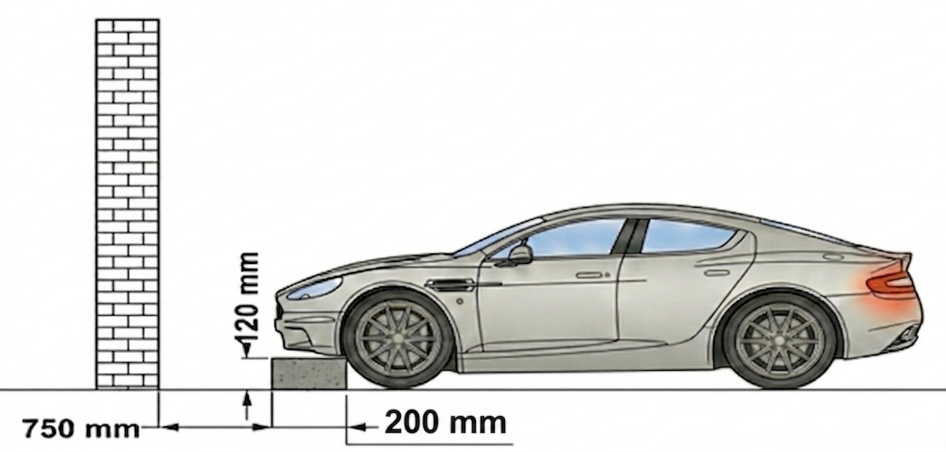
All columns and walls adjacent to vehicle movement areas shall be provided with appropriate rubber corner guards for protection during vehicle movement. These guards are not required where kerbs prevent vehicle contact.
Parking space locations and numbers shall be identified in accordance with the plans approved by the competent authority.
Parking spaces shall be designed so as not to obstruct fire exit doors, their access routes, or evacuation exit routes. These routes shall be kept clear and free from any permanent or temporary obstructions.
The minimum required number of parking spaces for private buildings not mentioned in this Regulation shall be as follows:
Table 51: Minimum Required Number of Parking Spaces for Private Buildings
# | Use | Min. Parking Lots |
1 | Theaters and Cinemas | One space per every 3 seats |
2 | Wedding and Banquet Halls | One space per every 20 m² of hall area |
3 | Entertainment Uses, Specialized/Public Buildings | As per dedicated studies for each project |
Parking Entrances and Exits
The following requirements shall be applied to determine the locations of parking entrances and exits:
Parking areas shall be provided with separate entry and exit lanes.
Opening vehicle entrances or exits on the chamfered edge of the plot boundary is prohibited due to its effect on traffic visibility.
The minimum distance between any vehicle entrance or exit and any local road intersection shall not be less than 15 meters from the chamfered plot edge. The competent authority may reduce this distance to 9.00 meters where technical reasons necessitate this.
Vehicle entrances shall not face a T-junction, and the distance between the entrance and the intersection point shall not be less than 15 meters. The competent authority may reduce this distance to 9.00 meters where technical reasons necessitate this.
Where the entrance and exit are located near higher-classification road intersections, the requirements of the competent authority shall be observed in a manner consistent with the road speed and classification, to ensure traffic flow and prevent any conflict with traffic movement. These locations shall be reviewed within the traffic impact study.
|
Figure (19): Location of Vehicle Entrance to the Plot in Relation to Neighbouring Intersections |
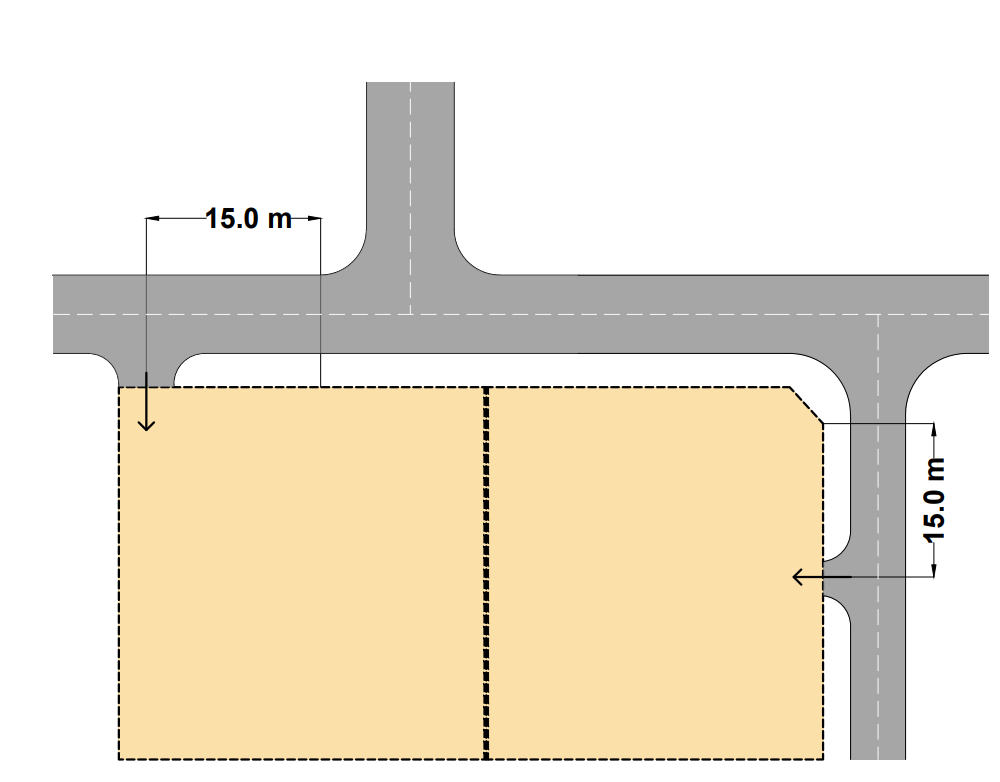
Land Use | Land Use Description | Number of Access Points | |
Single Entrance | Multiple Entrances | ||
Combined Entry and Exit | Separate Entry and Exit | ||
Residential | Villa or Townhouse for plot less than 1,000 m² | 4.5 m | 3.0 m |
Plot larger than 1,000 m² | 6.0m | 3.0 m | |
Residential Commercial | Plot less than 1,000 m² | 6.0 m** (recommended) | 4.5 m |
4.5* m (Notes) | |||
Plot larger than 1,000 m² | 6.0 m | 4.5 m | |
Commercial | Plot less than 1,000 m² | 6.0 m** (recommended) | 4.5 m |
4.5* m (Notes) | |||
Plot larger than 1,000 m² | 7.3 m | 4.5 m | |
Notes: | * The minimum entrance width of 4.5 m may be applied for residential-commercial and commercial buildings where:
The minimum width of parking entrances and internal roads is directly affected by land use and the number of available entrances. | ||
The minimum width of parking entrances and internal roads shall not be less than the minimum stated in the following table:
Table 52: Minimum Width of Parking Entrances and Internal Corridors
Vehicle Traffic Lanes
Vehicle Traffic Lane Requirements
Vehicle traffic lanes within parking areas shall be completely free from any structural or operational obstructions that may affect traffic flow or safety. A minimum clearance of 0.50 meters shall be provided between the outer face of columns and the traffic lane boundaries, to ensure ease of vehicle manoeuvring and to avoid potential conflict with structural elements.
When designing vehicle parking spaces bounded by structural elements or walls, an additional clearance of 20 cm from the structural element shall be included where it conflicts with vehicle door opening, manoeuvring, or is at the end of a lane. The competent authority may exempt plots not exceeding 1,000 square meters from this additional clearance, provided that a vehicle manoeuvring analysis is submitted demonstrating that vehicles can enter, exit, and open doors smoothly.
Structural column spacing coordination shall be observed when distributing structural columns in parking floors, with column spacing based on the parking space width and its multiples, plus the safe clearances prescribed in the preceding clause. Appropriate protection around columns in these locations is recommended to minimize damage from vehicle collision.
|
Figure (20): Clearance Distance Between the Outer Face of Column and Vehicle Traffic Lane Boundaries |
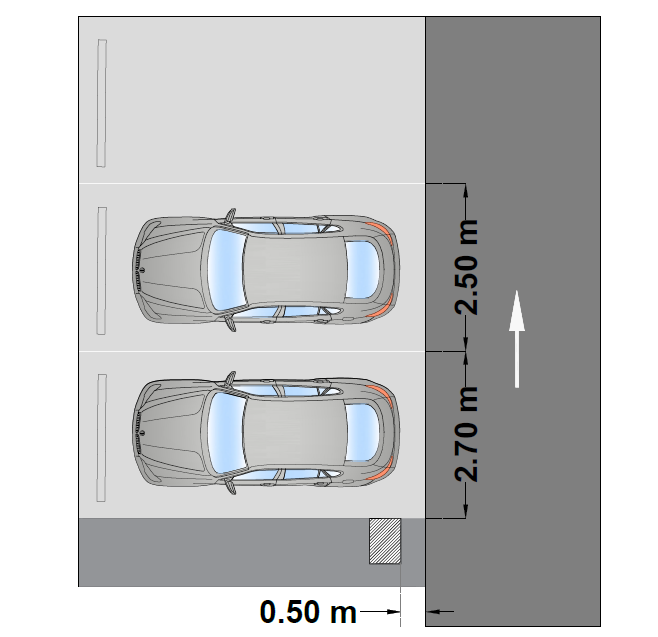
The width of vehicle traffic lanes shall not be less than 3 meters, plus a safety margin of not less than 25 cm raised on both sides of the lane. The competent authority may request an increase in lane width to accommodate bus or heavy vehicle movement requirements, based on the results of the vehicle manoeuvring analysis.
At vehicle parking entrances and exits, a straight and level lane before access control barriers is recommended, with a minimum length of 6 meters, to avoid traffic congestion in external lanes.
|
Figure (21): Clearance Distance Between Parking Entrances and Access Control Barriers |
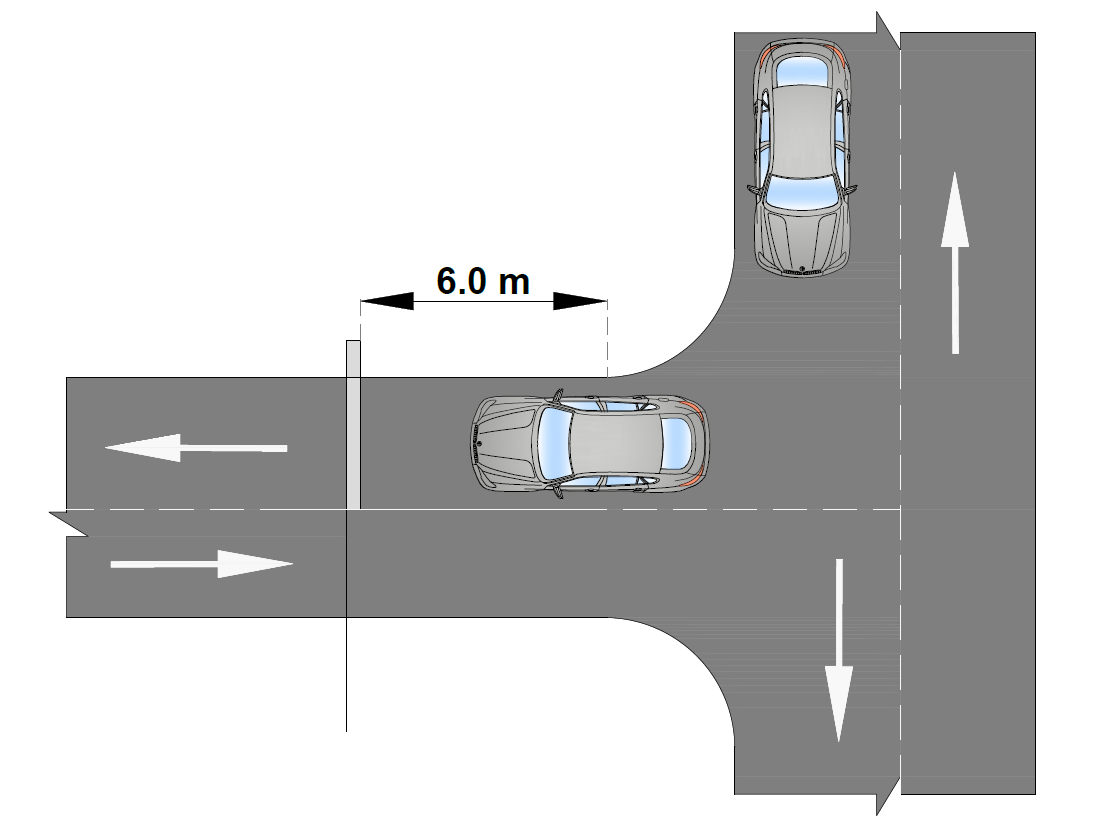
Curve Design
Curves within vehicle parking areas shall be designed with precise geometric dimensions to ensure smooth turning movement and safe manoeuvring, with a minimum internal turning radius of 3.50 meters. The turning radius shall be increased for larger vehicles based on a vehicle manoeuvring analysis, to ensure they can turn without any conflict, achieve smooth traffic flow within the site, and prevent any overlap between vehicle lanes.
|
|
| |
Figure (22): Dimensions of Curved Vehicle Traffic Lanes in Parking Areas | |||
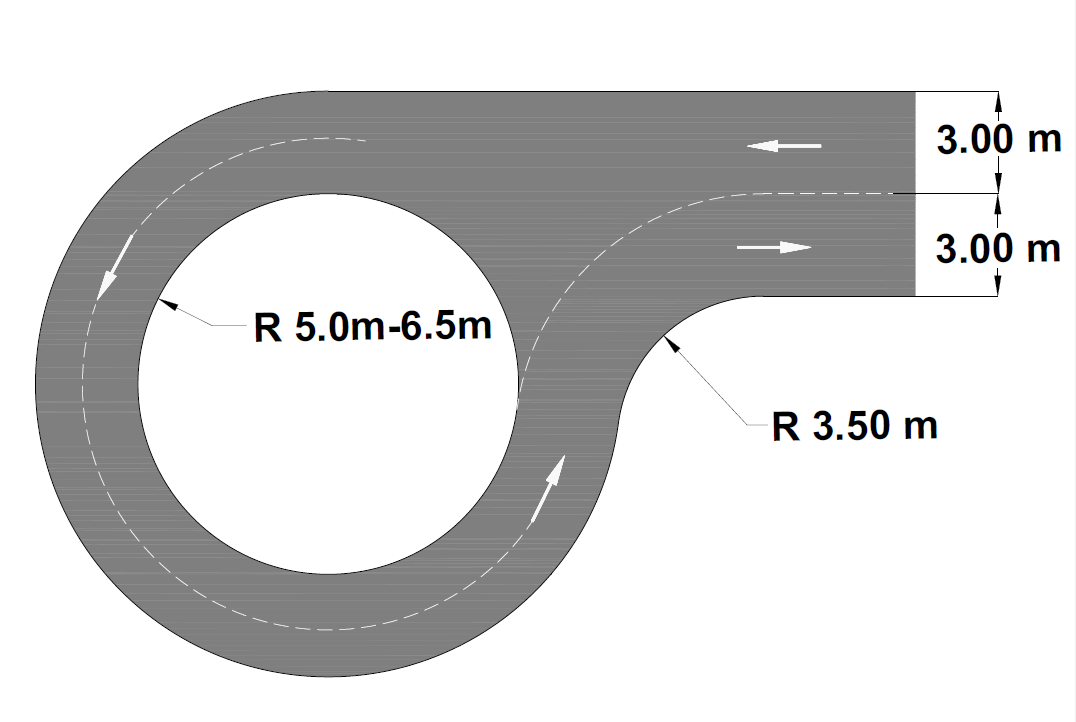
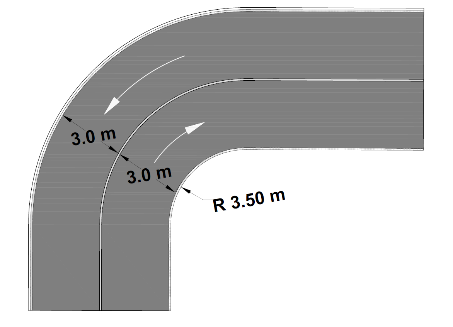
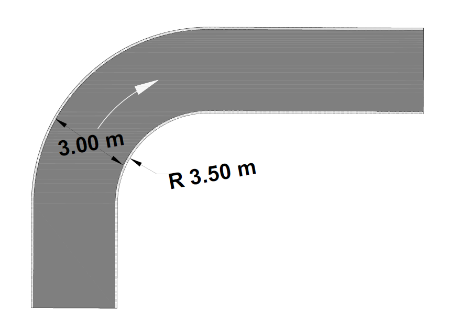
Vehicle Ramps
Vehicle ramps designated for entry and exit shall comply with the table below and the following requirements
Curved (arched) and spiral vehicle ramps are not recommended.
A separating kerb between vehicle lanes on ramps and along both sides of the lanes shall be provided, with a minimum width of 30 cm and a height of 15 cm, to enhance traffic safety levels and reduce the likelihood of collisions.
Table 53: Dimensions and Longitudinal Slopes for Different Types of Ramps
Ramp Type | Maximum Slope Gradient | Minimum Single Lane Width (m) | Minimum Internal Radius (m) | Minimum Clear Vertical Height Above Any Point (m) |
Straight | 12% | 3.00 | Not Applicable | 2.50 |
Curved | 12% | 3.50 | 4.00 | 2.50 |
Spiral | 8% | 5.00 | 6.00 | 2.50 |
|
|
|
Figure (23): Dimensions and Longitudinal Slopes for Different Types of Ramps | ||
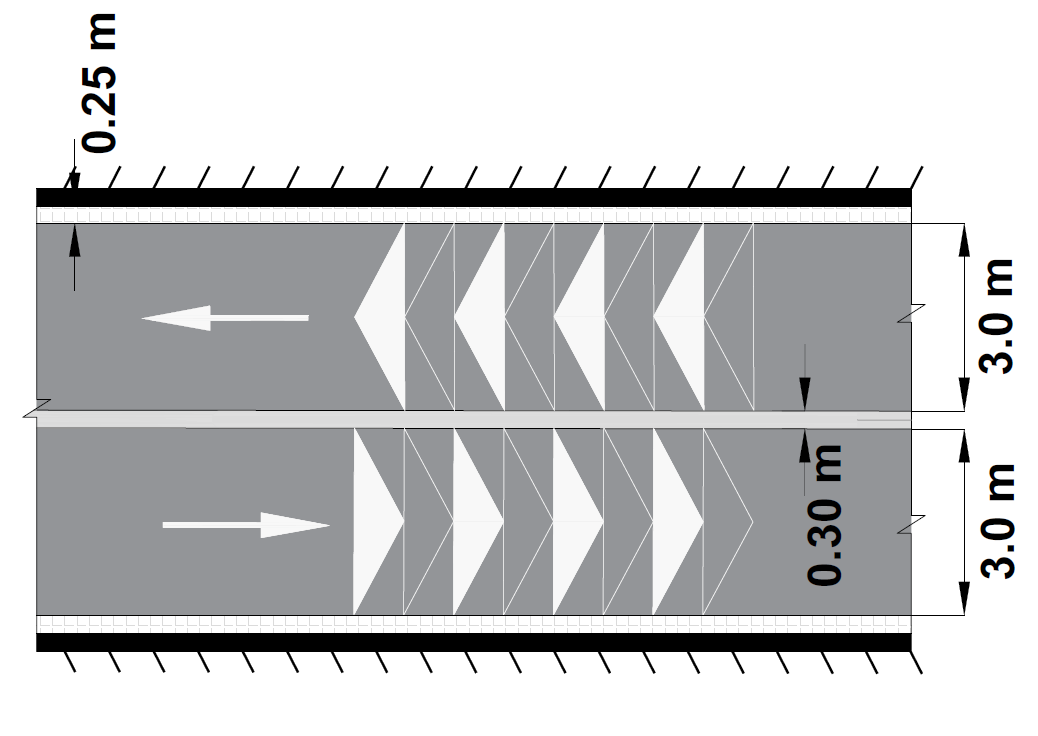
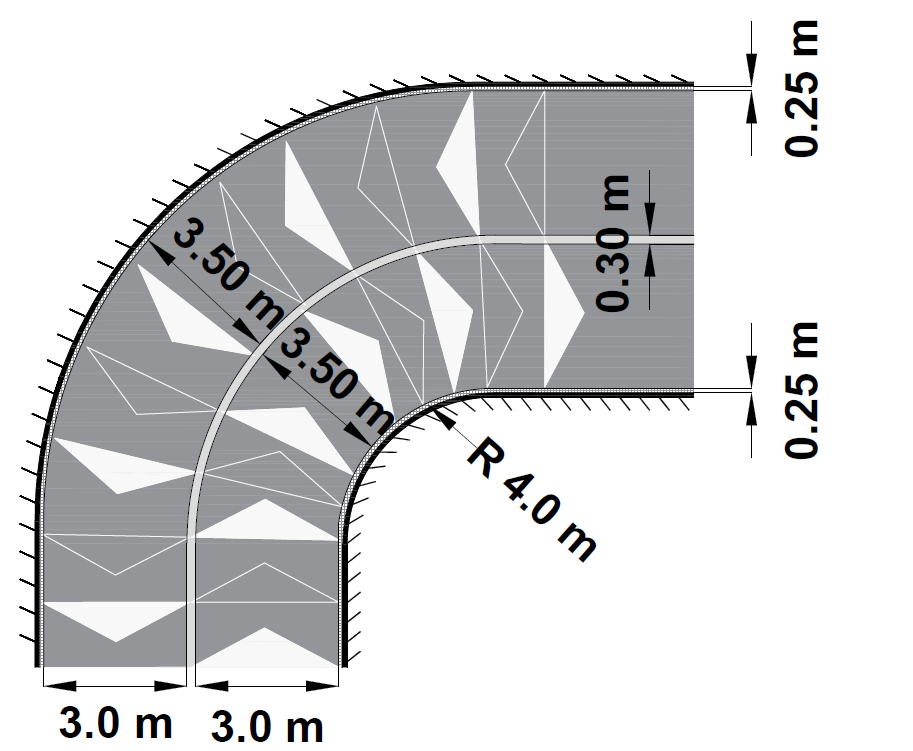
Vehicle ramps shall meet the following requirements:
Floor surfaces shall be of rough texture or treated with anti-slip material, and shall be non-combustible, graded, and equipped with drainage.
Protruding corners of structural elements adjacent to ramps shall be covered with protective materials.
Ramps shall be provided with appropriately sized reflective mirrors to enhance visibility at direction changes, turns, and areas where visibility is restricted.
Ramp design shall incorporate smooth transition zones at connections with horizontal parking levels, with the transition zone gradient designed at half the total gradient of the main ramp, to ensure smooth traffic flow and prevent vehicle chassis contact with the ground, in accordance with the dimensions and criteria shown in the table below.
Table 54: Dimensions and Safe Transition Distances for Vehicles on Ramps
Ramp Slope SL* | Transition Ramp Slope D* | Transition Ramp Length (m) L* |
12% | 6% | 3.60 |
10% | 5% | 3.00 |
8% | 4% | 2.40 |
|
Figure (24): Safe Vehicle Transition on Ramps |
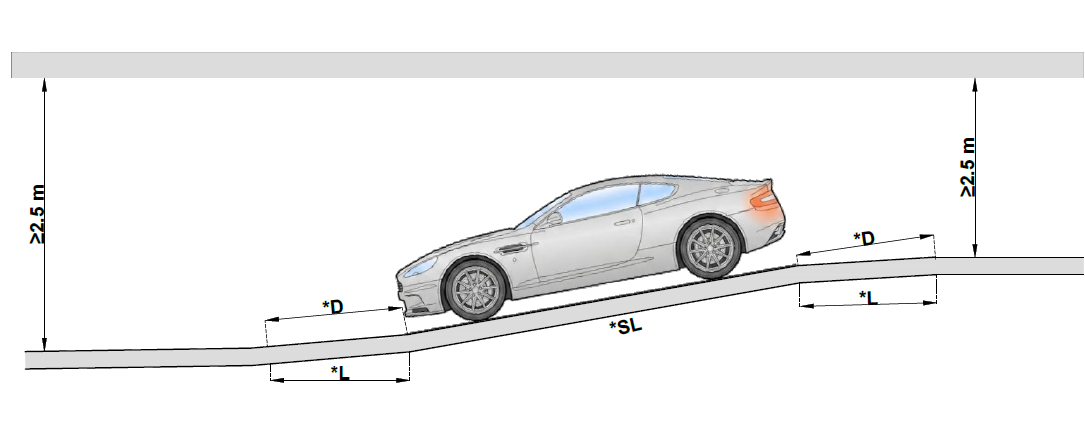
The longitudinal or cross slope in parking areas shall not exceed 4%, to ensure vehicle stability and prevent slipping risk. Parking spaces designated for people of determination shall not exceed a 2% slope, to facilitate wheelchair movement and ensure maximum safety and comfort during entry and exit.
|
Figure (25): Vehicle Parking on a Ramp |
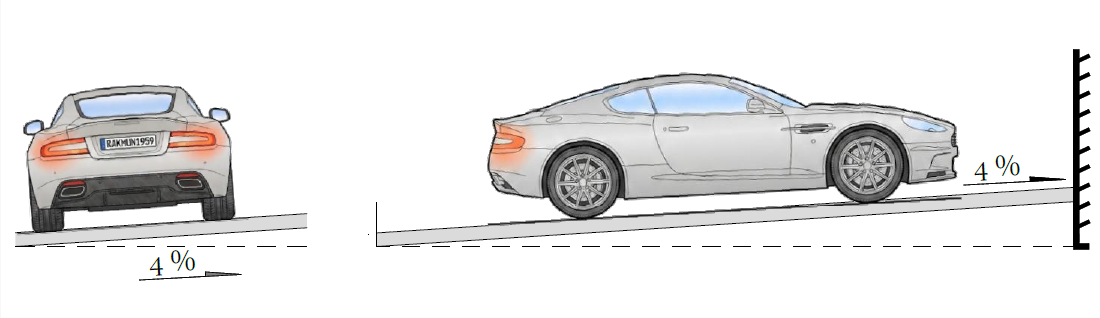
Parking spaces shall not be provided directly opposite ramp entrances or exits, to avoid conflicts in vehicle movement and to ensure clear sightlines and safe manoeuvring.
| ||
Figure (26): Parking Layout Opposite the Ramp | ||
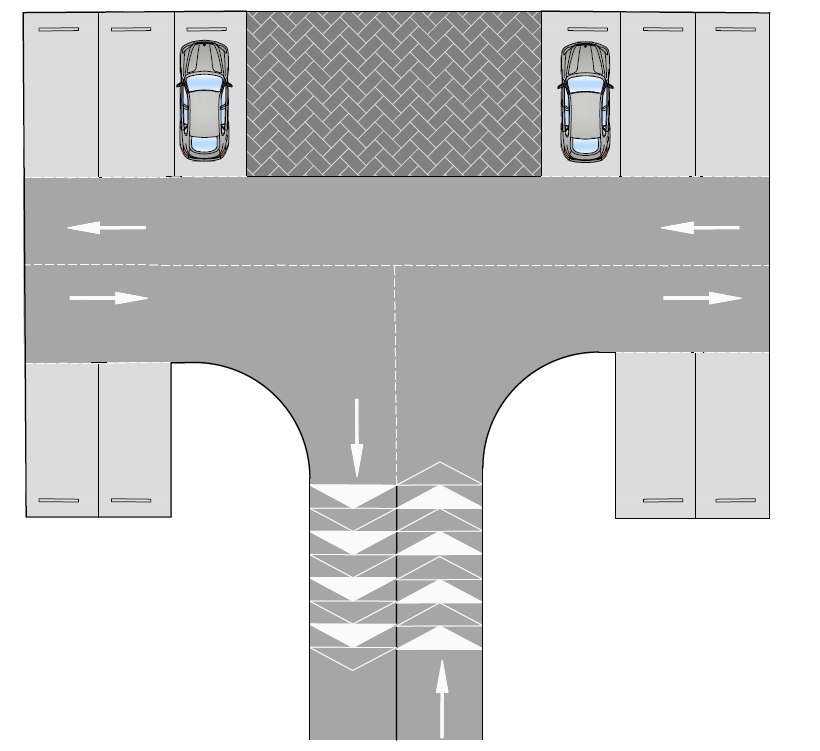
Where a ramp connects to a straight aisle with parking spaces on one or both sides, parking shall only begin after a minimum distance of 5.50 m, measured from the point where the ramp meets the horizontal ground level, or one vehicle length, whichever is greater. This requirement ensures a clear sight distance, unobstructed visibility, and safe manoeuvring without operational conflicts.
|
|
Figure (27): Safety Distance Between Ramp End and Parking Spaces | |
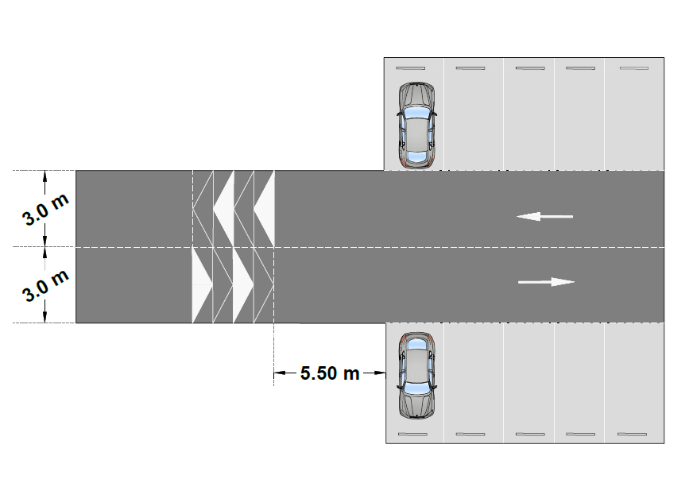
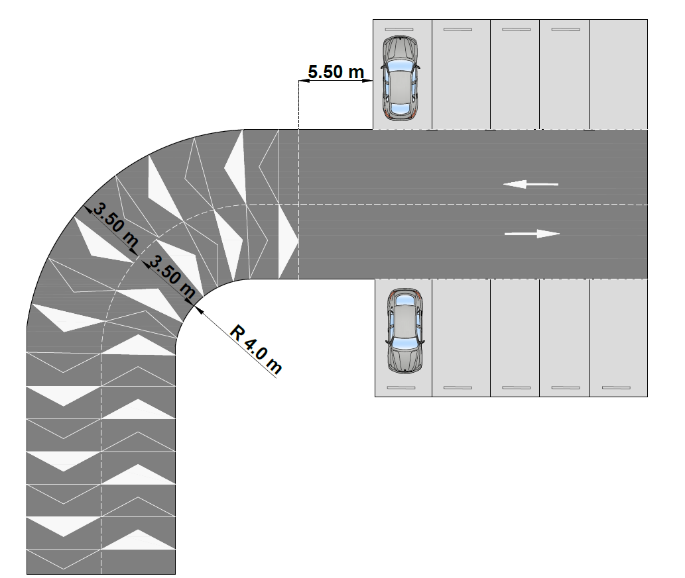
Parking Space Dimensions
The minimum dimensions of parking spaces and traffic lane widths for light vehicle parking shall be as follows, as shown in Figures No. (28, 29, and 30) and the following table:
Table 55: Dimensions of Parking Spaces and Circulation Aisle Widths
Parking Type | Traffic Direction | Parking Width (m) | Parking Length (m) | Aisle Width (m) |
Parallel | One-way | 2.5 | 6.0 | 4.0 / 3.0 |
Parallel | Two-way | 2.5 | 6.0 | 6.0 / 5.5 |
30° | One-way | 2.5 | 5.5 | 4.0 / 3.6 |
30° | Two-way | 2.5 | 5.5 | 6.0 / 5.5 |
45° | One-way | 2.5 | 5.5 | 4.0 / 3.3 |
45° | Two-way | 2.5 | 5.5 | 6.0 / 5.5 |
60° | One-way | 2.5 | 5.5 | 4.0 / 3.8 |
60° | Two-way | 2.5 | 5.5 | 6.0 / 5.5 |
90° | One-way | 2.5 | 5.5 | 5.5 / 5.5 |
90° | Two-way | 2.5 | 5.5** | 6.0 / 5.5 |
*W: refers to the lane width, shown in the figure below for angled parking spaces. ** For perpendicular parking spaces (90°), the space dimensions may be reduced to 5.1 m × 2.5 m in the following cases, provided they are designated for small vehicles: a. 25% of perpendicular parking spaces on plots with a length of less than 30 m. b. A maximum of 10% of perpendicular parking spaces on plots with a length of 30 m or more. °A: refers to the parking space angle, shown in the figure below for angled parking spaces at degrees (30, 45, and 60). | ||||
Parallel Parking Space Dimensions
A vehicle entry and exit angle of 1:1 shall be provided at the beginning and end of parallel parking rows to improve manoeuvring efficiency during entry and exit.
Where a parallel parking space is located between two obstructions such as walls or columns, the length of the parking space shall be increased based on the results of the vehicle manoeuvring analysis, to ensure adequate space for safe and smooth vehicle entry and exit.
A minimum clearance of 6 meters shall be provided in front of the last parallel parking space, to allow the vehicle to perform entry and exit manoeuvres smoothly.
|
Figure (28): Parallel Parking Layout for Vehicles |
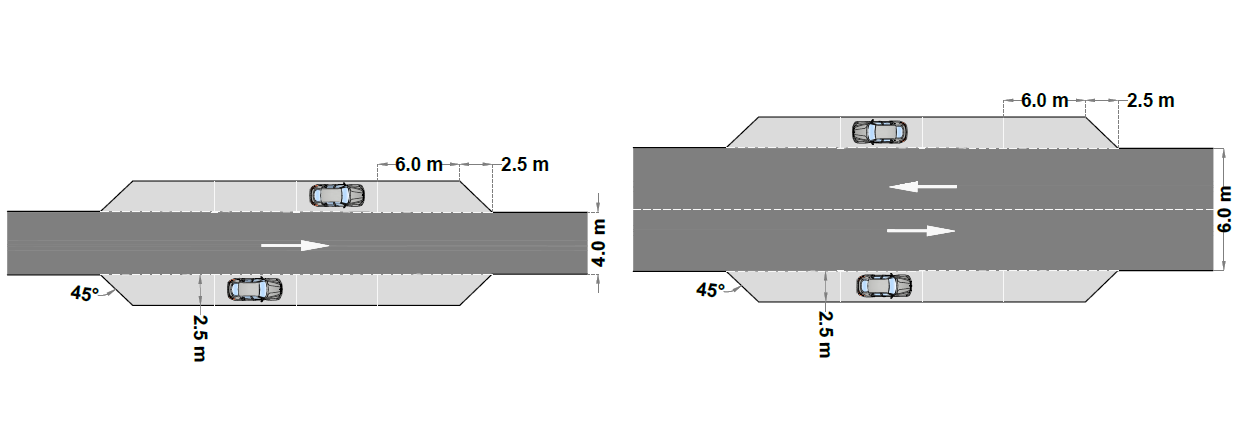
Dimensions of angled and perpendicular parking spaces
The dimensions specified in Table (55) shall be followed.
| |
Figure (29): Dimensions of Perpendicular Light Vehicle Parking and Aisle Circulation | |
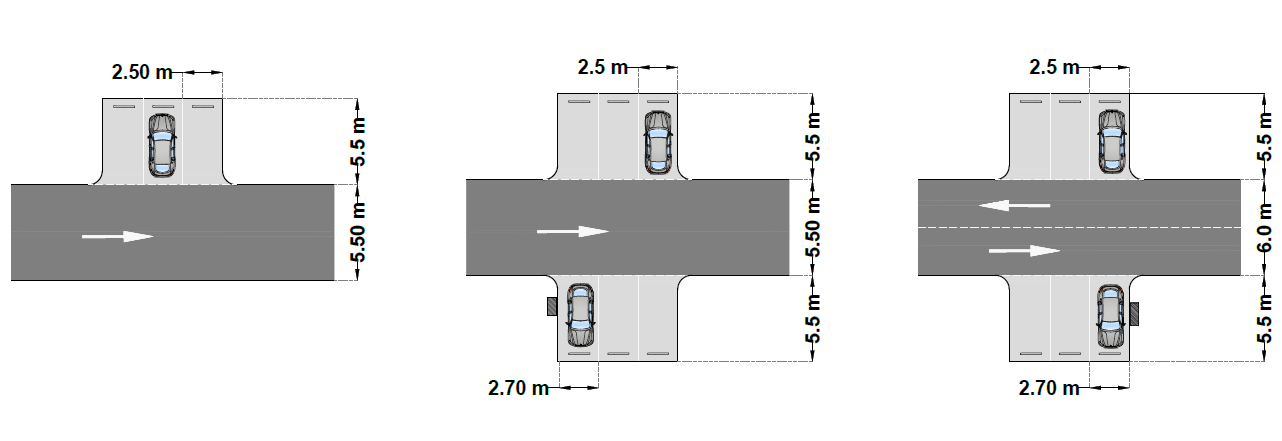
|
Figure (30): Dimensions of Angled Light Vehicle Parking (30°, 45°, 60°) and Circulation Aisles |
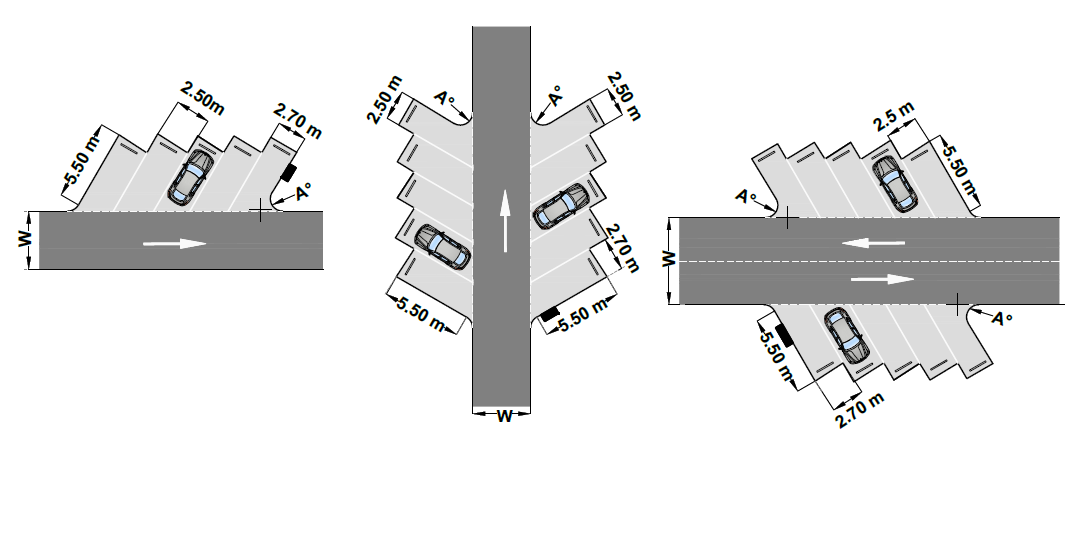
Circulation Aisles
Dead-end vehicle circulation aisles should be avoided where possible. Where required by design constraints, each aisle shall serve a maximum of eight parking spaces on one side, due to increased manoeuvring difficulty and higher collision risk.
Adequate and safe turning space shall be provided at the end of the dead-end aisle, as shown in the figure below, to ensure vehicles can turn and exit without complex manoeuvres or extended reversing distances.
|
| |
Figure (31): Vehicle Manoeuvring Area for Dead-End Circulation Aisles | ||
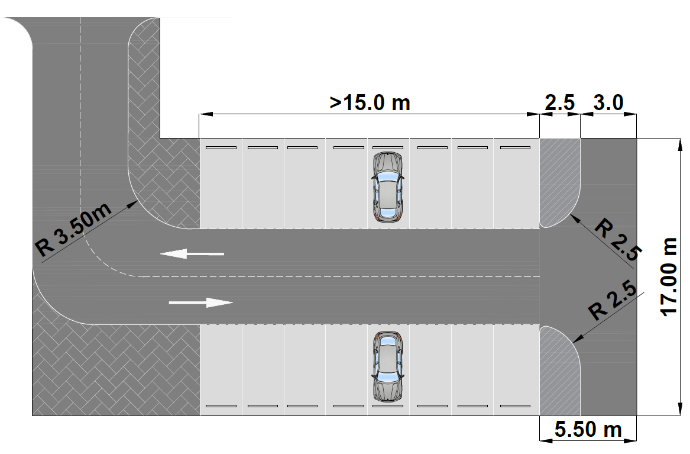
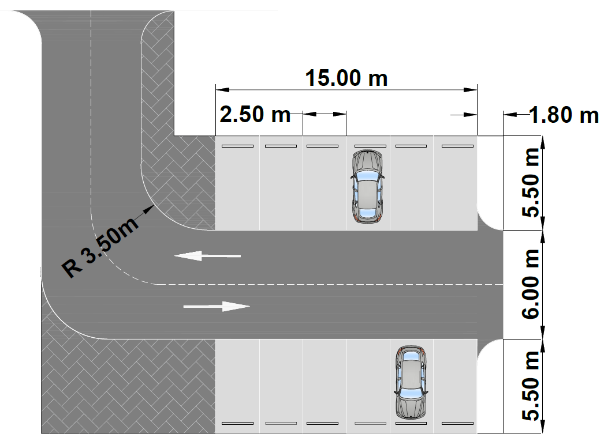
Tandem Parking Spaces
The use of tandem parking is permitted in the following cases, and the tandem parking system shall be limited to two vehicles only:
Residential units: where both tandem spaces are designated for the same residential unit that requires two parking spaces.
Hotel establishments: provided that all vehicle movement is managed entirely through a valet parking service.
|
Figure (32): Tandem Parking Spaces. |
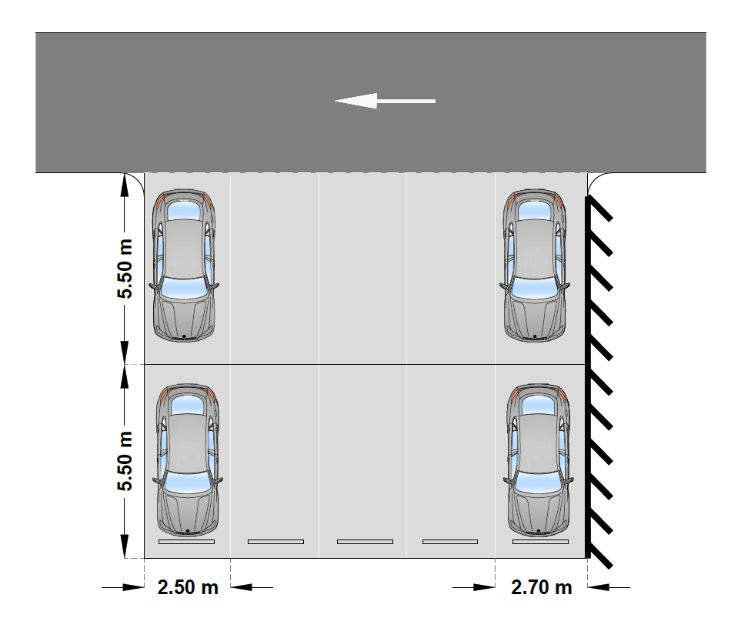
Mechanical Vehicle Parking Systems
Parking areas shall be provided with separate entry and exit lanes. Where automated vehicle lift systems are adopted, an independent standby ramp shall be provided to ensure continuity of operation in cases of malfunction, maintenance, or emergencies. The competent authority may approve the removal of the ramp in cases of absolute necessity, provided that an alternative emergency management plan (Contingency Plan) is submitted and approved by the General Directorate of Civil Defence.
The competent authority may permit the use of mechanical vehicle parking systems as an alternative to traditional ramps where technical justifications necessitate this, subject to full compliance with approved technical standards and requirements, and submission of a comprehensive report from a specialized consultant who bears exclusive responsibility for the design.
The consultant shall submit a comparative technical study demonstrating that all traditional parking design solutions have been exhausted and are not feasible. This study shall include a statement of the extent to which the proposed mechanical vehicle parking system meets the technical requirements, service, and maintenance standards approved by the competent authority, for approval of the proposed mechanical system.
In all cases, the following main standards and requirements shall be observed:
The plot area shall not exceed 1,000 square meters and the number of parking spaces shall not exceed 40 spaces, unless the competent authority determines otherwise based on technical justifications.
The system shall be provided with an installation and safety inspection certificate in accordance with approved standard specifications.
A traffic study shall be submitted in accordance with the guidelines for conducting traffic impact studies and entrance and movement studies.
Approval shall be obtained from the General Directorate of Civil Defence to ensure compliance with all safety, fire prevention, and approved firefighting system requirements.
Building occupants and the public shall be prevented from accessing the operational area of the mechanical parking system, with access restricted to authorized technical personnel and valet parking service staff only.
Maintenance requirements and standards for fully automated systems shall be determined in coordination with the specialized consultant. A certified maintenance manual shall be required as a prerequisite for operation, along with an automatic emergency response system.
The system shall be capable of operating at a minimum of 25% of total capacity through a standby generator in the event of power failure.
For vehicle lifts, a minimum of two entrances shall be provided, and the minimum dimensions of the parking room (6 m length × 3 m width × 2.5 m height) and minimum vehicle entrance opening (2.5 m width × 2.5 m height) shall be observed.
Bus Parking Requirements and Standards
Bus parking spaces within plot boundaries shall comply with the following table and figures.
Bus parking space dimensions, traffic lanes, and manoeuvring areas stated are based on a 12-meter bus. To determine the required dimensions for buses of different sizes and other parking angles, a vehicle manoeuvring analysis shall be conducted.
Table 56: x1234
Table 57: Bus Parking Dimensions
Parking Angle | Parking Width (m) | Parking Length (m) | Transition Distance Length (m) | Minimum Manoeuvring Width (m) |
Parallel to road | 4.0 | 13.0 | 16.0 | 4.5 |
45° | 4.0 | 13.0 | — | 8.0 |
90° | 4.0 | 13.0 | — | 15.0 |
|
| ||
Figure (33): Bus Parking Parallel to the Road | Figure (34): Bus Parking (Perpendicular and Angled Layouts) | ||
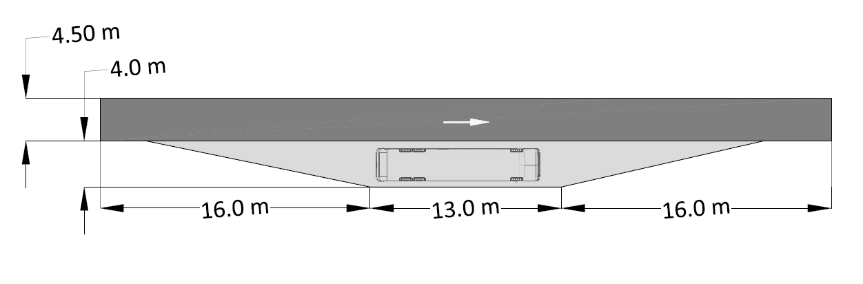
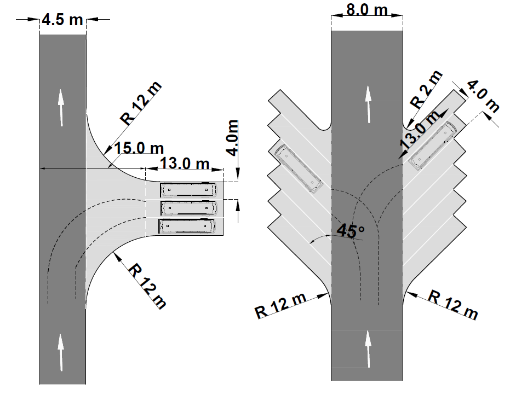
Bicycle Parking Requirements and Standards
Bicycle parking spaces are recommended to be provided inside the building or in covered (shaded) areas at ground level, in easily accessible locations within the plot boundaries and within a distance not exceeding 30 meters from the main building entrance.
Bicycle parking spaces shall not be placed in locations that may obstruct fire exit doors or impede evacuation routes and access to them.
Bicycle parking spaces shall be provided at a minimum ratio of 10% of the total number of occupants in buildings designated for student and workers' accommodation.
Bicycle parking spaces shall be provided at a ratio of 5% of the total number of prescribed vehicle parking spaces for other buildings.
The minimum dimensions of bicycle parking spaces as shown in the following table shall be observed to ensure efficient use
The consultant shall submit a technical study demonstrating that all design solutions for providing the full number of bus parking spaces within the plot have been exhausted in specialized development projects, along with a statement of the extent to which the passenger drop-off area complies with the requirements of the competent authority and in accordance with the guidelines for conducting traffic impact studies and entrance and movement studies in the Emirate, and submission of the required traffic impact study, for approval of the proposed bus passenger drop-off area.
Table 58: Bicycle Parking Dimensions
Parking Angle | Angled Parking Width X (m) | Distance Between Parking Spaces D (m) | Angled Parking Depth Y (m) |
25° | 1.6 | 0.85 | 0.8 |
45° | 1.45 | 0.6 | 1.45 |
90° | — | 0.65 | 1.9 |
|
Figure (35): Bicycle Parking Dimensions |
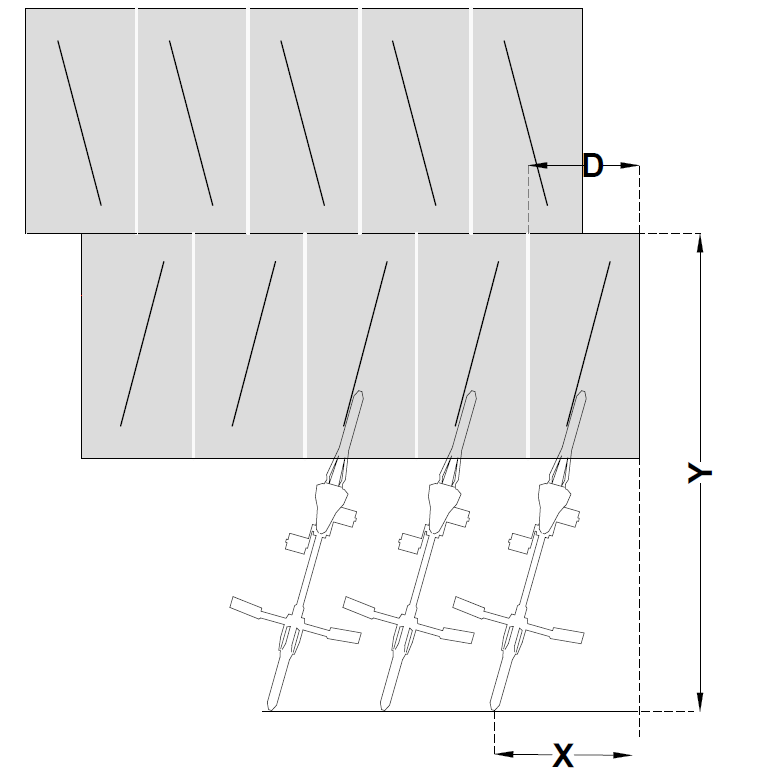
Article (32): Pavement Works for Parking Areas and Pedestrian Walkways of Buildings
The completed building owner shall execute interlock paving works for the entire area extending between the plot boundary and the street asphalt boundary (existing/proposed), including pedestrian walkways and parking areas (existing/proposed) on all sides facing streets or pedestrian pathways (half of the shared pathway with adjacent plots).
For non-residential plots, the completed building owner shall comply with the approved plan issued by the concerned authority in addition to the requirements of Clause (1) of this Article. Existing buildings may also apply for a paving works permit from the competent authority, provided compliance with the approved conditions and specifications issued by the relevant department of the Municipality.
No permit shall be required for paving works carried out within the plot boundaries where a wall separates the internal paving works from the external paving area.
Paving works shall include paving the connection points with entrances leading into the plot where approved parking spaces are provided within the plot, whether open or covered (multi-storey), in accordance with the approved design. Traffic signs and road markings for vehicle entrances and exits shall also be provided as per the approved design issued by the concerned authority. The concerned authority shall ensure compliance with all approved plans issued by the Municipality departments when designing paving works.
The ends of floor finishes adjacent to neighboring plots and street asphalt shall be closed using dropped kerbstones where the adjacent area is unpaved/unfinished. Where the neighboring side is already completed, the finished pavement shall be integrated and continued accordingly.
Constructed pedestrian walkways shall form an integral part of the road right-of-way and shall not be occupied or encroached upon. Parking spaces shall be treated similarly, and reserving them using bollards, chains, or similar obstructions shall be prohibited. Damaging the pavement or any of its elements shall also be prohibited.
A completion certificate and utility connection approval for the completed building shall only be issued after verification that parking spaces and pedestrian walkways have been executed in accordance with the approved designs issued by the concerned authority.
The consultant/contractor shall identify any site obstacles and coordinate with the concerned authority regarding any coordinates or levels required for the execution of paving works. Continuity of paving levels with adjacent plots shall also be maintained.
Article (33): Requirements for People of Determination
Reference shall be made to the approved UAE Code for the Built Environment for People of Determination, adopted pursuant to Cabinet Resolution No. (1/1) of 2019, for all detailed requirements and provisions related to People of Determination.
Requirements for Public Buildings
Public buildings such as markets, shopping centers, mosques, theatres, cinemas, sports stadiums, public parks, and government buildings frequented by the public shall, as a minimum, comply with the following requirements:
Ramps
Ramps shall be provided at sidewalks, external staircases, and level changes inside and outside buildings, with a maximum slope gradient of 1:12 (8%).
The minimum ramp width shall be 1.20 m.
The length of a single ramp run shall not exceed 10 m. Where this length is exceeded, a landing/rest area shall be provided with dimensions not less than the width of the ramp.
|
| |
|
|
|
| ||
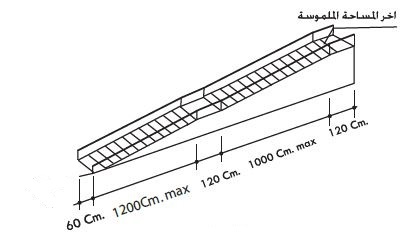
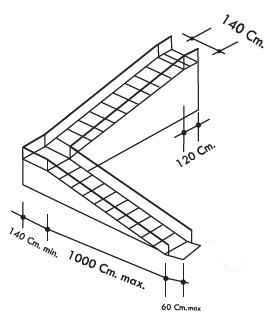
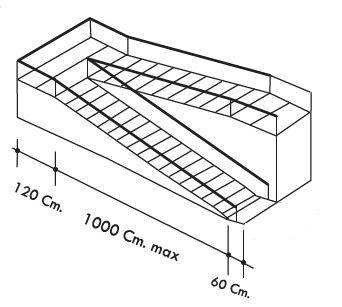
Accessible Parking for People of Determination
The number of designated parking spaces for People of Determination shall be determined as stated in the following table*:
Reference: UAE Code for the Built Environment for People of Determination
Table 59: minimum number of accessible parking spaces required for public buildings.
Required No. of Parking Lots | ||
Public Buildings | Total No. of Parking Lots | Minimum required Parkings |
≥ 200 Parking Lots | 1 People of Determination Parking/ 33 Lots | |
201:1000 Parking Lots | 1 People of Determination Parking/ 100 Lots | |
> 1000 Parking Lots | 1 People of Determination Parking/ 200 Lots | |
The following shall be considered:
Accessible parking spaces shall be located as close as possible to lifts or main accessible entrances, with direct, obstacle-free access routes from parking areas, including provision of curb ramps. The maximum walking distance shall not exceed 50 m. Parking dimensions shall be 2.60 m × 5.50 m for angled parking and 2.60 m × 5.50 m for perpendicular parking. The adjacent access aisle shall not be less than 1.20 m wide, connected to a pedestrian walkway with a maximum slope of 2%.
Adequate loading and unloading areas shall be provided at main entrances in accordance with accessibility design standards for People of Determination.
|
Minimum Dimensions and Requirements for Accessible Parking Spaces for People of Determination |
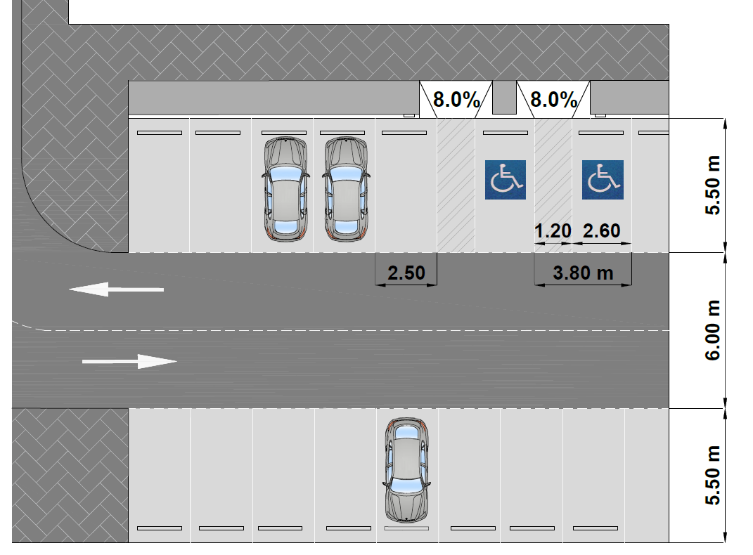
Restrooms
A dedicated restroom for people of determination shall be provided, equipped in accordance with the design standards approved by the competent authority, with appropriate directional signage installed wherever necessary. An internal clear turning space for a wheelchair with a minimum diameter of 1.50 meters shall be provided, and grab rails and support handles shall be installed in their designated positions as shown in Figure No. (38).
|
|
Figure (38): Dimensions of Restrooms for People of Determination | Figure (39): Dimensions of Bathrooms for People of Determination |
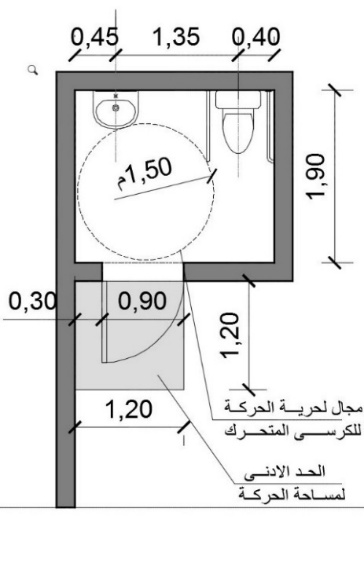
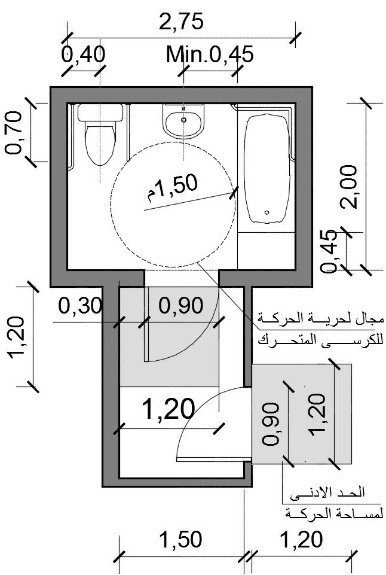
Elevators
At least one elevator shall have a capacity, specifications, dimensions, and fittings complying with internationally approved standard requirements for people of determination. The elevator car accommodating one wheelchair shall not be less than 1.30 × 1.00 meters, with an internal handrail height of 0.85 meters fixed to the internal perimeter of the car.
At least one elevator complying with the approved standard requirements for people of determination shall be provided in public buildings and shopping centres comprising more than one floor. Escalators shall not be considered a substitute for this elevator unless they are equipped with the necessary fittings for people of determination.
Corridors
Corridors shall be of adequate dimensions for people of determination in accordance with approved standard requirements, and accessibility shall be provided for entry and exit through all doors and access to all internal and external spaces without obstructions that limit movement, along with security and safety conditions for the various categories of people of determination.
Requirements for Investment Buildings
(Investment Buildings and Residential-Commercial) with a Total Area Exceeding 4,650 Square Meters
The following shall be provided:
Ramps
Ramps shall have a gradient not exceeding 1:10 at pavements, external staircases, and level-change areas wherever they exist inside and outside the building, as shown in Figure No. (36).
Elevators and Corridors
At least one elevator and corridors on floors, external and internal circulation routes, and parking areas shall have specifications and dimensions adequate to accommodate the movement of people of determination in accordance with approved standard requirements.
Parking Spaces Designated for People of Determination
The number of parking spaces designated for people of determination shall be determined in accordance with Item (1-33) of this Regulation.
Directional signage for people of determination parking spaces shall be installed wherever necessary in accordance with the approved standard requirements.
Circulation Routes
Circulation routes for people of determination shall be direct, with dimensions complying with approved standard requirements, and free from any obstructions.
Restrooms
A dedicated restroom for people of determination shall be provided in accordance with Item (33-1).
Requirements for Hotel Establishments Classified from One Star to Five Stars
The following minimum services shall be provided for people of determination:
The minimum number of rooms designated for people of determination shall be 1% of the total number of rooms, with a minimum of one hotel room.
A hotel room shall be provided at the first-floor level with access without steps.
The room shall be fully equipped in accordance with internationally approved standard requirements for people of determination, in terms of room dimensions, door dimensions, spaces surrounding the bed, a central turning area with a minimum diameter of 1.50 meters, a space in front of the wardrobe measuring 1.50 m × 1.50 m, automatic window opening, desk and wardrobe design, electrical switches, alarm bell, and seating chair.
The room shall be provided with a bathroom in accordance with internationally approved standard requirements for people of determination, including compliance with standard specifications for the toilet seat height (43-49 cm), bathtub, washbasin (height not exceeding 68 cm and not less than 75 cm), surrounding spaces, cabinets, mirror, floor type, door dimensions and movement, locations of bathroom accessories, locations of grab rails and support handles, and a clear turning space with a diameter of 1.50 meters for wheelchair movement within the bathroom, as shown in Figure No. (39).
The room shall have an emergency exit leading directly outside the building or to a balcony, and security and safety measures for the various categories of people of determination in the hotel shall be provided.
At least one elevator shall have specifications complying with the approved standard requirements for people of determination, in terms of dimensions, specifications, control panel height location, elevator door opening time, and internal handrail.
The number of parking spaces designated for people of determination shall be determined in accordance with Table No. (59) of this Regulation, and shall be located as close as possible to the elevators or main entrance of the hotel, provided with the necessary directional signage, and with dimensions in accordance with the approved UAE standard requirements for people of determination.
Loading and unloading areas at the main entrance of the hotel shall be provided in accordance with the approved standard requirements for people of determination.
Ramps with a gradient not exceeding 1:10 shall be provided at pavements, external staircases, and level-change areas inside and outside buildings, with the necessary warning signs.
Direct and unobstructed routes from parking spaces to the elevators or main entrance of the hotel shall be provided, with corridors of adequate width for people of determination movement in accordance with approved standard requirements. Accessibility shall be provided for entry and exit through all doors and access to all internal and external elements without any obstructions limiting movement.
General Requirements
The following conditions shall be met for ramps and corridors designated for people of determination:
The minimum ramp width shall not be less than 1.20 meters, and the ramp gradient shall not exceed 1:12. The competent authority may adjust the ratio to 1:10 where technically justified.
Ramps designated for pavements shall be within the pavement itself.
Where two consecutive ramps exist, a level landing area shall be provided between them with dimensions in accordance with the approved standard requirements of the competent authority.
All ramps, corridors, and staircases shall be equipped with the necessary warning signs (tactile surfaces, colours) at starting and ending points and upon reaching vehicle roads.
No parking spaces shall be placed in front of ramps. The minimum width of a parking space shall be 3.80 meters, and a passage of not less than 1.20 meters between parking spaces is preferred for people of determination, as shown in Figure No. (36).
Ramps shall be oriented in the direction of pedestrian movement on the pavement.
The upper surface of the ramp shall be level and free from cavities that impede movement.
Ramps exceeding 0.50 meters in height shall be provided with a solid protective side railing.
Manhole and drainage covers shall not be placed on ramps and corridors designated for people of determination.
Corridors and ramps shall be provided with pedestrian signs and direction indicators.
Corridors and ramps shall be equipped with solid protective barriers at direction-change points to prevent falls.
Handrails of ramps and staircases designated for people of determination shall extend 30 cm at the starting and ending points of the ramp and staircase and around corners.
An appropriate level approach area shall be provided in front of the entrance to facilitate wheelchair manoeuvring, with a minimum width of 1.20 meters, as shown in Figures No. (40) and (41).
|
|
Figure (40): Relationship Between the Entrance, Staircase, and Entrance Ramp for Ease of Wheelchair Movement | Figure (41): Dimensions of the External Entrance for Freedom of Wheelchair Movement |
Reference: (UAE Code for Accessible Environment) | |
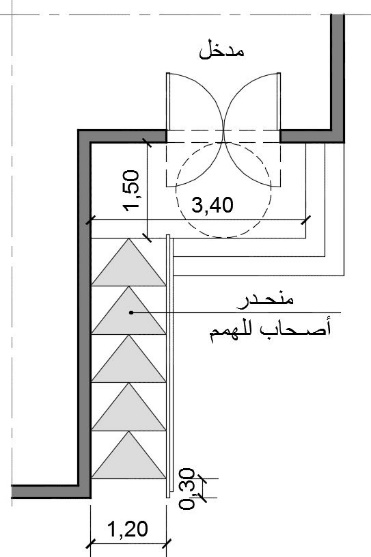
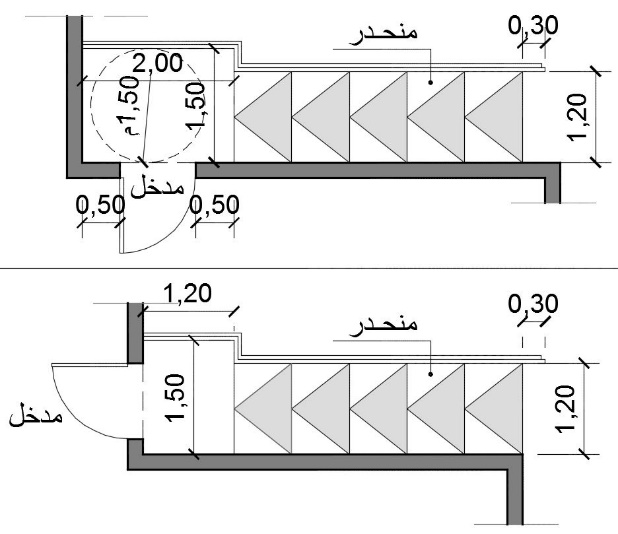
Article (34): Environmental Conditions and Energy Conservation
Environmental Requirements to be Observed in Building Design
The engineering office shall observe the following conditions when designing buildings:
Various environmental factors shall be considered (such as climatic conditions, solar radiation, ground nature, neighbouring context, noise levels, and other environmental factors), and thermal and acoustic insulation shall be used in roofs and walls. All conditions and specifications set out in the approved Green Building Requirements Regulation "Barjeel" shall be followed when preparing designs for various buildings.
Approval from the Environment and Development Protection Authority in the Emirate shall be obtained for projects that include uses causing direct or indirect environmental pollution of any kind, and all environmental protection conditions approved by the competent authority shall be applied.
Solar radiation directions shall be studied, and architectural elements shall be employed to minimize their negative effects, and prevailing wind directions shall be studied and utilized to the building's benefit.
Materials that do not cause harm to the environment, public health, or detract from the general appearance of the city, such as temporary structures, shall be selected both during and after their use, in accordance with the competent authority's specifications.
No buildings with asbestos roofing shall be permitted in accordance with Cabinet Resolution No. (39) of 2006, nor any material proven harmful to public health. Undertakings to remove such roofing from existing buildings shall not be accepted for licensing purposes, and the owner shall be obligated to remove and replace them with safer materials.
Public health conditions inside and outside the building shall be observed, including the study of ventilation movement and quantity, lighting, solar radiation and shadows, and the selection of materials, paints, and similar elements.
Privacy and screening shall be observed when preparing designs for various buildings, and boundary walls of appropriate heights and designs approved by the competent authority shall be constructed to separate different plots.
Environmental Requirements to be Observed During Construction
The engineering office and contractor shall observe the following conditions during construction:
Approved pesticides shall be used to control insects including termites in the ground floor slab and wherever necessary.
The provisions of the Environment and Development Protection Authority legislation in the Emirate shall be observed in all matters relating to wastewater reuse and disposal, air quality control, occupational health, swimming pools, safety of children's play equipment in buildings, noise control, and natural reserve systems.
The removal or cutting of perennial and existing trees within the plot boundaries shall not be permitted without obtaining the necessary written approval from the Environment and Development Protection Authority.
The maximum noise level generated by any equipment or construction works shall not exceed 55 decibels between 7:00 AM and 8:00 PM, and shall not exceed 45 decibels between 8:00 PM and 7:00 AM.
The demolition, removal, or modification of heritage and historical buildings and architectural elements shall not be permitted without approval from the competent authority.
Work shall be stopped and the municipality notified immediately upon discovery of any antiquities or archaeological sites, or upon causing damage to utility lines, buildings, streets, or the surrounding environment.
The necessary conditions to minimize adverse environmental impacts during construction phases at the site shall be ensured, including: a. Adherence to working hours as specified by the competent authority. b. Work at construction sites shall not be permitted after 8:00 PM and shall not commence before 6:00 AM in inhabited areas. The competent authority may grant permits to exceed these hours where justified, without prejudice to taking the necessary precautions to avoid disturbing neighbouring properties. c. The necessary measures to limit the noise level generated by equipment and machinery operating at the site shall be taken, with adherence to the permitted noise level. d. The necessary measures to limit dust and particulate emissions shall be taken through the following means:
Spraying dust and sites with water when exposed to dust effects.
Covering vehicle entrances and movement areas with appropriate materials or continuously spraying them with water to prevent dust emissions.
Prohibiting the direct disposal of debris from upper floors without using protective barriers.
Taking the necessary precautions during the transportation and unloading of building materials.
The necessary measures to limit gas and smoke emissions from equipment and machinery used at work sites shall be taken, ensuring they are maintained within the permitted level.
The necessary precautions at work sites shall be taken to maintain site cleanliness and the safety of the surrounding environment, including neighbouring buildings, streets, utility lines, pavements, landscaping, and similar elements.
Building materials shall be delivered and stored at the site in a manner proportionate to its area and without detracting from the general appearance. Petroleum and chemical materials shall be stored in confined areas away from direct daily movement, under constant supervision, and in small quantities.
Appropriate procedures and necessary programmes shall be implemented for the collection, sorting, and storage of waste and debris at work sites, and their subsequent transportation to designated disposal areas in a manner that prevents accumulation at the site or pollution of the surrounding environment.
The approved Green Building Requirements Regulation "Barjeel" of the competent authority shall be referred to and followed in all matters relating to thermal insulation works details.
Requirements to Be Observed During Operation
The consultant and contractor shall observe the following conditions during operation:
Buildings exceeding ground plus one floor in height and incorporating large, glazed areas on facades shall be equipped with the necessary equipment and devices for external glass cleaning in accordance with the competent authority's requirements. Where the building height exceeds ground plus six floors, the consultant shall submit a study or plan showing the method of operation of the glass cleaning equipment and devices, their movement on the roof, and their storage.
Building materials used on building facades shall be non-falling onto pedestrians, and their installation shall comply with the approved technical conditions and specifications of the competent authority.
Article (35): Fire Prevention and Safety
The approved standards and requirements for all buildings issued by the Civil Defence Department — "UAE Fire Prevention, Safety, and Life Protection Code" — shall be the primary reference for all matters relating to security, safety, fire prevention and suppression, and life protection.
All buildings exceeding twenty (20) floors in height shall be provided with a helicopter landing pad complying with the approved standard specifications of the Civil Aviation Department.
In high-rise and skyscraper buildings constructed on podium base floors where the distance from the fire engine route to the facade of the high-rise or skyscraper building exceeds 30 meters, fire truck access to the podium platform shall be provided in accordance with the requirements of Section 2.8, Chapter Two of the UAE Fire Prevention, Safety, and Life Protection Code.
External building cladding shall be approved in accordance with Civil Defence Department requirements.
All staircases and corridors shall be provided with natural and mechanical ventilation means in accordance with Civil Defence Department requirements.
Staircase enclosure areas and pump room areas shall be approved within the architectural plans submitted to the Civil Defence Department, as their areas vary according to requirements.
The responsibility for maintaining fire alarm and firefighting equipment and systems within buildings lies with the owner. The tenant shall be responsible for removing obstructions from evacuation corridors and maintaining fire alarm and firefighting equipment and systems in the leased area, ensuring the devices are operational and that electrical power is not disconnected from them at any time.
No barriers or obstructions shall be permanently fixed on external facade windows located on floors above the ground floor unless they are easily openable.
All requirements, conditions, and general building safety systems stipulated in the environmental, public health, occupational safety, and fire prevention legislation in force in the Emirate shall be observed.
The minimum number and width of building exits and entrances shall be determined in accordance with the number and area of floors, building use, and the standards approved by the competent authority.
Staircase doors, apartment and office doors, and all their accessories and fittings shall be fire-resistant in accordance with rates approved by the competent authority, smoke-proof, and self-closing.
All staircases shall be provided with normal and emergency ventilation and lighting means in accordance with the standards approved by the competent authority.
All buildings shall be provided with self-illuminated signs and directional boards in all corridors, staircases, and internal courtyards of the building, clearly indicating staircases, elevators, and exit and evacuation locations within the building.
All corridors leading to emergency exits shall be kept clear of anything that obstructs freedom of movement and always exit from the building.
Parking and staging areas for emergency vehicles shall be subject to the requirements of the UAE Fire Prevention, Safety, and Life Protection Code, and dedicated stopping areas for civil defence vehicles shall be provided within the site or on surrounding roads.
Table 60: Requirements for Firefighting Vehicle Entrances and Access Routes
Standard / requirement | Specification |
Minimum entrance width | 4.5 m |
Minimum entrance height | 4.5 m |
Minimum access road width | 6.0 m |
Maximum uninterrupted access road length | 45 m |
Maximum gradient of access road | 10% |
Minimum turning radius | 12 m |
Firefighting vehicle weight (structural design consideration) | 41–81 tons |
Notes:
| |
Article (36): Insulation Materials
The following provisions shall apply to thermal and moisture insulation materials:
Moisture insulation layers shall be provided on bathroom, kitchen, and toilet floors.
Moisture and thermal insulation layers shall be applied to the roof slab of the building to protect the top floor from rainwater leakage and heat. Roof insulation (moisture barrier and thermal insulation layer) shall be implemented as per the consultant’s approved design and in accordance with applicable technical standards.
Moisture insulation shall be applied around building foundations up to a height of 30 cm above natural ground level.
All corrosion-prone metal elements shall be coated and protected with insulating materials and maintained periodically, particularly drainage and water supply pipes.
External walls and roof materials shall be homogeneous, non-absorbent to water, moisture, and water vapor, durable, resistant to environmental conditions, dimensionally stable, and have low expansion/contraction characteristics. They shall resist thermal shock and rapid temperature changes without physical deterioration, provide fire resistance where exposed, prevent fungal growth, and be resistant to microbial, rodent, and insect infestation as well as chemical degradation.
Reference shall be made to the approved Green Building Regulations “Barjeel” regarding building envelope performance, cooling load calculations, and lighting systems.
Article (37): General Design Principles for All Urban Projects
These requirements represent the minimum mandatory standards applicable to all urban development projects:
The finished floor level of buildings shall be raised at least 90 cm above adjacent road levels to protect against rainwater, and shall not exceed the permitted level based on building type.
Consultants shall ensure stormwater management within plot boundaries for all open spaces (courtyards, entrances, roofs, and basements). Discharge outside the plot or into public right-of-way is prohibited. Stormwater shall be directed using approved systems (connection to public network or storage tanks), ensuring protection of building foundations and neighboring properties with adequate waterproofing.
Consultants shall provide engineering solutions for level differences between plot design levels and road levels (existing or future), based on approved survey data. All works shall be confined within plot boundaries or designated areas; external works beyond plot limits are not permitted.
Roof service installations shall consider aesthetic requirements. Mechanical services shall not be placed on roofs of buildings adjacent to boundary walls unless concealed within parapets or architectural enclosures and shall be included in building height calculations.
For urban aesthetics:
No air-conditioning units or ducting shall be installed on building façades, and window-type AC units are not permitted.
All air-conditioning units shall be installed on roofs and shall not be visible from outside the building.
Minimum thickness of internal partition walls between rooms and corridors shall not be less than 20 cm, and all external walls shall also have a minimum thickness of 20 cm.
For gymnasiums located on roofs or mezzanines, structural slab design shall account for the equipment loads to be installed.
Access to rooftop residential spaces shall be exclusively via lift lobby or stair core distribution areas.
Seventh: Requirements for Horizontal and Vertical Circulation and Access Elements |
Article (38): Corridors
Public Corridors
The minimum clear width of public corridors in specialized buildings shall be determined according to the nature of use, provided that it shall not be less than 2.40 m.
The minimum clear width of corridors in front of elevators shall depend on the width of the main corridor leading to them and whether the elevators are located on one side or both sides. In all cases, the dimensions of corridors in front of elevators shall not be less than those specified in Figure No. (42).
The competent authority may permit a reduction in corridor widths in cases where the shape or dimensions of the plot do not allow the provision of public corridors with the required widths in accordance with the above provisions.
Internal Corridors
The minimum clear width of internal corridors between different units shall not be less than 1.20 m.
|
Figure No. (42) illustrates the minimum clear width of public corridors in front of elevators. |
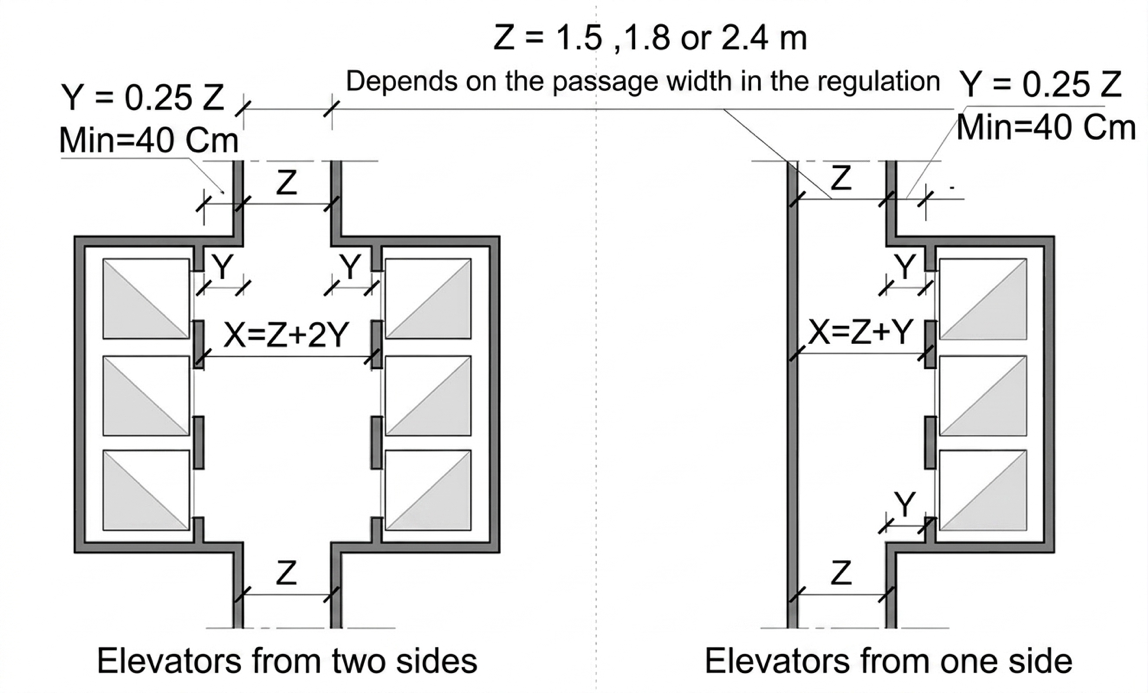
Article (39): Arcades (Liwan)
In buildings overlooking streets where arcades are required, arcades shall be provided in front of the façades of such buildings in accordance with the following conditions:
The design and construction of arcades shall comply with the architectural style, form, and height determined by the competent authority.
Decorative projections within the arcades are permitted in accordance with the following conditions:
Decorative ornaments and architectural elements shall not exceed 0.30 m in projection and shall be located at a height of not less than 3.00 m above the arcade floor level.
Window sills, window edges, and column shoulders within ground-floor arcades shall not project more than 0.15 m.
The installation of advertising signboards approved for the area shall comply with the applicable regulations and legislation in force within the Emirate.
Arcade openings shall be regular and harmonious in design.
The arcade shall be designated for public passage, and no obstacles or encroachments shall be placed within it that may prevent or obstruct its intended use. Arcades of connected buildings shall maintain continuity, and their levels shall be coordinated to serve public movement.
Article (40): Stairs
The minimum number of exit staircases, staircase widths, staircase separation, exit discharge organization, and staircase enclosure fire resistance rating shall be determined in accordance with Chapter Three of the Civil Defence Department requirements (UAE Fire Prevention, Safety, and Life Protection Code — 2018). In all cases, the requirements of Item (3-40) of this Regulation and the following table shall be met:
Table 61: Requirements for Providing a Single Staircase According to Building Occupancy
# | Occupancy Type | Required Conditions |
1 | Administrative (Offices) | A single staircase is permitted for buildings with a height not exceeding 15 m. |
2 | Educational | Not permitted |
3 | Healthcare | Not permitted |
4 | Residential (Residential Units – Apartments) GROUP A | A. A single staircase is permitted provided that all of the following conditions are met: |
5 | Residential (Staff Accommodation) GROUP B | Not permitted |
6 | Residential (Labor Accommodation) GROUP C | Not permitted |
7 | Commercial and Educational | Not permitted |
8 | Hotels | Not permitted |
9 | Rural Rest Houses | Not permitted |
10 | Commercial | Permitted, subject to the following exceptions: |
11 | Warehouses | A single staircase is permitted in the following exceptional cases: |
12 | Industrial | Not permitted |
13 | Parking | Not Permitted |
Table 62: Minimum required number of exits (stairs in buildings).
# | Building Criteria | Minimum Required Number of Exits |
1 | Any Building or Floor | Two (2) Exits |
2 | Occupant Load* Less than 500 | Two (2) Exits |
3 | Occupant Load Between 500 – 1000 | Three (3) Exits as a Minimum |
4 | Occupant Load Greater than 1000 | Four (4) Exits as a Minimum |
5 | Mezzanines / Balconies | Two (2) Means of Egress as a Minimum |
6 | Occupant Load Greater than 6000 for Open Areas | Two (2) Means of Egress as a Minimum |
7 | Occupant Load Greater than 9000 for Open Areas | Location of the Exit and Any Point on the Floor |
Occupancy Load*: The total number of persons expected in the building (the total number shall be calculated using the occupancy load factor in Table 3.13 of Chapter Three of the UAE Fire Prevention and Life Protection Code, or Appendix No. (1) of this Regulation). | ||
Stair Location
The following specifications shall be observed when selecting staircase locations:
Ease of access from any point in the building, with locations as close as possible to streets or lanes.
The distance between the farthest point on the floor or the entrance of any residential apartment and the staircase enclosure door shall not exceed the requirements of the Civil Defence Department.
Where a staircase is located immediately after a door, a minimum distance of 1.10 meters shall separate them, and inclined steps are not permitted to prevent tripping or falling.
Stair Dimensions and Measurements and Calculation of Number of Steps
The clear staircase width shall be determined based on exit width calculations. In all cases, the minimum width shall not be less than 1.10 meters in residential and office buildings, and 1.50 meters in public buildings. The landing width shall not be less than the staircase width itself.
The maximum number of consecutive steps in one direction shall not exceed 14 steps, except for spiral staircases and special designs. The maximum height of a single step shall not exceed 18 cm, its width shall not be less than 28 cm and not more than 32 cm. Staircase dimensions shall be determined according to the following formula: [2 × step height + step width = 60 cm to 65 cm].
Step dimensions in height and width shall be uniform on the same floor.
The minimum clear height above any step shall be 2.40 meters.
The number of consecutive steps in the same direction shall not exceed 14 steps.
Requirements for Exit Stairs (Emergency Stairs)
The following additional requirements shall apply to exit stairs:
The minimum width of fire escape stairs shall not be less than 1.20 m. Where the stair width exceeds 2.40 m, a handrail shall be provided at the center or at every 1.20 m interval.
Interlocking (scissor) stairs shall be considered as one exit only.
A single exit stair is permitted for new low-rise residential buildings (apartments, labor accommodations, staff accommodations, and lodgings) not exceeding 15 m in height, subject to the following conditions:
The area of the typical floor shall not exceed 500 m².
The maximum number of residential units shall not exceed six (6) units.
The distance from the residential unit door to the stair exit shall not exceed 10.7 m.
The exit stair door shall be designed with a fire-resistance rating of two hours, with a minimum width of 1200 mm, and shall discharge directly to the outside at street level.
The corridor leading to the single exit stair shall have a fire-resistance rating of one hour.
Two exits shall be provided from every part of each floor in buildings classified as staff accommodations, residential buildings, residential majlis and care facilities, hotel and tourism buildings, educational buildings, healthcare buildings, and parking structures. Single exits shall not be permitted.
The minimum separation distance between exit stairs shall be determined as follows:
In sprinklered buildings, the minimum separation distance between two exits shall not be less than one-third (1/3) of the maximum overall diagonal dimension of the building or the area served.
In non-sprinklered buildings, the minimum separation distance between two exits shall not be less than one-half (1/2) of the maximum overall diagonal dimension of the building or the area served.
Exit stairs serving high-rise buildings, mid-rise buildings, deep underground buildings, and buildings connecting four floors or more shall be enclosed with reinforced concrete walls having a fire-resistance rating of not less than two hours. Exceptionally, stair enclosures serving low-rise buildings or shallow underground buildings may be constructed using fire-rated masonry walls with a fire-resistance rating of two hours, in accordance with Civil Defense requirements.
Staircases shall be provided with smoke-proof doors having a fire-resistance rating of not less than one hour. Such doors shall be self-closing, allow visibility from both sides, and open outward in accordance with fire and life safety requirements.
At least one protected exit stair shall extend to all roof levels.
Emergency stairs shall be provided with adequate natural and artificial lighting, as well as natural ventilation openings with an area not less than 1.00 m² per floor.
Emergency escape stairs serving upper floors shall not continue to the basement. A separate staircase shall be provided for the basement. Where this is not feasible, the continuity of the stair enclosure at the ground floor shall be interrupted by a fire barrier wall extending to the ceiling, so that basement access is provided directly from the outside.
The number of continuous emergency escape steps in the same direction shall not exceed fourteen (14) steps and shall not be less than three (3) steps. The maximum riser height shall not exceed 17 cm. Sloped steps within emergency stair landings are not permitted, and spiral staircases shall not be used as escape stairs.
Fire escape exits in all buildings shall be provided with clear signage indicating their locations in accordance with the UAE Fire and Life Safety Code.
General Requirements
Main staircases in residential, commercial, and public buildings shall be constructed of non-combustible and slip-resistant materials (except villas). Adequate natural ventilation and lighting shall be provided through windows opening directly onto the external space or ventilation shafts. High-rise towers exceeding ten (10) floors are exempted from natural lighting and ventilation requirements, provided that mechanical ventilation and electrical lighting are supplied in accordance with the UAE Fire and Life Safety Code.
Stair enclosures shall be provided with doors on all floors.
A protective guardrail shall be installed along the open side of the stair, with a minimum height of 1.10 m. Openings within the guardrail shall not exceed 13 cm in width. Where the stair width exceeds 2.20 m, an additional central handrail or divider shall be provided as required.
Stair exits in all buildings and floors shall be provided with clear signage indicating their locations.
All approved fire and life safety requirements and specifications issued by the Civil Defense Department and the competent authority shall be complied with when designing stairs of all types.
Article (41): Elevators
Elevator Location
Elevator locations shall be selected to ensure easy accessibility from any point within the building. Elevators shall be positioned in visible locations, close to one of the staircases, and as near as possible to the main entrance of the building. The maximum travel distance between the elevators and the farthest unit shall comply with the requirements specified according to the building type as indicated in Table No. (63).
For buildings exceeding twenty (20) floors, it is preferable to divide the elevators into multiple groups, with each group serving a specific range of floors.
Table 63: Maximum travel distance to elevator locations according to building type.
# | Building Type | Maximum Travel Distance (m) | Measurement Reference Point |
1 | Residential | 60 | Between the elevator location and the entrance door of the residential unit farthest from the elevator |
2 | Open Offices | 60 | Between the elevator location and the farthest point on the office floor |
3 | Commercial Shops (such as shopping malls and retail centers) | 150 | Between the elevator location and any point on the floor |
4 | Hotel and Tourism Buildings | 60 | Between the elevator location and the entrance door of the guest room farthest from the elevator |
5 | Assembly Buildings (such as entertainment buildings and indoor halls) | 150 | Between the elevator location and any point on the floor |
6 | Educational | 150 | Between the elevator location and any point on the floor |
Conditions for Providing Elevators in Multi-Storey Buildings
Multi-storey buildings shall be provided with electric elevators in accordance with the following requirements:
Buildings exceeding a ground floor plus three floors shall be provided with electric elevators of adequate capacity in accordance with standard technical specifications and approved fire prevention and safety requirements.
Public buildings shall be provided with electric elevators or escalators of adequate capacity in accordance with standard technical specifications and approved fire prevention and safety requirements (subject to Civil Defence approval).
Shopping centers consisting of more than one floor shall be provided with glass-front electric elevators with a minimum capacity of ten (10) persons per elevator, or with escalators.
Determination of Number of Elevators
The number and capacity of elevators in a building shall be proportional to the number and area of floors. The total required number of elevators for the building shall be calculated as the sum of the number of elevators required according to the total building area as specified in Table No. (64), and the number of elevators required according to the number of building floors as specified in Table No. (65).
Table 64: Minimum number of elevators according to the total building area.
# | Total Building Area (m²) | Minimum Required Number of Elevators |
1 | From 1 to 4,500 | 1 |
2 | From 4,501 to 14,000 | 2 |
3 | From 14,001 to 23,500 | 3 |
4 | From 23,501 to 100,000 | 4 elevators for areas from 23,501 m² up to 37,500 m². |
5 | From 100,001 to 250,000 | 9 elevators for areas from 100,001 m² up to 120,000 m². |
6 | Building area exceeding 250,000 m² | A special study shall be submitted to the competent authority. |
Table 65: Minimum Number of Elevators According to Number of Building Floors
# | Number of Floors | Minimum Additional Number of Elevators Required |
1 | Floors from 11 to 30 | 1 |
2 | Floors from 31 to 60 | 2 |
3 | Floors from 61 to 90 | 3 |
4 | Floors from 91 to 120 | 4 |
5 | More than 120 floors | A special study shall be submitted to the Technical Committee of the competent authority. |
The number of elevators required under Clause (1) of this Article shall be considered the minimum required number of elevators, and reducing this number shall not be permitted even when elevators with higher speed or larger capacity are selected.
General Requirements
The consultant shall submit an elevator design study prepared by a specialized consultant for multi-storey buildings and public buildings. The study shall address the number, capacity, load, dimensions, speed, waiting time, stopping stations, and distribution of elevators based on scientific traffic analysis, building type, occupancy, peak hours, and the requirements of the concerned authorities. The design shall also include the dimensions of machine rooms, elevator shafts, and shaft pits. The consultant shall bear full responsibility for the design.
It is preferable that the number of adjacent elevators on one side serving all floors jointly shall not exceed four (4) elevators. If the number exceeds this limit, elevators should preferably be divided into groups serving designated floors.
All elevators shall be subject to periodic inspections to verify their operational safety. The building owner shall obtain an annual fitness certificate issued by a company approved by the competent authority.
A protected lobby with a door shall be provided in front of the elevator to protect against rain and various weather conditions in cases where the elevator extends to the roof floor.
Technical Requirements
The capacity of any elevator shall not be less than four (4) persons in accordance with approved elevator technical specifications and standards. Elevator load capacity shall be determined to achieve a transportation capacity ranging between 10% and 25% of the building occupant load within five minutes, depending on the building type and usage.
Elevator speeds should preferably not be less than the following:
Up to 4 floors: from 0.5 m/s to 0.75 m/s.
From 5 to 10 floors: from 1 m/s to 2 m/s.
From 11 to 20 floors: from 2 m/s to 3 m/s.
From 21 to 50 floors: from 3 m/s to 5 m/s.
More than 50 floors: more than 5 m/s.
Elevators, elevator shafts, machine rooms, and control systems shall comply with the elevator standards approved by Civil Defense.
Elevator shafts shall comply with the following requirements:
Shaft dimensions shall conform to the technical specifications of the elevator manufacturer.
Parts exposed to water within the elevator shaft shall be treated with waterproofing materials to prevent water leakage.
Elevators shall be equipped with an electrical locking system and an alarm system (audible or visual) that activates when the maximum load is exceeded. The elevator shall stop operating if the load exceeds the permissible limit specified by the manufacturer and shall resume operation automatically once the load returns within the allowable limit. Elevators shall also be provided with an emergency lowering system. Adequate mechanical ventilation shall be provided for passenger cabins, even during prolonged stoppages or power outages. Elevators shall be equipped with a mechanism preventing door closure in the event of contact with a person or object without causing harm. Suitable internal lighting with an intensity of not less than 50 lux at floor level shall also be provided. Compliance with all elevator system requirements contained in the environmental, occupational safety, and Civil Defense regulations in force within the Emirate is mandatory.
All necessary electrical safety devices shall be provided to prevent unintended machine movement or to stop operation safely. Passenger cabins shall be equipped with control and safety systems enabling automatic and manual lowering and door opening to the nearest exit in the event of sudden stoppage, malfunction, or emergency. Where the elevator motor temperature exceeds the maximum limit specified by the manufacturer, the elevator shall complete ongoing commands while rejecting any new commands.
Instructional and warning signs shall be installed inside elevators indicating no smoking, the permissible number of passengers, and the allowable load capacity. Additional warning signs shall be installed beside each elevator door indicating that elevators must not be used in case of fire.
Elevator shafts shall be enclosed by solid walls structurally designed to withstand loads, reactions, and vibrations generated by the machine, guide rails, safety brakes, uneven load distribution inside the cabin, and end buffers.
Elevator shafts shall be provided with inspection and emergency openings, as well as permanent lighting for inspection and maintenance operations, in accordance with approved safety codes and standards. Expansion joints or structural joints within the elevator shaft or machine room are strictly prohibited. No services or installations unrelated to the elevator system shall be placed within the elevator shaft.
Requirements for Elevator Equipment Rooms
The following conditions apply to elevator equipment rooms constructed on building rooftops:
Room dimensions shall be in accordance with the standard specifications of the elevator manufacturer.
The room shall be provided with a good air conditioning system to maintain a room temperature between 10°C and 32°C.
The room shall be provided with a securely closing door, and all other room openings shall be sealed to prevent dust or rainwater from entering.
All operational wiring and cables shall be concealed and made of good-quality, rust-resistant materials.
Appropriate covers shall be provided for all pulleys and moving parts
Elevator Requirements in Hotel Establishments
A minimum of two (2) elevators shall be provided for establishments containing fewer than 45 units. One additional elevator shall be added for every additional 30 repeated units. All guest rooms from the second floor and above shall be served by elevators.
Elevators shall comply with all requirements of the relevant governmental authorities and the regulations issued by the Ras Al Khaimah Tourism Development Authority.
Article (42) Ramps
Ramps may be included in calculating the required exits for evacuation from the building.
The dimensions of vehicle ramps shall comply with the dimensions specified in Article No. (31) of these Regulations.
The slope of ramps designated for pedestrians in public buildings, residential buildings, and administrative towers shall not exceed (1 to 12). The competent authority may amend the ratio to (1 to 10) whenever convincing technical reasons exist. The dimensions and slopes of ramps designated for People of Determination shall comply with Article No. (33) of these Regulations.
Ramp flooring shall be rough or treated in a manner that prevents slipping, and the corners of adjacent columns and walls shall be protected with rubber corner guards. These ramps shall also be protected from any projections or structures that may obstruct movement or hinder their safe and proper use.
Ramps shall be provided with reflective mirrors in accordance with the specifications stated in Article No. (31) of these Regulations.
The clear height above any point on the ramps shall not be less than (2.40) m, measured vertically to the ramp surface.
Natural or mechanical ventilation and lighting shall be provided for all parts of the ramps in accordance with the approved standard specifications, and they shall be equipped with all necessary installations for rainwater drainage.
Article (43) Loading and Unloading Areas
Loading and unloading areas shall be provided in all industrial facilities, including warehouses and workshops, and in specialized buildings that require such areas, provided that the minimum dimensions and area of loading and unloading platforms and zones comply with Table No. (66).
The provisions applicable to vehicle parking entrances and exits, as stated in Article (31) of these Regulations, shall apply to loading and unloading areas. In all cases, service lanes with a clear width of not less than (4.5) m for one-way traffic and (9.00) m for two-way traffic shall be provided to ensure the smooth movement of service vehicles.
Loading and unloading areas shall be located within the plot boundaries, away from streets and public areas. Their locations shall be determined in the rear or side portions of buildings in accordance with the designated access point of the plot in the site plan and the requirements of the development regulations.
Loading and unloading areas may be located in the building basement, provided that an appropriate clear height and manoeuvring space are maintained in accordance with the dimensions of the vehicles entering the facility.
All loading areas within the plot shall be provided with drainage installations and adequate lighting.
Table 66: Minimum dimensions of loading areas.
Truck Length in meters (L) | Width of the Loading Area in meters (D) | Loading Platform Dimensions in meters | Minimum Clear Height in meters (H) |
12 | 4 | 4 x 4 | 4.5 |
15 | 4 | 4 x 4 | 5 |
20 | 4 | 4 x 4 | 5 |
|
Figure (43): Net Dimensional Requirements for Loading Areas |
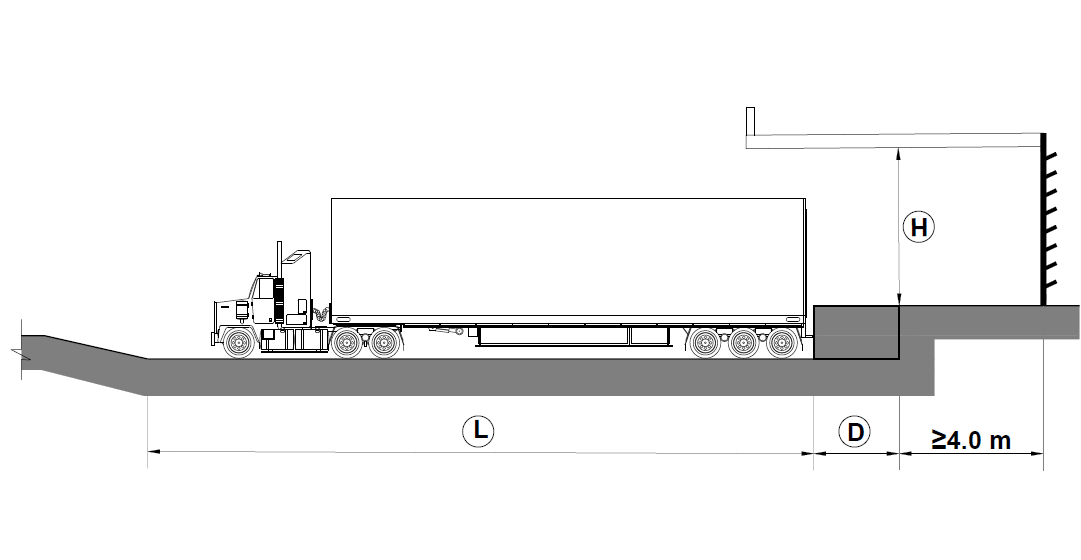
The area of the loading and unloading zone within the plot boundaries designated for specific uses shall be determined and designed in accordance with the type of land use and the dimensions of the expected trucks, as illustrated in the following table:
Table 67: minimum number of loading spaces and truck size according to the building use.
Use | Minimum Number of Loading Areas / Truck Size |
Hotels and Shopping Centers | One loading area for a truck with a length of 12 m |
Industrial | One loading area for a truck with a length of 15 m |
Any other loading area required within the plot boundaries | One loading area for a truck with a length of 9 m |
Additional space shall be provided in front of the loading and unloading area, designated for the manoeuvring of heavy vehicles, such that its width is directly proportional to the truck length and parking angle. The width of the manoeuvring area shall increase with the increase in vehicle length or the increase in the inclination of the parking angle relative to the traffic path, in accordance with the attached standards and drawings. The consultant shall submit a manoeuvring path analysis plan to ensure smooth traffic flow and the safety of site users, if requested.
|
Figure (44): Designated Manoeuvring Area for Trucks and Heavy Vehicles |
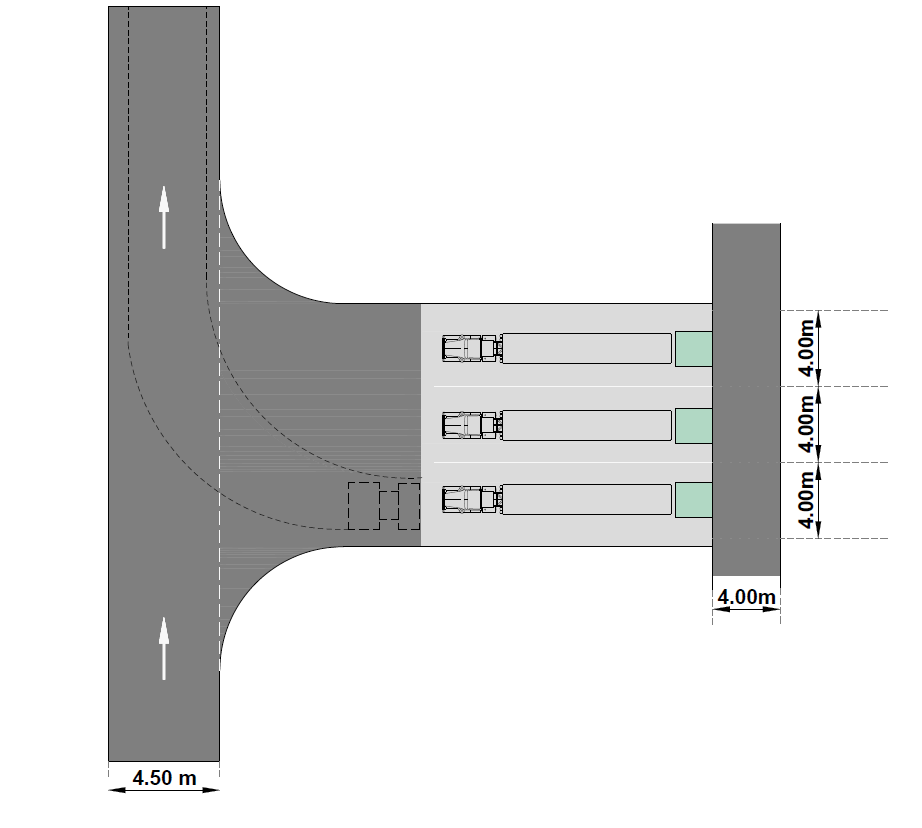
Eight: Public Utilities Requirements |
Article (44): Utility Services (Electricity – Telephone – Water – Building Services)
The consultant shall coordinate with the local utility authorities in the Emirate to obtain the requirements that must be provided within the building (such as electrical power, telecommunication rooms, and other services), and to identify and determine the locations of service inlets and outlets before finalizing the designs and drawings.
Electrical rooms in buildings shall comply with the following requirements:
They shall be approved by the Emirates Water and Electricity Company (EWE).
Meter room doors shall be constructed of non-combustible materials and provided with ventilation openings. A ventilation fan shall also be installed in one of the room walls.
Fire and life safety requirements shall be provided in accordance with Civil Defence regulations.
The dimensions and design of transformer rooms and electrical rooms shall be determined according to the number of required transformers and in accordance with the approved details issued by Emirates Water and Electricity Company, as follows:
One transformer: Transformer room dimensions shall be 5 × 5 m, and the electrical room dimensions shall be 3 × 5 m.
Two transformers: Transformer room dimensions shall be 5 × 8 m, and the electrical room dimensions shall be 3 × 5 m.
Three transformers: Transformer room dimensions shall be 5 × 11 m, and the electrical room dimensions shall be 3 × 5 m.
The requirements and specifications for the design of telecommunication rooms in buildings shall comply with the joint specification manual for the design of telecommunication rooms in buildings: (In-Building Telecommunication Network – Specification Manual)
Main Telecommunication Room, Typical Floor Telecommunication Rooms, and Mobile Service Rooms The dimensions and design requirements of the main telecommunication room, telecommunication rooms for repeated floors, and mobile service rooms shall be in accordance with the following table:
Table 68: Dimensions of the main telecommunication room for different building types.
Building Type | Main Telecommunication Room Dimensions (L × W × H) in meters | Typical Floor Telecommunication Room Dimensions (L × W × H) in meters | Mobile Telecommunication Service Room Dimensions (L × W × H) in meters | |
1 | Single Villa | No requirements | No requirements | No requirements |
2 | Villa Complex | No requirements | No requirements | No requirements |
3 | Buildings: | (2.00 × 2.00 × 3.00) | (1.00 × 0.60 × 3.00) | Location: |
4 | Buildings: | (3.00 × 3.00 × 3.00) | (1.00 × 1.00 × 3.00) | Location: |
5 | Buildings: | (3.00 × 3.00 × 3.00) | (1.50 × 1.50 × 3.00) | Location: |
6 | Buildings with occupancy exceeding 300 residents | (3.00 × 3.00 × 3.00) | (2.00 × 2.00 × 3.00) | Location: |
7 | Shopping Malls and Commercial Centers | (3.00 × 3.00 × 3.00) | To be determined during design | Floor rooms and roof room to be determined during design |
8 | Bulk Services Buildings | (3.00 × 3.00 × 3.00) | To be determined during design | Floor rooms and roof room to be determined during design |
9 | Warehouse Complexes, Labor Accommodation, and Factories | (2.00 × 3.00 × 3.00) | (1.00 × 1.00 × 3.00) | Not applicable |
Reduction of mobile service room dimensions or use of a floor telecommunications room as an alternative shall be determined during No Objection Certificate approval review. | ||||
Dimensions of Mobile Telecommunication Service Rooms
(Size of Mobile Service Room and Rooftop Mobile Room)
Table 69: Dimensions of Telecommunication Rooms for Mobile Services According to Number of Floors
Number of Floors | Dimensions of Mobile Service Room (L × W × H) in meters | Dimensions of Rooftop Room (L × W × H) in meters | |
1 | Up to Ground + 10 Floors | Not Applicable | (3.00 × 3.00 × 3.00) |
2 | From Ground + 11 Floors up to Ground + 100 Floors | (3.00 × 3.00 × 3.00) | (3.00 × 3.00 × 3.00) |
3 | Shopping malls and Large Service Centers | To be determined upon review and consultation with mobile service operators | |
4 | Building Complexes Exceeding Ground + 5 Floors | To be determined upon review and consultation with mobile service operators | |
The structural loads to be considered during the design of telecommunication room floors shall comply with the following table:
Table 70: Design Loads for Telecommunication Room Floors
Type of Telecommunication Room | Floor Load | |
1 | Main Telecommunication Room or Floor Telecommunication Room (MTRs and FTRs) | 10 kN/m² (Distributed Load) |
2 | Mobile Service Telecommunication Room (MSRs) | |
3 | Rooftop Telecommunication Room | |
General Requirements:
In multi-storey buildings, telecommunications rooms shall be aligned vertically and connected by a shared vertical system without compromising the minimum room dimensions.
Telecommunications rooms shall not be located below or adjacent to wet spaces or water sources such as bathrooms, restrooms, handwashing rooms, ablution areas, swimming pools, or refuse rooms.
Telecommunications rooms shall be kept away from the following sources: heat, humidity, climate or environmental conditions causing corrosion, radio frequency interference, and electromagnetic interference.
Where a design is submitted for compelling technical reasons with part of a telecommunications room near a water source, the solution shall be approved at the design stage by the competent authority, consisting of installing a floor drain (raised slab), an automatic submersible pump to address any risk of water entering the room, and water leak detection sensors inside the room.
The main telecommunications room shall be on the ground floor or basement, with doors opening outward, a minimum door width of 1.00 m and height of 2.10 m, and two-hour fire resistance.
Telecommunications room requirements shall comply with the latest edition of the In-Building Telecommunication Network Specification Manual issued by the Telecommunications Regulatory Authority..
The requirements for telecommunications rooms must comply with the latest edition of the In-Building Telecommunication Network Specifications Manual issued by the Telecommunications Regulatory Authority.
Water and electricity meters for residential units must not exceed one water meter and one electricity meter for each separate residential, commercial, or office unit according to the approved plan. Additional meters are not permitted for annexes in houses and residential villas, rooftop gyms, or when separating buildings or parts thereof without authorization from the competent authority, or when separating the first floor from the ground floor in two-storey residential houses and villas.
All building components must be provided with the necessary electrical installations, telephone lines, and television reception systems. All required facilities such as electrical rooms, telephone rooms, and internal and external extensions must also be provided in accordance with the specifications and conditions approved by the local authorities in the emirate. Service areas are exempted from telephone and television reception extensions.
All manufactured materials related to utility services must fully comply with the approved conditions and specifications of the concerned authorities. Service room doors must open outward.
A guidance/information board must be provided at the entrances of buildings, preferably near the elevator and in a clearly visible location, for all multi-storey buildings containing more than (10) apartments or offices.
When placing any equipment, service devices, water tanks, or satellite dishes for television broadcasting, the necessary architectural treatments must be carried out to prevent distortion of the building’s general appearance.
In the design of residential apartments, spaces or means for hanging and drying laundry must be provided and allocated in a manner that prevents them from being visible externally or from distorting the general appearance.
Architectural treatment must be provided on façades to conceal air-conditioning units — except in multi-storey buildings — in a manner that prevents distortion of the general appearance. The distance between any air-conditioning unit and neighbouring property boundaries must not be less than (1.00 m).
All conditions and specifications stated in the approved thermal insulation regulations must be adhered to during the preparation of studies and designs, as well as during the construction of various buildings.
Article (45): Water Supply
The materials used, their specifications, the design of networks, and the workmanship related to water supply installations must comply with the conditions and specifications of the Emirates Water and Electricity Company (EWE).
Every building or facility must be connected to the public water network unless its water supply is secured by another method approved by the competent authority.
Article (46): Potable Water Tanks
Potable water tanks shall be manufactured from non-corrosive and rust-resistant materials that do not affect the physical or chemical properties of water, nor alter its colour, taste, or odour. Such tanks shall be resistant to heat and humidity, impermeable to light, and free from any harmful effects on human health.
Tanks shall be provided with cleaning openings of suitable size fitted with tightly sealed covers specifically designed for water tanks. These openings shall be large enough to allow a person to enter for periodic cleaning and shall be located in clean areas away from direct daily movement and pollution sources, and elevated above floor level.
Tanks shall be designed without sharp corners that may cause accumulation of dirt or bacteria or obstruct periodic cleaning operations.
Tanks shall be provided with openings for water filling, distribution, drainage, and ventilation sized appropriately to the tank capacity. Distribution outlets shall be located at least 6 cm above the tank floor level, drainage outlets shall be located at the tank bottom, and filling and ventilation openings shall be located at the upper section of the tank. All openings shall be fitted with control valves, and ventilation pipes shall be designed to prevent entry of contaminants or insects. All openings and connections shall be made of rust-resistant materials without harmful effects on human health.
Tanks shall be located in clean areas away from contamination sources and elevated at least 20 cm above floor level. Tanks shall be fixed in a manner that does not affect roof waterproofing layers. Tanks should preferably be located in shaded areas and arranged so as not to distort the building appearance or obstruct roof movement.
Water tanks shall be cleaned at least once every six months. Cleaning materials shall not contain toxic or harmful substances, and all health requirements during cleaning operations shall be strictly observed.
Water tank locations shall be selected as far as possible from sewer lines, inspection chambers, septic tanks, and soakaway pits. In all cases, tanks shall not be constructed outside the approved building line facing the street, nor shall sewer lines pass above or beside water tanks where tanks are located below ground level.
Water tank capacity shall be calculated according to the actual requirements of the building as determined by the competent authority.
Inspectors shall have the right to enter any building to inspect water tanks and verify compliance with health and technical requirements.
Underground water tanks shall be designed and located in accordance with the specifications and dimensions approved by the competent authority. They shall be constructed of reinforced concrete or equivalent materials and designed to safely withstand expected loads throughout their service life, including soil pressure, water pressure, and vehicle loads passing above them.
Article (47): Sanitary Works
Provisions and Conditions for Sanitary Works
Plans for sanitary works shall be approved by the competent authority in accordance with its established procedures.
The surfaces of toilets, urinals, and washbasins shall be smooth, easy to clean, and non-absorbent. These fixtures shall be manufactured and installed to ensure drainage without storage through a water trap protected from evaporation and drying. Toilet and urinal flush tanks shall be of an effective type capable of cleaning waste residue and withstanding operational stresses in public areas.
In buildings not exceeding 20 floors in height, ground floor sanitary drainage shall be connected separately and directly to the inspection chamber, and shall not be connected to the same vertical stacks serving upper floors.
In buildings exceeding 20 floors in height, ground and first floor sanitary drainage shall be connected separately and directly to the inspection chamber, and shall not be connected to the same vertical stacks serving upper floors.
The internal drainage system in buildings shall be provided with the necessary ventilation pipes of sufficient size for their intended use, with a minimum internal diameter of 5 cm for internal connections and 7.5 cm for vertical stacks. They shall be installed vertically and extended to a minimum of 1 meter above the highest opening in the building and at a horizontal distance of not less than 2 meters. The competent authority may require the ventilation pipe to be raised or extended further from openings where technical reasons necessitate this. Pipe ends shall be covered with appropriate caps.
Bidet discharge shall not be drained to floor drains or ordinary drainage stacks, and shall be discharged directly to soil stacks or inspection chambers through a deep water trap.
Soil pipes and ordinary sewer pipes buried underground shall be made of strong and durable materials, with diameters and gradients in accordance with the specifications issued by the competent authority. Their joints shall be airtight, shall not create any obstruction inside the pipes, and shall withstand a minimum pressure of 3 meters water head. These pipes shall be laid in a manner suitable for soil conditions and loading and in accordance with the manufacturer's instructions.
An inspection chamber shall be constructed at every point where the direction of sewer pipes changes, where the gradient changes, or where one pipeline connects to another. The maximum distance between any two consecutive inspection chambers shall not exceed 15 meters. Inspection chambers shall comply with the specifications issued by the competent authority.
Inspection chambers shall not be constructed inside roofed buildings except in light wells, corridors, service rooms, parking areas, and adequately ventilated corridors, and shall be of the dry type. Drainage pipes extending under floors and walls shall be protected from external works or floor settlement, and clean-out openings shall be secured at intervals not exceeding 10 meters.
All inspection chambers shall be constructed within the plot boundaries, and when designing and locating inspection chambers, appropriate locations and levels shall be selected for the last inspection chamber in terms of ease of connection to the public sewer network and compliance with the competent authority's requirements.
All basement floors shall be provided with appropriate means and equipment for water drainage and purification, such as sand settling chambers, pumps, grease traps, and similar. Where grease traps are not required in the current proposed design, the necessary provisions for their future installation shall be made.
Drainage pipes shall not be extended through columns, beams, foundations, or electricity rooms unless approved by the competent authority. In such cases, pipes shall be extended through openings pre-formed during concrete pouring, and the necessary flexible joints shall be provided.
Where large quantities of grease or oils are discharged into the sewer network from restaurants, kitchens, or similar facilities, an approved design grease and oil trap shall be installed.
Commercial and industrial waste shall not be discharged into the public sewer network without approval from the competent authority and service department. Such approval shall only be granted where appropriate preliminary treatment facilities are available. Water heater discharge exceeding 37°C shall not be discharged into the public sewer network before cooling.
Requirements for Sanitary Fixtures
The minimum sanitary fixtures required in specialized and public buildings not specifically covered in this regulation shall comply with special studies and internationally recognized standards and specifications, subject to approval by the competent authority.
At least 50% of sanitary fixtures (toilets) in public activity areas shall be of the eastern-style type.
Septic Tanks
Where a public sewer network is unavailable in the area where the building is to be constructed, the building shall be provided with septic tanks or collection tanks in accordance with the requirements of the Sewerage Authority in the Emirate and subject to the following conditions:
Septic tanks shall be located within the boundaries of the plot and shall not be constructed outside the approved building line facing the street.
Septic tanks shall be located close to the street or access road, away from the main building and neighboring properties, and easily accessible for cleaning, maintenance, and emptying, subject to approval by the competent authority. Provision shall also be made for future connection to the public sewer network.
Septic tanks shall be constructed of watertight reinforced concrete. Tank covers shall be designed to withstand vehicle loads where necessary.
Septic tanks shall be provided with tightly sealed heavy-duty covers of adequate dimensions.
The tank roof level shall not project above the surrounding ground level.
Tank capacity shall be suitable and calculated on the basis of daily per capita consumption according to standard tables.
Septic tanks shall be located not less than 1.00 m from adjacent buildings and boundary walls, and their depth shall not be less than 1.50 m below the invert level of the inlet pipe.
In areas with high groundwater levels or insufficient soil percolation rates, sewage collection tanks shall be constructed for wastewater storage until transported to locations designated by the concerned authority.
Septic tanks shall be designed in accordance with approved standard specifications and shall be provided with ventilation pipes in accordance with the requirements of the concerned authority. All openings shall be covered to prevent insect entry or escape.
Except for residential buildings, grease and oil traps shall be provided for kitchens and food preparation areas.
Rainwater Drainage
Suitable means shall be provided for the collection and disposal of rainwater to prevent moisture penetration.
All exposed roofs shall be finished with a slope ranging from 1:50 to 1:70 to direct water toward suitable channels or outlets connected to drainage pipes or gutters.
Channels, gutters, outlets, and drainage pipes shall have a minimum slope of 1:90 and shall be made of durable materials with watertight joints, adequate sizes, and secure fixing.
Rainwater shall not be discharged into sanitary drainage pipes, septic tanks, soakaway pits, or neighboring properties. Rainwater shall be discharged over the surface to streets and access roads. Rainwater may also be discharged directly into the public stormwater drainage network or soakaway pits in coordination with the concerned authority.
Air conditioning condensate and balcony water shall not be discharged directly onto streets or into rainwater drainage lines. Air conditioning condensate and balcony water shall be discharged into the public sewer network.
Wastewater shall not under any circumstances be discharged into the rainwater drainage network.
Article (48): Swimming Pools
Requirements for Swimming Pool Permits
Swimming pools, whether underground, above ground, or on buildings, shall not be constructed before obtaining a building permit for the proposed building from the competent authority.
All requirements for the construction and operation of swimming pools stipulated in the environmental regulations in force within the Emirate shall be complied with. Structural and engineering review of the swimming pool structure by the competent authority and preliminary approval from the Public Health Department for swimming pool licensing shall also be obtained. The competent authority may exempt private residential swimming pools from certain requirements.
Swimming pools shall maintain a setback of not less than 1.50 m from building walls and foundations. Swimming pools shall not be constructed outside the approved building line facing the street.
Subject to all other conditions and requirements stipulated in environmental, health, and public safety regulations, swimming pools shall include all public safety and health requirements, particularly the following:
A water filtration and recirculation system.
Water disinfection and sterilization systems.
Additional safety and public health control measures applied during the design and operation stages.
PLOT LIMIT |
Figure No. (45) illustrates certain requirements for swimming pools.Right: Example of the required setbacks for swimming pools.Left: Example of the required clearance height above diving boards and the appropriate swimming pool depth. |
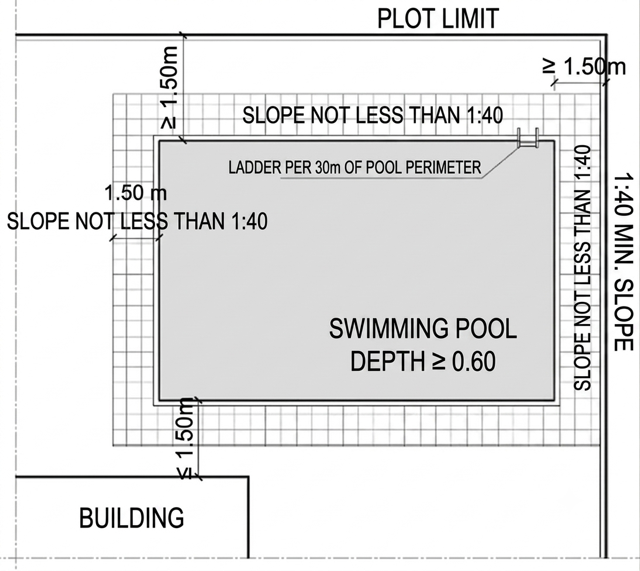
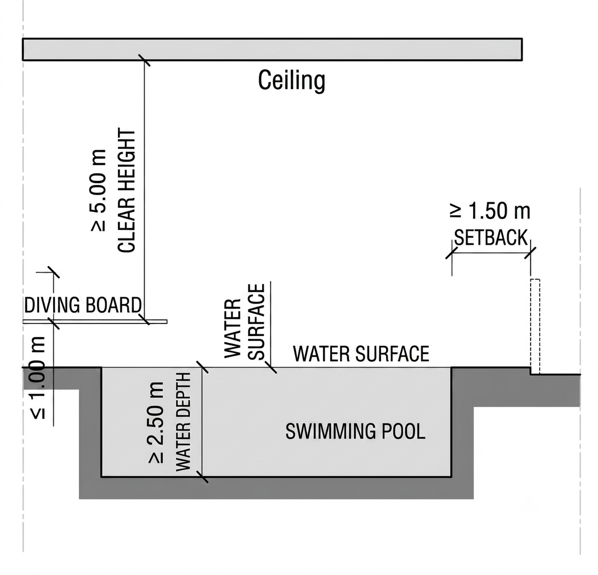
Swimming Pool Systems
Overflow Gutter Swimming Pools
This system shall be used where the water surface area of the pool is 3.80 m² or greater. Overflow gutters shall be provided around the entire perimeter of the swimming pool.Surface Skimmer Swimming Pools
This system is permitted for swimming pools with a water surface area of less than 3.80 m². The skimmer system shall maintain a controlled water level within the swimming pool.
General Requirements for Swimming Pools
Swimming pools shall be provided with ladders in accordance with the following requirements:
The pool shall be equipped with steps and ladders where the depth exceeds 0.60 m.
At least one ladder shall be provided for every 30 m of pool perimeter.
Pool ladders shall be corrosion-resistant and equipped with slip-resistant footrests, maintaining a 10 cm clearance from the wall.
Where recessed internal steps are provided within the pool, such steps shall have non-slip surfaces and self-draining construction, with a minimum tread height of 15 cm and a minimum tread width of 30 cm.
The pool shall be provided with side handrails extending above the pool surface and returning to the horizontal pool deck at each side of every ladder or recessed step.
Pools with steps only are permitted where the pool is shallow and does not exceed 1 m in depth.
Public swimming pools shall be enclosed by a fence or barrier not less than 1.29 m in height, with no openings capable of allowing passage of a 10 cm diameter ball. The enclosure shall be equipped with self-closing and self-latching gates.
Swimming pools shall be provided with shower facilities and foot-washing basins at a rate of one (1) for every 25 m of pool perimeter. Pools shall also be provided with toilets and changing rooms proportional to the pool perimeter, with a minimum of one toilet, one shower, and one changing room for each gender separately.
Diving towers and diving boards shall comply with the following requirements:
A minimum clear vertical space of 5 m shall be provided above the diving board or diving platform for head movement clearance.
Diving boards and platforms shall be fully covered with slip-resistant materials.
The minimum water depth beneath any diving board installed at a height of 1 m above the water surface shall not be less than 2.5 m. For diving boards higher than 1 m, the water depth shall increase by 0.30 m for every additional 1 m or part thereof.
A horizontal separation of 3 m shall be provided between adjacent diving boards and between any diving board and the side wall.
Swimming pools shall be provided with adequate lighting, whether underwater or above water, to illuminate the entire pool including the bottom, without causing reflections, glare, burns, electric shock, or bodily injury.
Every electrical circuit shall be equipped with a ground fault circuit interrupter (GFCI).
Swimming pools shall be provided with a safety cover complying with approved standards to protect children under five years of age when the pool is not in use.
The swimming pool shall be surrounded on all sides by non-slip level surfaces with a minimum width of 1.50 m and a slope ratio of 1:40 directed away from the pool. These surfaces shall also be provided with suitable drainage outlets.
Water depth markings shall be installed on the pool deck edge or pool wall at the shallowest point, deepest point, and slope transition points.
Swimming pools shall be provided with outlet drains, skimmers, hair and debris strainers, filtration systems, disinfection equipment, and safety and rescue equipment in accordance with approved environmental requirements.
A designated location shall be provided for a lifeguard chair and for instructional signage for swimming pool users.
Article (49): Gas Storage
Gas Cylinders
Domestic/residential gas cylinder storage areas shall be designed in a covered, well-ventilated location outside the kitchen or residential area. All gas piping installations shall comply with the approved standard specifications issued by the concerned authority.
Gas cylinder storage rooms in public buildings shall be well ventilated, easily accessible for cylinder replacement, and designed for easy isolation and firefighting in emergencies.
Gas storage tanks for scientific laboratories in educational buildings shall be located on the ground floor and accessible from outside the building.
Central Gas Tanks
Central gas tanks in buildings shall comply with Civil Defence requirements. The building owner shall conduct annual inspections of all gas connections and pipelines serving residential units to ensure their safety and absence of leaks.
General Requirements
All gas cylinder storage areas shall be equipped with fire alarm and firefighting systems in accordance with Civil Defence specifications and requirements, and firefighting equipment shall be periodically maintained.
All gas installations shall comply with the approved standard specifications issued by the concerned authority.
Combustible materials such as vehicle tires, cardboard, and paper shall not be stored together with gas cylinders.
Article (50) Waste Rooms and Waste Collection Area
General Requirements
Buildings and residential, industrial, educational, healthcare, recreational, and tourism complexes shall be provided with a waste collection area within the plot boundaries and inside the building fence, or in a room established on the ground floor of the building itself, for the collection of waste in preparation for transporting it outside the building for disposal.
The specifications of waste rooms shall be as follows:
They shall be established in a location close to the street, or on the alley in the absence of a street, to facilitate the removal of containers and their delivery to waste collection vehicles without obstacles.
The entrance dimensions shall allow containers to be moved in and out easily, and the entrances shall be provided with ramps having suitable slopes for this purpose.
The dimensions and areas of the rooms and collection areas shall comply with what is specified in Clause (50-2) of this Article.
The flooring and the full height of the room walls shall be finished with ceramic tiles to facilitate cleaning.
They shall be supplied with water directly from the network or from the booster tank and shall be connected to the building’s sewage lines.
They shall be well-lit and provided with a proper ventilation system.
All windows shall be tightly sealed and fitted with fine metal mesh screens to prevent the entry and exit of insects and rodents.
The door of the collection room shall be made of non-corrosive metal material (aluminum), provided at the bottom with ventilation louvers or any mechanical ventilation system, and the doors shall open outward.
The waste container collection area shall be located on the ground floor, and its floor level shall not be lower than the specified survey benchmark. Its entrance shall be connected to the street by a ramp with a suitable slope, and it shall be paved with washable ceramic finishes and provided with a water point.
The building owner, or whoever is authorized by them, shall be responsible for cleanliness within the building and the surrounding external areas belonging to it up to the limits of the public street, as well as for transporting and moving waste containers from the waste rooms to the nearest street at the designated times and returning the containers to the rooms after the emptying process is completed.
A standard compactor (Compactor) shall not be considered a substitute for the required number of containers or the area of waste rooms.
If the location of the waste chute (Chute) is far from the streets surrounding the plot, a waste collection room may be established in a location close to the street or alley in the absence of a street.
It is prohibited, in any form, to dispose of chemically active waste, toxic materials, liquids, or hazardous materials inside waste containers.
To contribute to environmental protection, efforts shall be made to recycle waste through the allocation and classification of waste containers according to the main categories of discarded materials.
Dimensions of Waste Rooms and Waste Collection Areas
In buildings with an area of less than (250) square meters and not exceeding three floors above the ground floor, a waste room shall be provided on the ground floor only, with dimensions of (1.00 X 1.50) square meters, with mechanical ventilation provided thereto, provided that the width of its door is not less than (0.90) m and that it is fitted with a self-closing unit (Door Closer).
In buildings with an area of (250) square meters or more and not exceeding three floors above the ground floor, and where a waste disposal chute system (Chute System) is not required, small rooms for collecting waste bags shall be provided on each floor with an area not less than (1.00 X 1.50) square meters, provided that the width of the door of this room is not less than (0.90) m, opens outward, and is fitted with a self-closing unit (Door Closer), with mechanical ventilation provided thereto. Ventilation through door openings (louver) shall not be permitted. A waste room shall also be provided on the ground floor in these buildings to accommodate the number of containers according to Table No. (71), while complying with the general requirements mentioned in Clause (50-1) of this Article and the dimensions stated in Figure No. (46).
In buildings exceeding three floors above the ground floor, a waste disposal chute system (Chute System) shall be provided together with a waste room on the ground floor. A mezzanine shall not be considered a floor if its use is accessory to the ground floor, provided that the waste room accommodates the number of containers according to Table No. (71), while complying with the general requirements mentioned in Clause (50-1) of this Article and the dimensions stated in Figure No. (46).
Requirements for the waste disposal chute (Chute): its diameter from the floors to the collection room shall not be less than (0.60) m in addition to a minimum of (0.20) m required for fixing the chute to the wall. The waste disposal openings on the typical floors shall be preceded by a small room with an area not less than (1.00 X 1.00) square meters, and the width of the door of this room shall not be less than (0.80) m. Its door shall open outward and shall be fitted with a self-closing unit (Door Closer).
The waste disposal chute (Chute) may be replaced with an alternative service elevator located in an isolated area separate from the main elevators, with small collection rooms having the same area as the elevator provided on each floor, such that the elevator is close to the main waste rooms in the building.
Table Refuse Room Capacity Based on Waste Quantities and Number and Capacity of Containers
Waste Quantities | Number and Capacity of Containers | |
1 | Up to (100) kg of waste | A room accommodating one container with a capacity of (1.2) cubic meters. |
2 | Up to (250) kg of waste | A room accommodating one container with a capacity of (2.5) cubic meters or two containers, each with a capacity of (1.2) cubic meters. |
3 | Up to (500) kg of waste | A room accommodating two containers, each with a capacity of (2.5) cubic meters. Figure No. (27). |
4 | Up to (750) kg of waste | A room accommodating (3) containers, each with a capacity of (2.5) cubic meters. |
5 | Up to (1000) kg of waste | A room accommodating (4) containers, each with a capacity of (2.5) cubic meters. |
6 | More than (1000) kg of waste | The number of waste rooms shall be determined in accordance with a special study, or the same previous calculations shall be applied to half of the quantity exceeding (1000) kg. |
Waste quantities shall be calculated according to the rates stated in the following table.
Table : Waste Quantity Rate Determination by Building Use
Use | Waste Quantity Rate | |
1 | Residential Use | (12) kg for every (100) square meters of utilized area. |
2 | Commercial Use | (12) kg for every (100) square meters of utilized area. |
3 | Office Use | (5) kg for every (100) square meters of utilized area. |
4 | Hotel Use | (3) kg for each room and (5) kg for each suite, and the remaining elements according to the type of activity. |
In residential villas, the following shall be complied with:
In investment villa complexes, centralized waste rooms shall be provided in accordance with the specifications specified in Clause (50-1) of these Regulations and according to the following table:
Table 73: Container Capacity and Number Calculation by Number of Villas
Number of Villas | Capacity and Number of Containers |
(4-10) | Number of (1) container with a capacity of (2.5) cubic meters. |
40:10< | The number of (1) container with a capacity of (2.5) cubic meters shall be calculated for every (10) villas. |
41< | If the number of villas in a single complex exceeds (40) villas, the number of (1) container with a capacity of (2.5) cubic meters shall be calculated for every (10) villas, and a study shall be submitted for the mechanism of collecting waste from the villas and transporting it to equipped collection stations provided with compacting containers, provided that this mechanism is approved by the concerned authority. |
-The number of rooms shall exceed one room if the number of containers in a single complex exceeds what is specified in this Article. | |
To determine the areas of waste rooms, the following measurements shall be adopted:
Waste rooms shall accommodate all required containers according to the approved container dimensions as follows:
The dimensions of a (1.2) cubic meter container are (1.35 X 1.90) m².
The dimensions of a (2.5) cubic meter container are (1.50 X 2.10) m².
A minimum distance of (0.30) m shall be maintained between the containers and the walls of the waste room.
A minimum distance of (0.30) m shall be maintained between the containers themselves from all sides.
A minimum distance of (1.00) m shall be maintained between the container and the side of the room where the door of the waste room is located.
The width of the internal corridor of the waste room shall not be less than (1.20) m.
The door of the waste room shall have a width that allows containers to be moved in and out easily, provided that it is not less than (1.80) m as a minimum.
The clear height of the waste room shall not be less than (2.50) m as a minimum.
The dimensions of the waste room and its door shall depend on the method of distribution and movement of containers within it and the accessibility to all containers and their removal, as shown in Figure No. (46).
| |
Figure (46): Examples of Waste Rooms at Ground Floor Level | |
Right: Example of a waste room up to 1000 kg capacity. | Left: Example of a waste room up to 500 kg capacity |
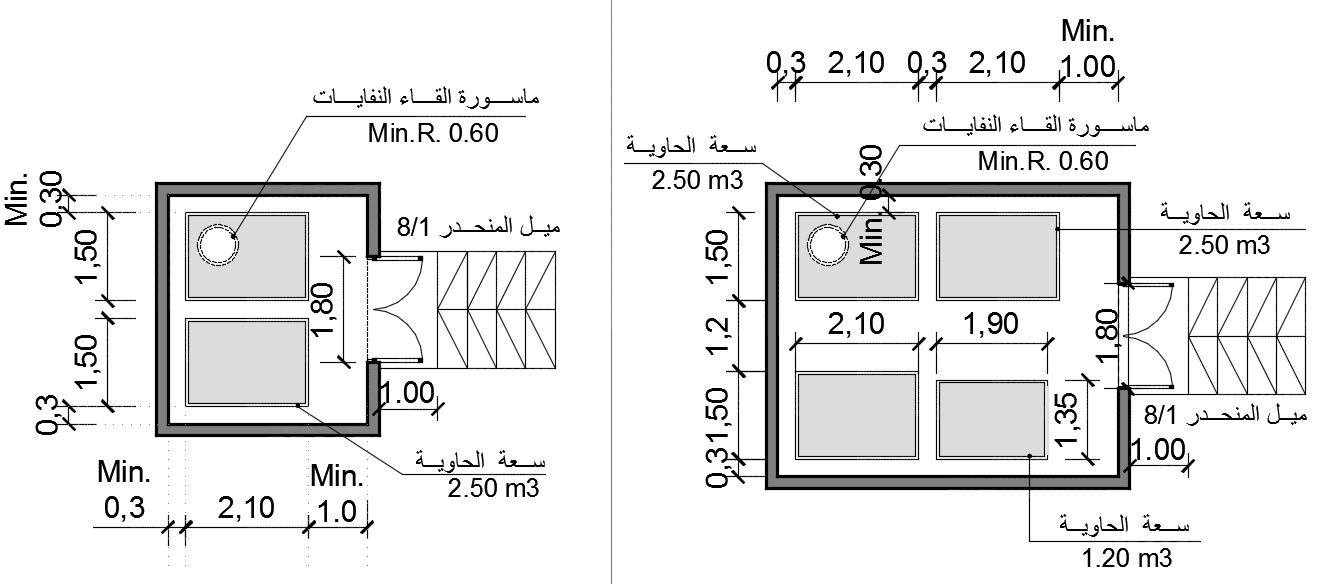
In hotels and specialized facilities, a hydraulic compactor may be provided or an acceptable alternative solution to the waste chute may be proposed, with a special study submitted in this regard and approval obtained from the concerned authority, provided that the area and dimensions of the waste room are not less than the required minimum.
A waste container collection area shall be provided in educational facilities to accommodate not less than two containers with a capacity of (2.50) cubic meters, one designated for paper and the other for the remaining materials.
A waste container collection area shall be provided in healthcare facilities to accommodate not less than two containers with a capacity of (2.50) cubic meters, in addition to the special and required containers for patient rooms, offices, and administrative spaces, which shall be calculated on the basis of (12) kg for every (100) square meters of their net areas.
A waste collection area shall be provided in workers’ accommodations to accommodate the required number of containers at a rate of one container with a capacity of (2.50) cubic meters for every (950) square meters of the total building area, with a minimum of one container.
A waste room collection area shall be provided in industrial facilities (warehouses or light industrial workshops) with an area not less than (3.00 X 3.00) meters, paved with washable floor finishes and provided with a water point for washing, such that it accommodates the required number of containers at a rate of one container with a capacity of (2.50) cubic meters for every (1900) square meters of the total building area. In heavy industrial areas, large, specialized projects, and sports clubs, the waste rooms and the type and number of containers shall be determined according to special studies approved by the competent authority.
The size and type of containers may be replaced, or an acceptable alternative solution to the waste disposal chute may be proposed in industrial areas, workers’ accommodation areas, and certain specialized projects, subject to the approval of the concerned authority.
Article (51) Quality Approval Tests for Building Materials
The competent authority shall have the right to request the performance of any tests necessary to approve the quality of building materials not approved in the Emirate from any party involved in the construction process, which it deems necessary to make the appropriate decision regarding the acceptance or rejection of the approval of the building material, in accordance with the required standard specifications and requirements as per the approved Building Materials Quality Guide.
Article (52) Advertising Signs (Commercial Signboards) Attached to Buildings
The locations for placing signboards for all shops, showrooms, and commercial activities shall be specified, provided that the width of the signboards is not less than (1.00) m and that they comply with the conditions and specifications stipulated in the applicable legislation.
No advertising sign shall be installed, nor any advertisement written on a building, structure, or within any plot of land, except after obtaining the necessary permit from the competent authority.
Advertising signs attached to buildings, whether fixed on the walls of buildings and commercial buildings, on the façades of commercial shops, or placed on rooftops, shall take into consideration the architectural character of the place and the aesthetic appearance of the Emirate, particularly the main corridors, as well as the requirements and specifications of the competent authority and the legislation regulating them.
Article (53): Building Standards and Requirements for Agricultural Facilities
Where a permit application is submitted for the construction of agricultural facilities using closed systems, the consultant shall comply with the approved construction standards specific to agricultural facilities using closed systems (Appendix No. 3).
Article (54): Development Projects (Encouraging Innovation and Architectural Excellence)
The Authority may consider unique design proposals that offer innovative engineering solutions serving the urban landscape of the Emirate. Certain flexibility may be granted as incentives and encouraging advantages, provided that general safety standards and neighbouring rights are not compromised, and that the project is aligned with the urban vision of Ras Al Khaimah.
Final Provisions |
Article (55): Conditions for Granting a Permit
The following conditions shall be fulfilled when granting a permit:
All conditions and specifications set out in the law, regulations, and any regulatory decisions governing construction shall be fulfilled.
All necessary procedures, precautions, and measures to ensure the general safety of those carrying out construction at the work site, passers-by, property users, and neighbouring properties shall be taken in accordance with federal and local decisions, the building conditions and specifications regulation, and the procedures approved by the relevant health, safety, and environment authorities.
The protection of neighbouring buildings shall be ensured by taking all necessary precautions to maintain the structural safety of neighbouring buildings from the effects of mechanical equipment operation, groundwater dewatering, excavation and demolition procedures, and similar works, in accordance with the building conditions and specifications regulation and the structural design codes and references cited.
All necessary procedures, precautions, and measures to ensure the general safety of residents and property users shall be taken, along with all measures to reduce noise and dust and to implement necessary fire protection precautions, where the permit relates to works in an occupied building.
Where the engineering office withdraws from supervising construction for any reason, it shall notify the Authority in writing. In such case, the owner shall appoint a replacement engineering office (consultant) and notify the Authority accordingly.
A certificate or certificates shall be submitted in the form prepared by the Authority in the name of the engineering offices responsible for specialized inspection and monitoring works stipulated in the Regulation and the structural codes referred to.
Article (56): Modification of Plans and Permit Data During Works
Where the concerned party wishes to make changes to designs and drawings from those previously permitted, or to change the designing engineering office during construction, the modified plans and data showing the new changes shall be submitted to the competent authority for review and approval upon confirmation of their compliance with the Regulation and structural design codes. An additional permit may be issued or the existing permit amended depending on the nature of the proposed change.
Article (57): The Technical Committee
A committee known as the "Technical Committee" shall be formed by a decision of the Director General, tasked with the following:
Providing technical interpretation of any technical provision contained in these regulations, or of unclear specifications or standards. The technical interpretation issued by the competent authority based on the recommendation of the Technical Committee shall be considered the officially approved interpretation of such provision or specification.
Reviewing any structural systems or construction materials submitted for approval, provided they achieve the building’s design life and structural safety requirements.
Studying any proposals or recommendations submitted by work partners that enrich the content of the regulations.
Periodically reviewing the regulations and the operational procedures necessary for their implementation, proposing any required amendments and development mechanisms, and submitting them to the Director General for inclusion in the regulations through a decision issued by him.
Other technical committees shall be dissolved
Article (58): Integration with the Manuals and Guidelines Issued by the Department
All manuals and guidelines issued by the Autority must be followed in a manner integrated with these Regulations within the scope of their application, to the extent that they overlap with them, without prejudice to the articles and provisions of these Regulations.
In the event of any conflict between the provisions of these Regulations and the requirements of the approved manuals, the provisions contained in those manuals shall prevail.
Article (59): Traffic Impact Studies, Access Studies, and Movement Path Studies
The requirements for traffic studies shall be applied in accordance with the Guideline Manual for Traffic Impact Studies, Access Studies, and Movement Path Studies approved by the Department, in a manner proportionate to the size of the project and its expected impact on the surrounding transportation network, while observing the following:
An access and movement path study must be submitted for all projects, buildings, and facilities intended to be constructed, modified, or have their use changed. Private villas are exempt from this requirement.
A traffic impact study shall be required for development projects expected to generate more than (500) traffic trips during peak hours, or for projects which the concerned authority determines may have a traffic or operational impact warranting such a study. The concerned authority may also request any additional studies according to the nature or location of the project. Such studies must be prepared by a specialized consultancy office registered with the Department, and approval of these studies shall form part of the requirements for plan approval and issuance of permits.
Article (60) Requirements for Drive-Through Service (Drive-Through)
Licensing of activities and projects that include Drive-Through service within the plot boundaries shall be permitted subject to the following requirements:
All proposed activities shall comply with the approved planning requirements, with the obligation to obtain all necessary approvals from the concerned authorities before commencing implementation.
These requirements shall apply to all projects and facilities when establishing, adding, or modifying the service, provided that it is requested within the approved building permit or through amendment of the existing permit and issuance of its approval before implementation or operation.
The required engineering and traffic studies shall be submitted in accordance with the approved guides and guidelines. Entrances, exits, service lanes, waiting and stacking areas shall be designed to ensure traffic safety and smooth traffic flow, avoid encroachment on the road right-of-way, and provide sufficient spaces within the plot boundaries, while achieving access requirements for emergency and service vehicles.
The permit applicant shall maintain the operational efficiency of the service and not cause any traffic or operational impacts. The Authority may require facilities to take necessary measures and modifications upon any violations or traffic impacts.
These activities shall be subject to periodic inspection and monitoring in accordance with the legislation and approved guides in the Emirate.
Article (61) Repeal of Previous Decisions
Any previous decisions that contradict the provisions of this Decision shall be repealed.
Article (62) Effectiveness and Publication
These Regulations shall come into effect from the date of their issuance and shall be published on the Department’s website.
Procedural Guideline for the Preparation of
Appendix No. (1)
Table No(A-01): Occupancy Load Factors for Building Spaces
(Reference: UAE Fire and Life Safety Code of Practice)
Occupancy | Use | Occupant Load Factor per Person | Area Used |
Assembly Occupancies | High-density occupancy (banquet halls, multipurpose halls, assembly halls, waiting areas, and standing areas) | 0.65 m² | Net Area (NA) |
Mosques, prayer halls, and prayer rooms | 0.90 m² for the prayer area | Net Area (NA) | |
Lower-density occupancy: conference halls, meeting rooms, exhibition halls, outdoor buildings, restaurants and dining rooms/halls, waiting areas with seating, seating areas, stages, and production studios | 1.40 m² | ||
Kitchens (in restaurants, private non-residential spaces) | 9.30 m² | ||
Library (reading areas) | 4.60 m² | ||
Library (storage areas) | 9.30 m² | Gross Area (GA) | |
Art galleries and museums | 5.00 m² | ||
Training halls or rooms without equipment | 1.40 m² | ||
Training halls or rooms with equipment – skating rinks | 4.60 m² | ||
Play and entertainment rooms | 1.00 m² | ||
Airport baggage claim | 27.90 m² | ||
Business – Administrative | Enclosed administrative offices “low density” | 9.30 m² | |
Open administrative offices “high density” | 4.60 m² | ||
Educational | Classrooms | 1.90 m² | Net Area (NA) |
Laboratories, vocational or specialized training, workshops | 4.60 m² | ||
Healthcare | Inpatient treatment departments | 22.30 m² | Gross Area (GA) |
Sleeping departments | 11.10 m² | ||
Consultation departments – clinics – limited care | 9.30 m² | ||
Hotels | Hotel apartments – hotel rooms | 18.60 m² | |
Residential | Workforce housing – sleeping areas | 3.70 m² | Net Area (NA) |
Residential, shared sleeping spaces | 5.00 m² | ||
Shopping Centers | Leasable area less than 14,000 m² | 2.80 m² | Gross Area (GA) |
Leasable area 14,000 m² | 3.30 m² | ||
For every additional 1,290 m² of leasable area | 0.10 m² added to 3.30 m² | ||
Storage | Warehouses | 27.90 m² | |
Industrial | Industrial buildings | 9.30 m² | |
Parking | Enclosed or open parking areas | 27.90 m² | |
Automated/mechanical parking | 46.50 m² |
Annex No. (2)
Table No. (A-02): Minimum Number of Required Sanitary Fixtures
Occupancy | Use | Toilets | Wash Basins | ||
Male | Female | Male | Female | ||
Assembly | Restaurants and Dining Rooms | 1 per 75 occupants for the first 300 occupants | 1 per 50 occupants for the first 200 occupants | 1 per 75 occupants for the first 300 occupants | 1 per 50 occupants for the first 200 occupants |
Banquet Halls – Multi-purpose Halls – Exhibition Halls – Production Studios – Art Galleries and Museums – Exercise Rooms – Fitness Centers – Waiting Areas | 1 per 125 occupants | 1 per 65 occupants | 1 per 125 occupants | 1 per 65 occupants | |
Fixed Seating Areas (Cinemas, Theaters, and Similar Uses) – Conference Halls – Meeting Rooms – Libraries – Reading Areas | 1 per 125 occupants | 1 per 65 occupants | 1 per 125 occupants | 1 per 65 occupants | |
Amusement Parks – Game Rooms – Skating Rinks | 1 per 75 occupants for the first 1500 occupants | 1 per 40 occupants for the first 1600 occupants | 1 per 120 occupants | 1 per 60 occupants | |
Administrative (Business) | Offices | 1 per 20 occupants for the first 100 occupants | 1 per 20 occupants for the first 100 occupants | ||
Commercial | Retail Shops – shopping malls | 1 per 200 occupants | 1 per 100 occupants for the first 500 occupants | 1 per 200 occupants | 1 per 100 occupants for the first 500 occupants |
Industrial | Factories, Workshops, and Warehouses | 1 per 25 occupants | 1 per 25 occupants | 1 per 25 occupants | 1 per 25 occupants |
Educational | Schools (Students) | 1 per classroom | 1 per classroom | ||
Kindergartens (Children) | 1 per classroom with dimensions suitable for children | 1 per classroom with dimensions suitable for children | |||
Nurseries (Children) | 1 per children’s room | 1 per children’s room | |||
Schools – Kindergartens – Nurseries (Teachers and Staff) | 1 per 10 rooms, with a minimum of 2 for each gender | 1 per 10 rooms, with a minimum of 2 for each gender | |||
Residential | Labor Accommodation | 1 per 10 occupants | 1 per 10 occupants | ||
| |||||
Student Accommodation | 1 per 10 occupants | 1 per 10 occupants | |||
One shower facility shall be provided for every 8 occupants. | |||||
Petrol Stations and Similar Uses | Public and Visitors | Minimum of one toilet for males and one toilet for females with a wash basin | |||
Employees | 1 per 20 occupants for the first 100 occupants | 1 per 20 occupants for the first 100 occupants | |||
General Requirements | The minimum number of sanitary fixtures shall be calculated based on the occupant load factors specified in Table No. (00). | ||||
The number of occupants of each gender shall be calculated by dividing the total number of occupants equally and rounding up to the next whole number. | |||||
For calculations in mixed-occupancy buildings, fractional values for each occupancy shall first be summed and then rounded up to the next whole number. | |||||